
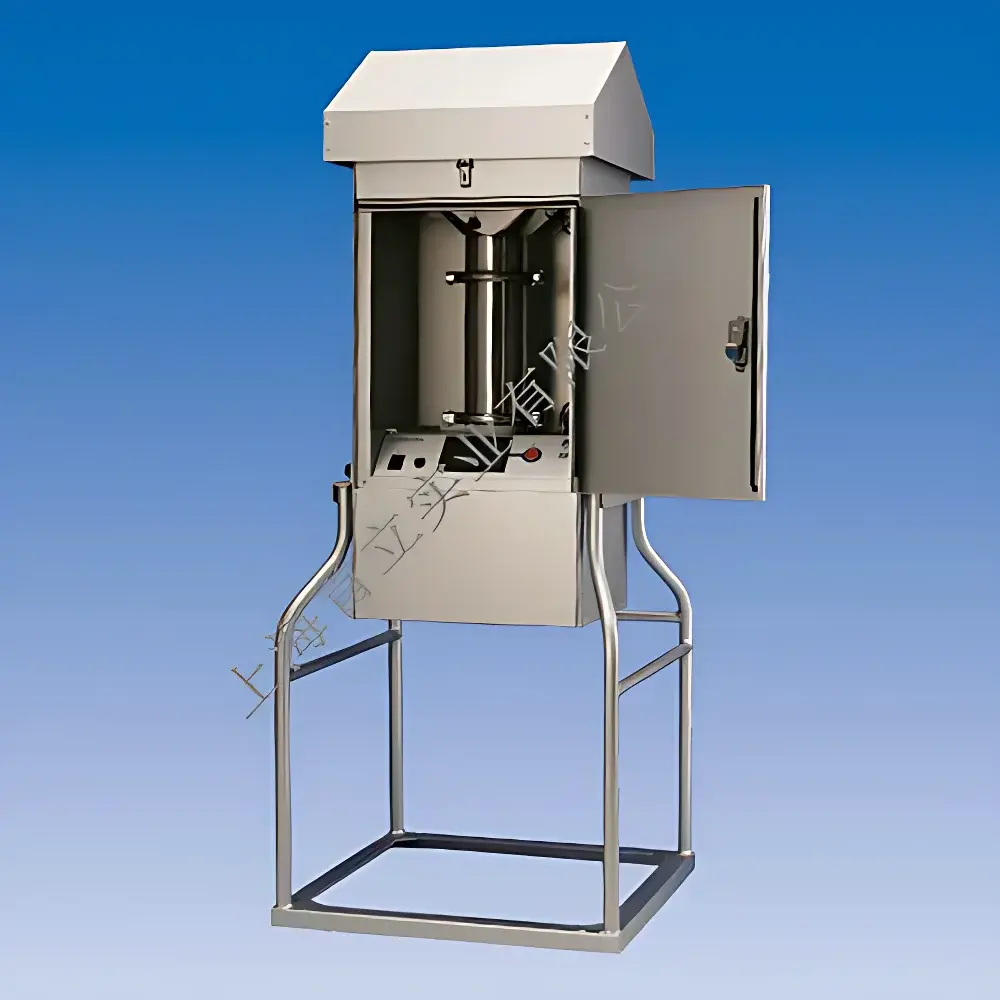
SIBATA HV-RW High-Flow Air Sampler
| Origin | Japan |
|---|---|
| Manufacturer Type | Authorized Distributor |
| Origin Category | Imported |
| Model | HV-RW |
| Price Range | USD 7,000 – 14,000 (FOB) |
| Flow Rate Options | 100 / 700 L/min (quartz fiber filter + dual PU foam) or 556 / 1000 L/min (glass fiber filter) |
| Adjustable Flow Range | 100–1200 L/min |
| Flow Detection Method | Differential Pressure Sensing |
| Flow Accuracy | ±5% of setpoint |
| Pump Type | Brushless Centrifugal Blower |
| Display | Touchscreen LCD |
| Power Supply | 100 V AC (90–132 V), 220 V AC (180–264 V), 50/60 Hz |
| Operating Environment | 0–40 °C, 10–90% RH (non-condensing) |
| Filter Format | 8″ × 10″ (203 mm × 254 mm) rectangular |
| PU Foam Cartridge | Φ90 mm × 50 mm |
| Housing Material | Foldable aluminum |
| Dimensions (operational) | 575 W × 575 D × 1420 H mm |
| (folded) | 575 W × 575 D × 960 H mm |
| Sampling Inlet Height | 1210 mm above base |
| Net Weight | ~31 kg |
| Standard Kit Includes | 1 filter cassette holder, 1 straight sampling tube (for particulate), 1 shuttle tube (for dioxins), 10 quartz filters, 10 PU foam cartridges |
| Note | Filters and foam cartridges are consumables — sold separately |
Overview
The SIBATA HV-RW High-Flow Air Sampler is an engineered solution for regulatory-grade ambient and stack air sampling of airborne particulate matter (PM) and semi-volatile organic compounds (SVOCs), including polychlorinated dibenzo-p-dioxins (PCDDs) and dibenzofurans (PCDFs). Designed and manufactured in Japan under stringent quality control standards, the HV-RW operates on the principle of constant-flow volumetric sampling using differential pressure feedback control. Its dual-mode configuration supports both open-face particulate collection (e.g., PM10, PM2.5, total suspended particulates) and adsorptive capture of gas-phase dioxins via polyurethane foam (PUF) cartridges coupled with quartz or glass fiber filters. The system maintains stable flow across extended durations—critical for compliance with EPA Method TO-9A, EN 1948-1, ISO 18332, and JIS K 0325—despite progressive filter loading or environmental pressure fluctuations.
Key Features
- High-precision differential pressure-based flow control ensures long-term stability within ±5% of user-defined setpoints across the full 100–1200 L/min range.
- Brushless centrifugal blower delivers robust suction performance with low maintenance requirements and extended service life (>10,000 hours).
- Intuitive touchscreen LCD interface displays real-time instantaneous flow rate, cumulative volume, operational status, and error diagnostics.
- Auto-resume functionality restores pre-interruption sampling parameters—including elapsed time and accumulated volume—following power loss.
- Foldable aluminum chassis enables rapid deployment and transport while maintaining structural rigidity during field operation.
- Dual-sampling-path architecture: dedicated straight tube for gravimetric particulate analysis and interchangeable shuttle tube for dioxin/furan adsorption using PUF + backup filter.
- Modular consumable design simplifies field replacement—filter cassettes and PUF cartridges are standardized and compatible with certified analytical workflows.
Sample Compatibility & Compliance
The HV-RW is validated for use with standard 8″ × 10″ (203 × 254 mm) quartz fiber filters (QFF) and glass fiber filters (GFF), as specified in EPA Compendium Method TO-13A and ISO 7708 for respirable dust assessment. For dioxin analysis, it accommodates Φ90 mm × 50 mm PUF cartridges aligned with EN 1948-1 Annex A and JIS K 0325 protocols. All wetted components are inert and non-outgassing to prevent analyte loss or artifact formation. The instrument meets electromagnetic compatibility (EMC) requirements per IEC 61326-1 and safety standards per IEC 61010-1. It supports GLP-compliant data integrity when integrated with audit-trail-enabled laboratory information management systems (LIMS).
Software & Data Management
While the HV-RW operates as a standalone hardware platform without embedded PC software, its touchscreen interface logs timestamped flow data internally (minimum 1 Hz resolution) and exports CSV-formatted records via USB port. Field technicians may synchronize sampling metadata—including location ID, operator code, filter lot numbers, and calibration certificates—using external LIMS or electronic lab notebooks (ELN). The device complies with FDA 21 CFR Part 11 requirements when paired with validated third-party data acquisition software that enforces user authentication, electronic signatures, and immutable audit trails.
Applications
- Ambient air monitoring for regulatory reporting under national air quality standards (e.g., NAAQS, EU Directive 2008/50/EC).
- Source emission testing from incinerators, metallurgical facilities, and chemical manufacturing plants.
- Occupational hygiene surveys for workplace exposure assessment to respirable crystalline silica, asbestos, and metal fumes.
- Research-grade collection of atmospheric SVOCs for congener-specific dioxin quantification by HRGC-HRMS.
- Validation studies supporting method transfer between laboratories accredited to ISO/IEC 17025.
- Long-term trend analysis requiring high-volume, low-blank sampling in remote or unattended settings.
FAQ
What filter media are compatible with the HV-RW?
Quartz fiber filters (QFF) and glass fiber filters (GFF) sized 8″ × 10″ (203 × 254 mm) are supported. Polyurethane foam cartridges must conform to Φ90 mm × 50 mm dimensions and meet low-bleed specifications per EN 1948-1.
Does the HV-RW include calibration traceability documentation?
Yes—each unit ships with a factory calibration certificate traceable to JCSS (Japanese Calibration Service System) standards, covering flow sensor linearity, pressure transducer accuracy, and timer stability.
Can the HV-RW operate unattended for multi-day sampling?
Yes, with stable AC power and appropriate environmental protection (e.g., weatherproof enclosure), the HV-RW supports continuous operation up to 168 hours at nominal flow rates.
Is the touchscreen interface available in English?
Yes—the firmware supports multilingual UI, including English, Japanese, and Chinese, configurable via system settings.
How often does the flow sensor require recalibration?
Annual recalibration is recommended under routine use; more frequent verification is advised after mechanical shock, filter housing replacement, or exposure to extreme humidity or particulate loading.
Related Products







