
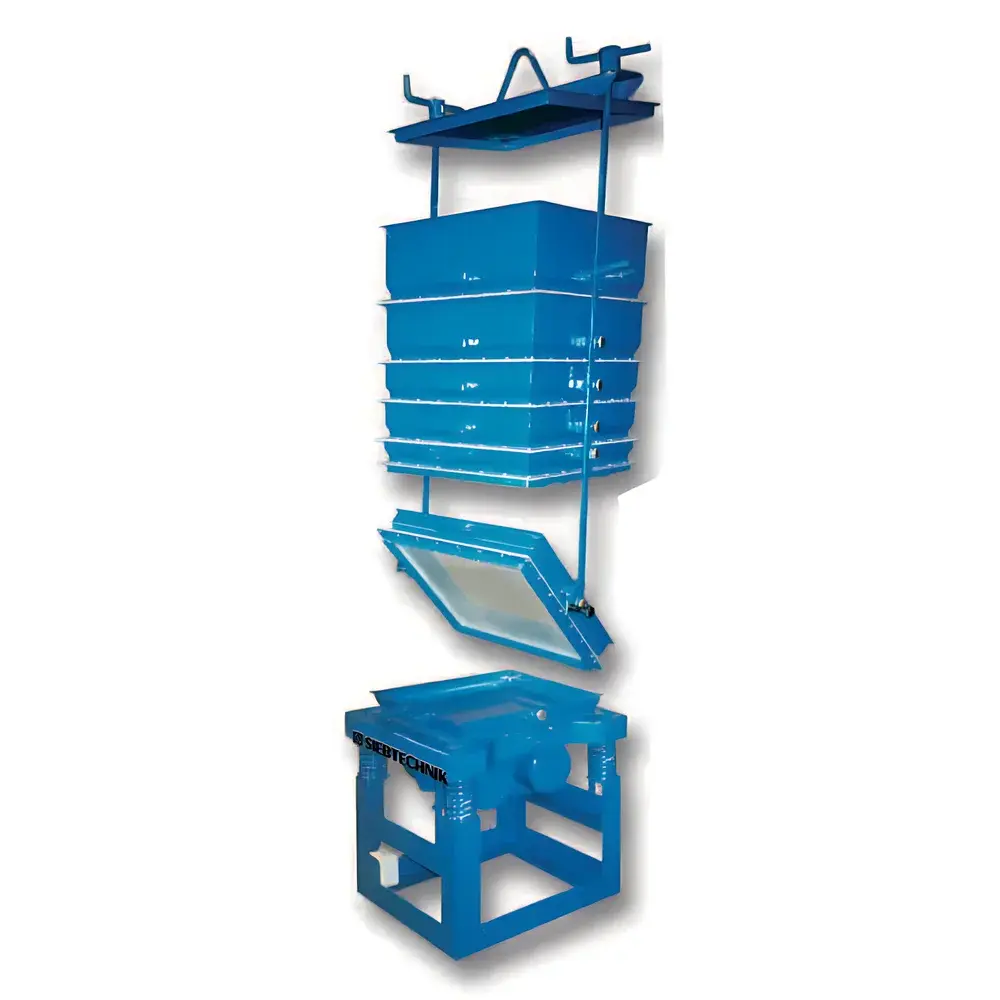
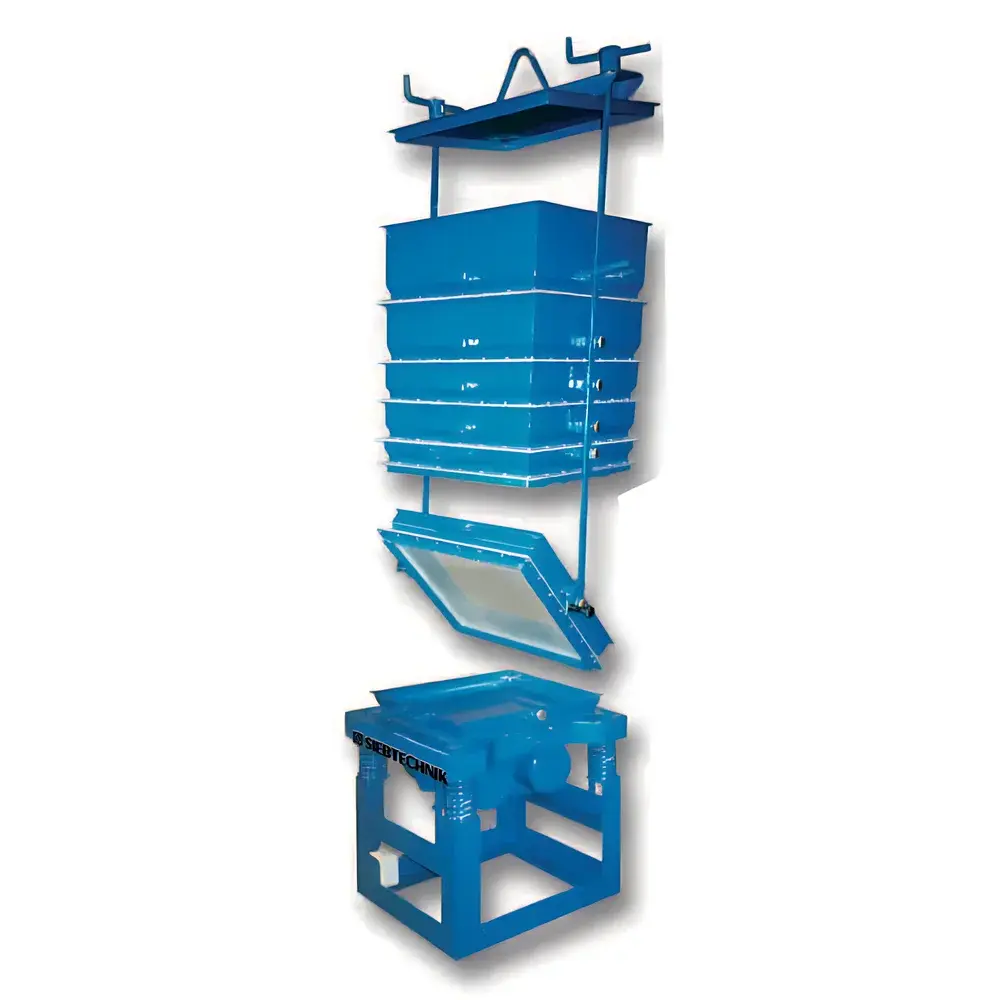
Siebtechnik GAS500 Large-Scale Sieve Analyzer
| Brand | Siebtechnik |
|---|---|
| Origin | Germany |
| Model | GAS500 |
| Sieve Diameter | 500 mm |
| Sieve Area | 500 × 500 mm |
| Screening Range | 200 µm – 120 mm |
| Number of Sieve Levels | 9 |
| Rotational Speed | 1000 min⁻¹ |
| Power Supply Frequency Compatibility | 50 Hz |
| Compliance | DIN ISO 2591-1, ISO 9276-2, ASTM E11 |
| Drive Type | Horizontal Circular Vibration |
| Control Interface | Digital Display & Keypad (Time, Amplitude, Rotation Direction, Speed) |
Overview
The Siebtechnik GAS500 Large-Scale Sieve Analyzer is an industrial-grade mechanical sieving system engineered for high-precision particle size distribution analysis of free-flowing, dry or wet-dispersed bulk materials. Based on the principle of horizontal circular vibration—optimized to minimize particle agglomeration and maximize stratification—the GAS500 delivers reproducible, traceable sieve analysis results compliant with internationally recognized standards including DIN ISO 2591-1 (determination of particle size distribution by sieving), ISO 9276-2 (representation of results of particle size analysis), and ASTM E11 (specification for wire cloth and sieves for testing purposes). Designed for laboratories and production environments where robustness, long-term stability, and method transferability are critical, the GAS500 serves as a reference-grade instrument for QC release testing, raw material qualification, formulation development, and process validation in pharmaceuticals, minerals, chemicals, food, and construction materials industries.
Key Features
- Large-format sieving platform with 500 mm diameter sieves and total active screening area of 500 × 500 mm—enabling representative analysis of high-mass samples without pre-reduction or splitting.
- Horizontally oscillating drive mechanism operating at a fixed frequency of 1000 min⁻¹, delivering consistent kinetic energy input across variable supply frequencies (50 Hz certified), ensuring inter-laboratory comparability.
- Digital control panel with real-time adjustment and display of key operational parameters: sieving duration (programmable up to 99 min 59 s), amplitude setting, rotational direction (clockwise/counter-clockwise), and speed confirmation.
- Patented anti-clogging sieve rim design with laser-engraved calibration markings and integrated sealing gaskets—eliminating cross-contamination and sample retention between sieve levels.
- Modular mechanical architecture supporting up to nine stacked sieve levels; rapid-lock clamping system with ergonomic rotary knobs enables tool-free, repeatable assembly under GLP/GMP-aligned handling protocols.
- Acoustically optimized housing (<65 dB(A) at 1 m) suitable for open-plan laboratory environments without dedicated acoustic enclosures.
Sample Compatibility & Compliance
The GAS500 accommodates a broad spectrum of particulate matrices—including fine powders (e.g., lactose, silica fume), granules (e.g., API granulations, fertilizer pellets), coarse aggregates (e.g., sand, crushed stone), and suspended solids (via wet-sieving mode with optional spray manifold). Its 200 µm–120 mm analytical range covers applications from pharmaceutical excipient grading to quarry aggregate classification. All sieve meshes are manufactured to ISO 3310-1 tolerances and individually certified with laser-etched traceability codes. The system supports full audit trail generation when interfaced with validated LIMS or ELN platforms, meeting documentation requirements under FDA 21 CFR Part 11 and EU Annex 11 for regulated environments.
Software & Data Management
While the GAS500 operates as a stand-alone electromechanical analyzer, its digital interface includes RS-232 and optional USB outputs for integration with third-party data acquisition software (e.g., LabVIEW, MATLAB, or custom QA/QC dashboards). Time-stamped operation logs—including start/stop timestamps, amplitude settings, and cycle counts—are stored onboard and exportable as CSV files. When deployed alongside Siebtechnik’s optional SieveSoft™ reporting module (sold separately), users gain automated calculation of D10/D50/D90 values, cumulative undersize/oversize curves, and statistical process control (SPC) charts aligned with ISO 2859-1 sampling plans.
Applications
- Pharmaceutical: Excipient particle sizing per USP , granule batch release testing, blend uniformity assessment prior to compression.
- Minerals & Mining: Classification of crushed ore, tailings characterization, and flotation feed optimization.
- Construction Materials: Grading of concrete aggregates, asphalt gradation compliance (ASTM C136), and sand fineness modulus determination.
- Food & Feed: Flour particle distribution control, pet food kibble size consistency, and spice grinding validation.
- Chemicals & Polymers: Catalyst support particle integrity checks, pigment dispersion screening, and masterbatch quality assurance.
FAQ
Is the GAS500 suitable for wet sieving?
Yes—when equipped with the optional water spray kit and corrosion-resistant stainless-steel sieve frames, the GAS500 performs standardized wet sieving per ISO 2591-2.
Can sieve stack configurations be customized beyond nine levels?
No—the mechanical design and dynamic balance are validated exclusively for up to nine nested sieves; exceeding this count compromises amplitude fidelity and measurement repeatability.
Does the system meet FDA 21 CFR Part 11 requirements?
The base unit does not include electronic signature or audit trail functionality; however, when integrated with validated external software and procedural controls, it supports Part 11 compliance within a documented QMS framework.
What maintenance intervals are recommended?
Biannual verification of vibration amplitude (using calibrated accelerometer), annual recalibration of timer circuitry, and routine inspection of gasket integrity and clamping torque per Siebtechnik Maintenance Bulletin MB-GAS500-Rev.4.
Are replacement sieves supplied with calibration certificates?
Yes—each certified sieve set includes a manufacturer-issued test report referencing ISO 3310-1 mesh tolerance verification and individual aperture measurement data.



