
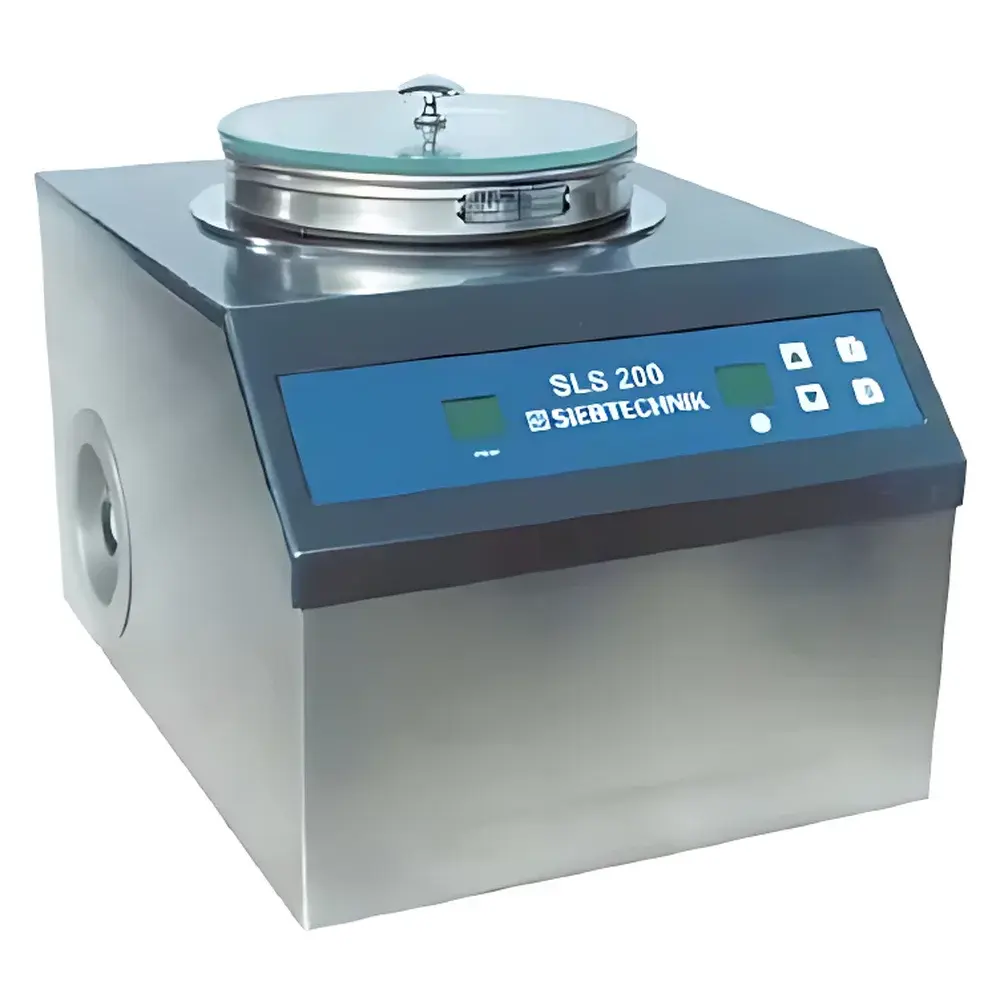
Siebtechnik SLS 200 Air Jet Sieve Analyzer
| Brand | Siebtechnik |
|---|---|
| Origin | Germany |
| Model | SLS 200 |
| Particle Size Range | 20 µm – 4,000 µm |
| Sample Capacity | 1–100 g per run |
| Sieve Diameter | 200 mm |
| Sieving Time Setting | 1–99 min (digital LCD) |
| Vacuum Control | Adjustable, digitally displayed |
| Dimensions (W×H×D) | 326 mm × 270 mm × 425 mm |
| Compliance | ISO 3310-1, ASTM E11, DIN EN 10204.21 |
| Construction | Stainless steel housing, polished stainless steel sieves (optional copper or nylon meshes) |
| Optional Accessories | Anti-static module, sample pre-heater |
Overview
The Siebtechnik SLS 200 Air Jet Sieve Analyzer is an engineered solution for the precise, reproducible dry sieving of fine and ultra-fine powders in the 20 µm to 4,000 µm range. Unlike conventional mechanical sieve shakers—whose vibrational energy proves insufficient for de-agglomerating cohesive, electrostatic, or hygroscopic materials—the SLS 200 employs a controlled air-jet principle under negative pressure to achieve high-fidelity particle size distribution data. At its core, the instrument utilizes a rotating air nozzle mounted beneath a standardized 200 mm diameter test sieve. This nozzle generates a tangential, laminar airflow that continuously lifts, disperses, and re-suspends particles above the sieve surface. Simultaneously, vacuum suction—generated by an external industrial vacuum unit—applies consistent negative pressure across the sieve mesh, driving undersized particles through the apertures while retaining oversized fractions. This dynamic fluidization mechanism eliminates blinding, minimizes static adhesion, and ensures uniform particle presentation to the mesh—critical for regulatory-compliant quality control in R&D and production environments.
Key Features
- Rotating air-jet nozzle with precisely calibrated angular velocity and airflow profile—engineered to maximize particle dispersion without mechanical impact or attrition.
- Digital LCD interface for independent, repeatable setting of sieving duration (1–99 minutes) and real-time vacuum level monitoring (kPa or mbar).
- Transparent polycarbonate sieve cover enabling full visual observation of material behavior throughout the entire sieving process—essential for method development and troubleshooting.
- Stainless steel instrument housing with corrosion-resistant, electropolished finish; designed for long-term operation in demanding laboratory and pilot-plant settings.
- Modular accessory support: optional anti-static ionizer module for charge-sensitive materials (e.g., pharmaceutical APIs, polymer powders); optional heated sample chamber for moisture-prone samples (e.g., lactose, starch, hydrated silicates).
- Interchangeable sieve frames compatible with ISO 3310-1–compliant stainless steel, brass, or nylon meshes—traceable to certified calibration standards.
- No internal moving parts beyond the rotating nozzle assembly—minimizing maintenance intervals and enhancing operational reliability.
Sample Compatibility & Compliance
The SLS 200 is validated for use with a broad spectrum of industrially relevant powders, including but not limited to cement clinker, fly ash, pigment dispersions, metal alloys (Al, Ti, Ni), ceramic precursors, pharmaceutical excipients and actives, food-grade starches and flours, graphite anode materials, and mineral fillers (CaCO₃, talc, kaolin). It accommodates both free-flowing and highly cohesive materials—particularly those prone to electrostatic charging or ambient moisture adsorption. All sieve meshes conform to ISO 3310-1 (Test Sieves — Technical Requirements and Testing) and ASTM E11 (Standard Specification for Woven Wire Test Sieve Cloth and Test Sieves), ensuring metrological traceability. The system supports documentation requirements for GLP, GMP, and ISO/IEC 17025-accredited laboratories—including audit-ready parameter logging when integrated with compliant LIMS or ELN platforms.
Software & Data Management
While the SLS 200 operates as a standalone benchtop analyzer with embedded digital controls, it is fully compatible with Siebtechnik’s optional SieveSoft™ data acquisition software (v3.2+). This Windows-based application enables automated method storage, multi-run comparative analysis, statistical reporting (e.g., D10/D50/D90, % retained, cumulative passing curves), and export to CSV, PDF, or XML formats. All critical parameters—including actual vacuum level, elapsed time, and operator ID—are timestamped and logged locally. When deployed in regulated environments, the software supports 21 CFR Part 11 compliance via electronic signatures, role-based access control, and immutable audit trails—facilitating FDA, EMA, or MHRA inspection readiness.
Applications
The SLS 200 serves as a primary analytical tool in QC laboratories across cement manufacturing (ASTM C100, EN 196-6), pharmaceutical solid dosage development (USP , Ph. Eur. 2.9.33), battery materials qualification (ISO 18333), food safety testing (Codex Alimentarius standards), and advanced ceramics processing. Its ability to resolve fine fractions—especially in the 20–100 µm range—makes it indispensable for evaluating pigment fineness in coatings, optimizing sintering behavior of metal injection molding feedstocks, and verifying granule size distribution prior to tablet compression. In R&D contexts, it supports formulation screening, process optimization studies, and stability assessment of moisture- or charge-sensitive blends.
FAQ
What particle size range is the SLS 200 validated for?
The instrument is optimized for dry sieving of powders between 20 µm and 4,000 µm, with highest resolution and repeatability in the 20–500 µm sub-range.
Can the SLS 200 be used with non-standard sieve diameters?
No—it is mechanically and aerodynamically calibrated exclusively for 200 mm diameter sieves compliant with ISO 3310-1. Use of non-conforming sieves invalidates measurement accuracy and voids calibration certification.
Is vacuum source integration mandatory?
Yes. An external vacuum generator (minimum 12 kPa suction capacity at ≥30 L/min flow rate) is required for proper operation and must be connected via the integrated vacuum port with pressure feedback loop.
How is method reproducibility ensured across different operators?
Through fixed parameter control (time, vacuum setpoint), standardized sieve preparation protocols, and optional SieveSoft™ user authentication and method locking—ensuring identical execution regardless of personnel.
Does the SLS 200 require periodic recalibration?
The instrument itself does not require field recalibration; however, annual verification of vacuum sensor accuracy and rotational nozzle speed against NIST-traceable references is recommended per ISO/IEC 17025 guidelines.
Related Products



