
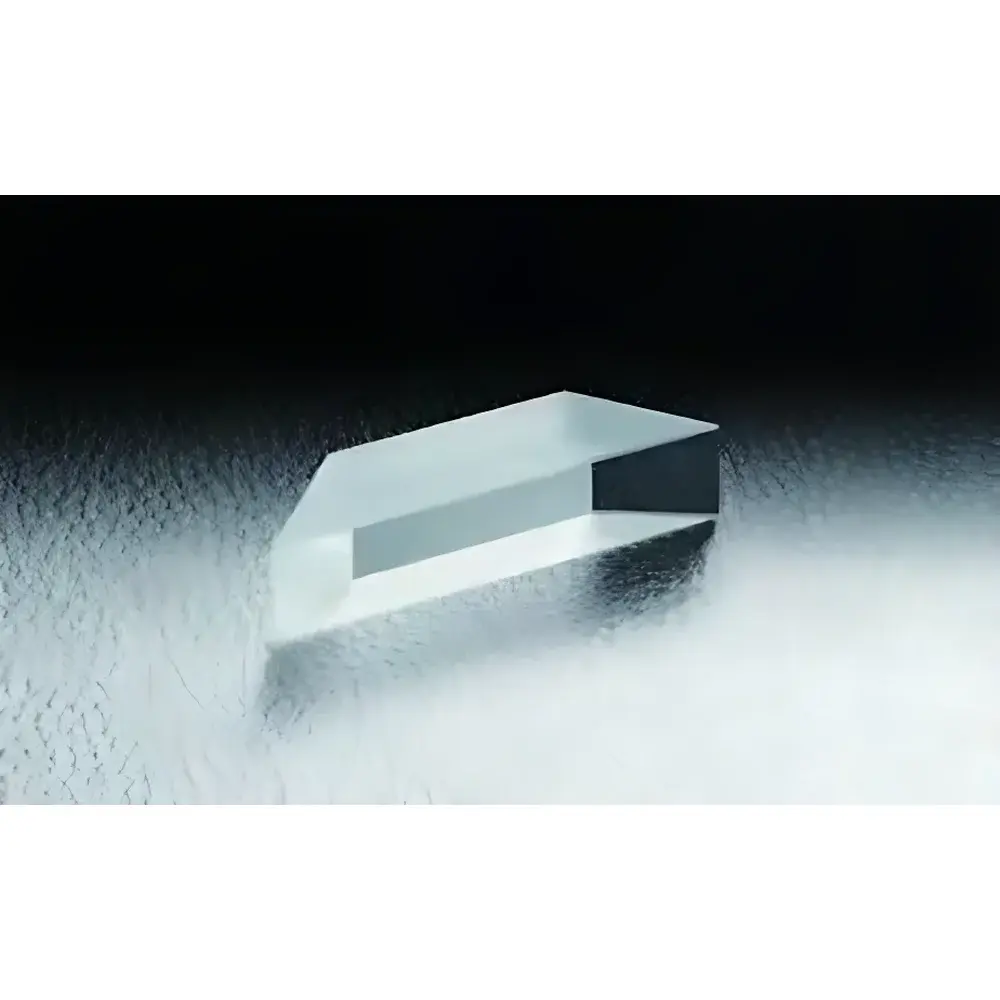
Sigma DOP Series Dove Prism
| Brand | Sigma |
|---|---|
| Origin | Japan |
| Model | DOP Series |
| Component Type | Optical Prism |
| Surface Accuracy Options | λ/4 (for laser applications) |
| Orientation Behavior | Image inversion (upside-down), 2× rotation ratio, mirror-reversed left-right when uprighted |
| Optical Axis Deviation | Minimal (precision-ground) |
| Design Feature | Full aperture imaging (A×B) without vignetting, optimized length D for complete beam transmission |
| Mounting Compatibility | DBH Rotational Mount (co-aligned optical axis and mechanical rotation center) |
| Cleaning Note | Bottom face (uncoated) must remain contamination-free to avoid image artifacts |
| Tolerance Definition | Based on trapezoidal base length formed by bottom face and two inclined faces |
| Chromatic Aberration | Present in high-magnification systems |
Overview
The Sigma DOP Series Dove Prism is a precision optical component engineered for controlled image rotation and orientation manipulation in laboratory and industrial optical systems. Based on the classical Dove prism geometry—first described by H. W. Dove in 1859—the DOP series operates on the principle of total internal reflection (TIR) within a trapezoidal glass body. When placed in a collimated beam path, it inverts the image vertically; more critically, rotating the prism about its longitudinal axis rotates the output image at twice the angular rate of the physical rotation—a property rooted in the symmetry of its internal reflection paths. This 2× rotation magnification enables fine angular control without complex mechanical gearing, making it indispensable in beam steering, optical alignment verification, interferometric setups, and polarization-sensitive instrumentation. Manufactured in Japan under stringent quality control, each DOP prism undergoes precision grinding and polishing to minimize optical axis deviation, ensuring high wavefront fidelity and spatial consistency across the full clear aperture (A × B). The standard version meets general laboratory requirements, while the λ/4 surface accuracy variant is certified for demanding laser applications—including He-Ne, Nd:YAG, and diode laser systems—where wavefront distortion must remain below 0.25 wavelength RMS.
Key Features
- Precision-trapezoidal geometry with tightly controlled dimensional tolerances defined on the base edge (formed by the uncoated bottom face and two polished inclined faces)
- Negligible optical axis deviation due to high-accuracy grinding and metrological validation during production
- Full-aperture imaging design: engineered to transmit the entire incident beam (A × B) without vignetting or edge truncation
- λ/4 surface flatness option available for low-wavefront-distortion operation in coherent laser systems
- Uncoated bottom face serves as the reference mounting surface—must remain free of scratches, dust, or fingerprints to prevent stray light and image artifacts
- Compatible with the Sigma DBH rotational mount, which mechanically aligns the prism’s optical axis with the mount’s rotation center for repeatable, drift-free angular positioning
Sample Compatibility & Compliance
The DOP Series is fabricated from high-homogeneity optical glass (e.g., BK7 or equivalent), selected for low bubble/inclusion content and consistent refractive index uniformity. It complies with ISO 10110-3 (surface form tolerances) and ISO 10110-7 (surface imperfection limits) for precision optical components. While not inherently compliant with FDA 21 CFR Part 11 or GLP/GMP documentation standards—as it is a passive component—it is routinely integrated into ISO/IEC 17025-accredited optical test benches and ASTM E284-compliant measurement systems where traceable angular calibration and stable image orientation are required. For laser safety compliance, users must ensure proper enclosure integration per IEC 60825-1 when used in Class 3B or Class 4 laser pathways.
Software & Data Management
As a passive optical element, the DOP prism does not incorporate embedded electronics or firmware. Its performance parameters—such as angular rotation fidelity, image inversion behavior, and transmission efficiency—are characterized using external metrology tools including autocollimators (e.g., Zygo Verifire™), interferometers (e.g., 4D AccuFiz), and spectrophotometers (e.g., PerkinElmer Lambda 950). Calibration data is typically recorded in laboratory information management systems (LIMS) or electronic lab notebooks (ELN) per ISO/IEC 17025 clause 7.7 (control of equipment records). When mounted on the DBH rotational stage, angular position can be tracked via integrated rotary encoders compatible with common motion controllers (e.g., Thorlabs KDC101, Newport ESP301), enabling automated scan sequences in custom LabVIEW or Python-based optical alignment routines.
Applications
- Rotational image stabilization in astronomical guiding systems and adaptive optics testbeds
- Optical null testing and shearography where controlled image rotation isolates phase errors
- Laser cavity mode alignment and resonator optimization requiring precise beam reorientation
- Educational optics labs demonstrating TIR, image parity inversion, and rotational magnification principles
- Industrial machine vision inspection systems requiring dynamic field-of-view rotation without moving cameras
- Interferometric vibration analysis setups where dual-path coherence must be preserved during angular scanning
FAQ
Why does the output image appear mirror-reversed left-to-right when the Dove prism is rotated to produce an upright image?
This is an inherent geometric consequence of the two successive reflections inside the prism. Uprighting the image requires 90° physical rotation, but the reflection sequence flips horizontal parity—resulting in a true mirror image, not a rotated copy.
Can the DOP prism be used with broadband white light sources?
Yes, but chromatic dispersion will induce lateral color shifts and reduced contrast in high-magnification imaging systems. For achromatic performance, consider pairing with corrective doublets or limiting spectral bandwidth via filters.
What is the significance of the “D” dimension in the mechanical drawing?
“D” denotes the axial length optimized to ensure full transmission of the specified clear aperture (A × B) without beam clipping at the exit face—critical for maintaining M² factor integrity in laser applications.
Is cleaning the uncoated bottom face recommended—and if so, how?
Cleaning is permissible only with spectroscopic-grade acetone or isopropanol applied via lint-free optical tissue; never use abrasive cloths or compressed air that may introduce particulates onto this critical datum surface.
How is tolerance specified for the DOP prism’s base dimension?
Per Sigma’s manufacturing specification, tolerance applies exclusively to the trapezoid’s base edge—the linear dimension formed by the intersection of the uncoated bottom face and the two inclined reflective faces—not the overall outer length.






