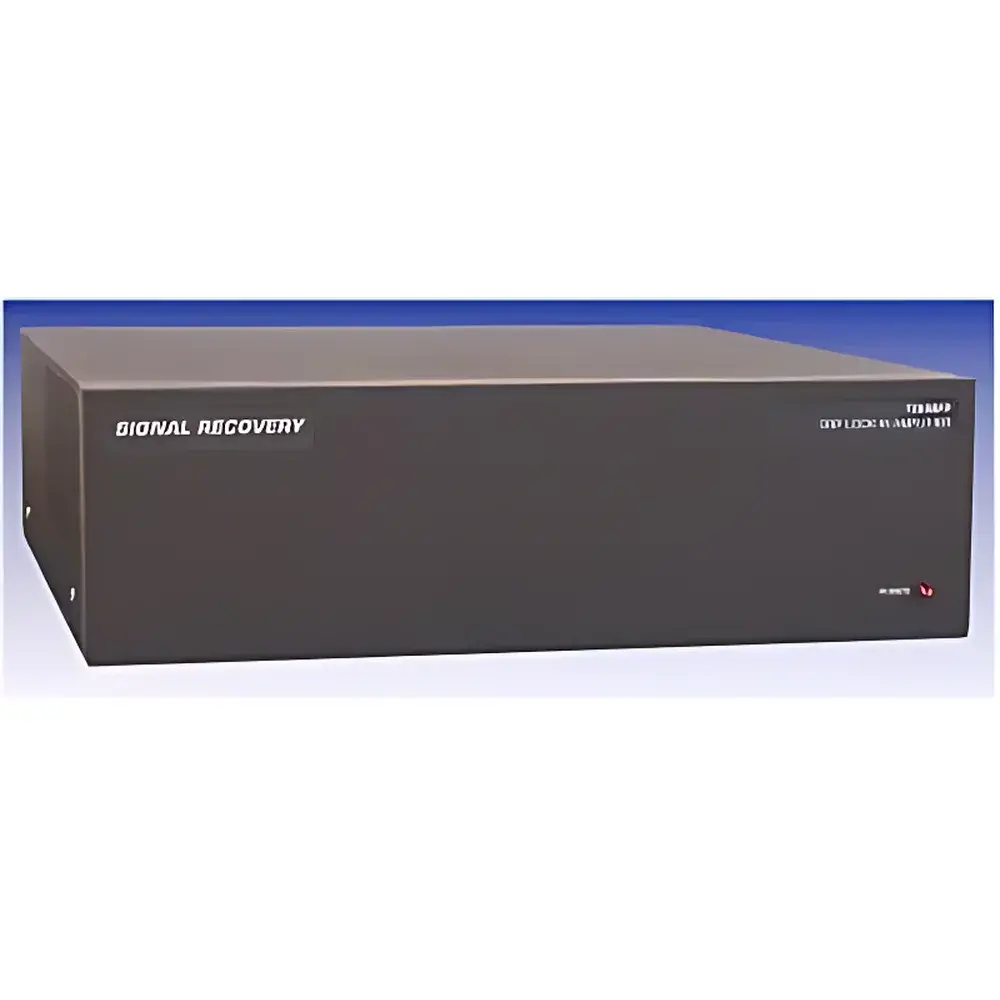
Signal Recovery Model 7280 Dual-Phase Wideband DSP Lock-in Amplifier
| Brand | Signal Recovery |
|---|---|
| Origin | USA |
| Model | 7280 |
| Frequency Range | 0.5 Hz to 2 MHz |
| ADC Sampling Rate | 7.5 MHz |
| Time Constant Range | 1 µs to 100 ks |
| Reference Modes | Dual Reference, Dual Harmonic, Virtual Reference |
| Optional Frequency Extension | Up to 2 MHz for Dual Reference/Dual Harmonic Operation |
| Input Modes | Voltage and Current |
| Software Support | Acquire Data Acquisition Software, LabVIEW Drivers Available |
| Form Factor | Front-Panel Equipped (Standard) |
Overview
The Signal Recovery Model 7280 is a high-performance dual-phase wideband digital signal processing (DSP) lock-in amplifier engineered for precision measurement of weak AC signals buried in high-noise environments. Operating on the principle of synchronous demodulation, the 7280 employs direct digitization of the input signal followed by real-time digital multiplication with a phase-locked reference—eliminating analog drift, harmonic distortion, and gain nonlinearity inherent in legacy analog architectures. Its native frequency range spans from 0.5 Hz to 2 MHz, with optional firmware-enabled extension supporting full dual-reference and dual-harmonic functionality up to 2 MHz. The instrument integrates a temperature-compensated quartz-stabilized internal oscillator (±0.5 ppm stability over 0–50 °C), ensuring long-term phase coherence and enabling traceable, repeatable measurements across extended acquisition periods. Designed for demanding applications in low-temperature physics, nanoscale transport characterization, impedance spectroscopy, and optical heterodyne detection, the 7280 delivers deterministic signal recovery where conventional amplifiers fail.
Key Features
- True dual-phase DSP architecture with independent X (in-phase) and Y (quadrature) outputs, each with selectable low-pass filtering and time constant control
- Direct digitization at 7.5 MHz sampling rate using a high-resolution 24-bit sigma-delta ADC, preserving dynamic range (>120 dB) and minimizing aliasing artifacts
- Programmable time constants from 1 µs to 100 ks (11 decades), with 6-pole Bessel or Butterworth filter roll-off options for optimal noise rejection vs. response speed trade-offs
- Comprehensive harmonic analysis: fundamental + harmonics up to 32F, with amplitude and phase resolution of 0.001° and 0.001 dB
- Flexible reference handling: dual physical reference inputs, virtual reference synthesis, and dual-harmonic mode enabling simultaneous detection at two distinct harmonics of the same or independent excitation sources
- Rack-mountable 7280BFP variant available—identical core specifications and firmware—optimized for OEM integration and automated test systems requiring front-panel-free operation
Sample Compatibility & Compliance
The Model 7280 supports both voltage and current input configurations, with programmable gain (1 nV–1 V full scale for voltage; 1 fA–1 µA full scale for current) and auto-ranging capability. Input impedance is configurable (1 MΩ/50 Ω for voltage; transimpedance gains from 1 kΩ to 109 Ω for current), accommodating piezoresistive sensors, photodiodes, SQUIDs, and cryogenic preamplifiers. All analog signal paths are fully shielded and guarded to minimize EMI/RFI coupling. The device complies with IEC 61326-1:2013 (EMC for laboratory equipment) and IEC 61010-1:2010 (safety requirements for electrical equipment). Its deterministic digital architecture supports audit-ready data provenance when used under GLP or GMP frameworks—particularly when paired with Acquire software’s timestamped metadata logging and HDF5-based binary export.
Software & Data Management
Acquire software (Windows/macOS/Linux) provides full remote control, real-time visualization (including XY plots, polar plots, and FFT-based spectrum display), and synchronized multi-channel data streaming at up to 10 kS/s per output channel. All instrument settings—including filter type, time constant, harmonic order, and reference phase—are stored with each dataset in human-readable JSON headers. Native LabVIEW drivers (NI-VISA compliant) enable seamless integration into automated test sequences, including those subject to FDA 21 CFR Part 11 requirements when deployed with appropriate electronic signature and audit trail configuration. Data exports support CSV, MATLAB (.mat), and standardized HDF5 formats—ensuring long-term archival integrity and cross-platform reproducibility.
Applications
- Low-frequency noise spectroscopy in semiconductor devices and 2D materials
- AC susceptibility and dynamic magnetization measurements in quantum materials
- High-resolution scanning probe microscopy (SPM) lock-in detection, including Kelvin probe force microscopy (KPFM) and conductive AFM
- Optical beam deflection and interferometric displacement sensing with sub-nanometer resolution
- Electrochemical impedance spectroscopy (EIS) with multi-harmonic excitation and reconstruction
- Calibration-grade reference signal generation and phase-sensitive null detection in metrology labs
FAQ
What distinguishes the Model 7280 from analog lock-in amplifiers?
It replaces analog multipliers and RC filters with oversampled digital demodulation and infinite-impulse-response (IIR) filtering—delivering superior linearity, thermal stability, and immunity to component aging.
Can the 7280 perform simultaneous measurements at two different frequencies?
Yes—via dual-reference mode, it accepts two independent external reference signals and computes four orthogonal outputs (X₁, Y₁, X₂, Y₂) in real time.
Is harmonic analysis limited to integer multiples of the fundamental?
No—virtual reference mode allows arbitrary frequency offsets, enabling sideband detection and parametric gain measurements.
How is calibration traceability maintained?
Internal oscillator stability (±0.5 ppm) and factory calibration against NIST-traceable standards ensure measurement repeatability across instruments and laboratories.
Does the 7280 support external trigger synchronization?
Yes—TTL-compatible trigger input/output ports enable precise timing alignment with pulsed lasers, mechanical choppers, or other modular instrumentation in complex experimental stacks.