
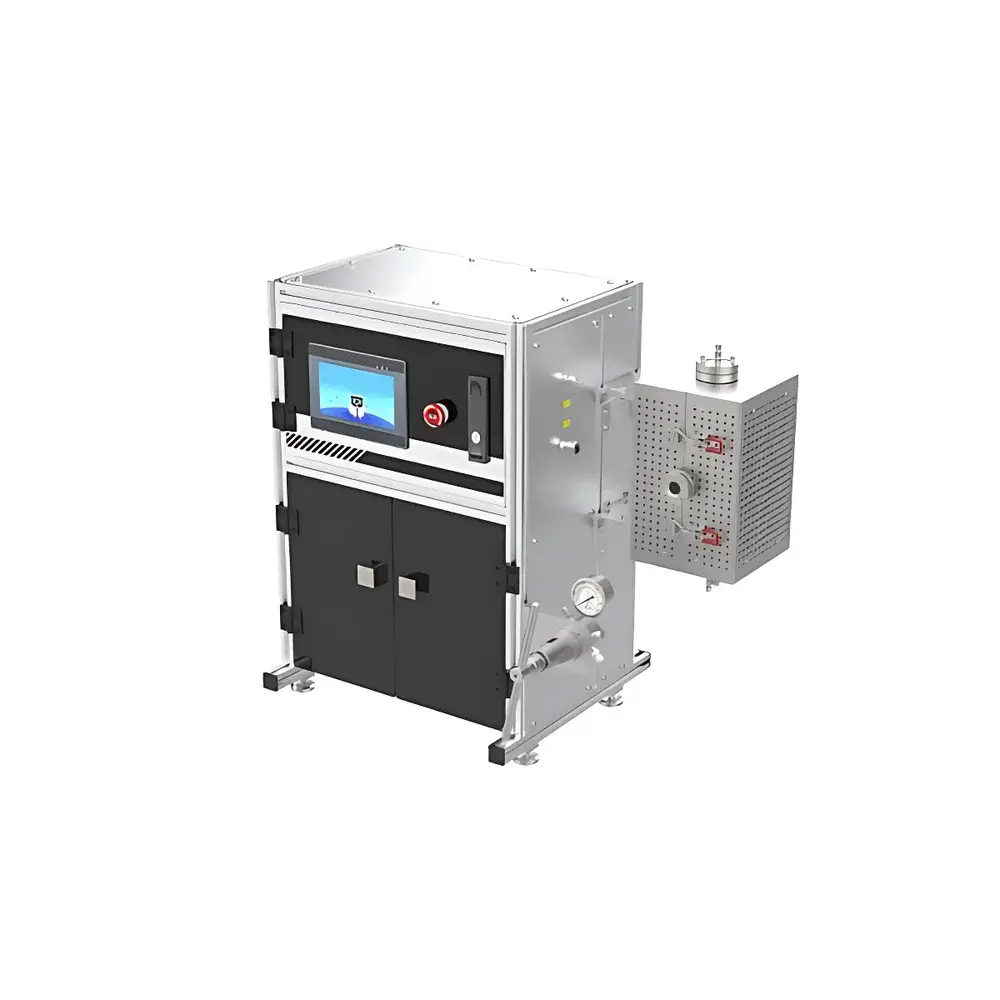
Silica Microsphere Forming Instrument MS-5L by AA OPTO Electronic
| Brand | AA OPTO Electronic |
|---|---|
| Origin | Beijing, China |
| Manufacturer Type | Authorized Distributor |
| Origin Category | Domestic (China) |
| Model | MS-5L |
| Pricing | Upon Request |
| Power Supply | AC 220 V / 50 Hz |
| Installed Power | 4.5 kW |
| Spherical Diameter Range | 0.5–5 mm |
| Production Rate | 50–100 mL/h (batch-based) |
| Feed Reservoir Capacity | 500 mL |
| Reservoir Temperature Control Range | Ambient to 99 °C |
| Oil/Ammonia Column Volume | 2.5 L |
| Oil/Ammonia Column Temperature Control Range | Ambient to 99 °C |
| Washing Chamber Volume | 5 L |
| Dimensions (L×W×H) | 800 × 500 × 1000 mm (approx.) |
| Net Weight | ~120 kg |
| Maximum Recommended Batch Feed Volume | 0.5 L |
Overview
The AA OPTO Electronic MS-5L Silica Microsphere Forming Instrument is an engineered laboratory-scale system designed for the controlled, reproducible fabrication of monodisperse spherical silica particles via the emulsion-based droplet gelation method. It operates on the principle of precision pneumatic dispensing, where a viscous sol precursor—formulated with tetraethyl orthosilicate (TEOS), ethanol, water, and catalytic ammonia—is metered through a calibrated nozzle under regulated air pressure. Droplets fall freely into a vertically oriented oil–ammonia column, where interfacial tension induces spheroidization, followed by base-catalyzed hydrolysis and condensation to form hydrated silica gels. Subsequent thermal treatment—including aging, drying, and calcination—yields dense, high-surface-area, mechanically robust silica microspheres with tunable porosity and narrow size distribution (CV < 8% typical). This process avoids mechanical grinding or sieving, preserving structural homogeneity and minimizing defect density—critical attributes for catalyst support integrity, fixed-bed reactor performance, and chromatographic stationary phase consistency.
Key Features
- Pneumatically actuated quantitative dosing pump enabling repeatable droplet volume control (±1.5% volumetric accuracy under stable pressure conditions)
- Thermally regulated feed reservoir and oil/ammonia column (ambient to 99 °C, ±0.5 °C stability) for precise kinetic control over hydrolysis and gelation rates
- Modular column design accommodating both ammonia-water neutralization and thermal oil curing pathways, supporting process optimization for different silica precursors
- Integrated washing chamber (5 L capacity) with bottom filtration manifold for efficient removal of residual organics, salts, and unreacted species
- Monocoque stainless-steel frame with corrosion-resistant internal wetted surfaces (316L SS and borosilicate glass components) ensuring long-term chemical compatibility with alkaline and alcoholic media
- CE-compliant electrical architecture with isolated power circuits, emergency stop, and overtemperature cutoff for operator safety and regulatory alignment
Sample Compatibility & Compliance
The MS-5L supports aqueous, alcoholic, and mixed-solvent silica sol systems—including TEOS-, TMOS-, and silicic acid–based formulations—as well as select metal-doped variants (e.g., Al–Si, Ti–Si) when compatible with ammonia-mediated gelation. It complies with ISO 9001:2015 manufacturing protocols and meets essential requirements of IEC 61000-6-2 (immunity) and IEC 61000-6-4 (emissions). While not intrinsically rated for hazardous area use, its sealed column configuration minimizes solvent vapor exposure, facilitating operation within standard fume hood environments per OSHA 1910.1200 and EU CLP Regulation (EC No. 1272/2008). Process documentation aligns with GLP principles for material qualification studies; audit trails for temperature logs and batch records can be exported in CSV format for internal QA review.
Software & Data Management
The MS-5L operates via a dedicated embedded HMI panel with real-time monitoring of reservoir/column temperatures, pneumatic pressure, and elapsed cycle time. All setpoints and runtime parameters are stored in non-volatile memory with timestamped event logging (start/stop, temperature deviations >±2 °C, pressure loss alerts). No proprietary cloud platform is required; data export is performed manually via USB interface. For integration into validated QC workflows, optional RS-485 Modbus RTU output enables connection to SCADA or LIMS systems—supporting 21 CFR Part 11–compliant electronic signatures when paired with external validation packages. Firmware updates are delivered offline to maintain cybersecurity integrity in regulated lab environments.
Applications
- Preparation of spherical silica carriers for heterogeneous catalysts (e.g., Ni/SiO₂, Pt/SiO₂) used in hydrogenation, reforming, and selective oxidation
- Synthesis of uniform mesoporous silica microspheres (e.g., SBA-15 analogues) for drug delivery vehicle development and enzyme immobilization matrices
- Production of calibration standards for particle sizing instruments (e.g., laser diffraction, SEM image analysis)
- R&D-scale prototyping of adsorbents for VOC capture, heavy metal sequestration, and CO₂ amine-functionalized sorbents
- Material science studies on structure–property relationships: correlating sphericity, crush strength (>15 MPa post-calcination), and attrition resistance with sol aging time and thermal ramp profiles
FAQ
What solvents and precursors are compatible with the MS-5L?**
Ethanol/water/TEOS-based sols with NH₃ catalyst are fully supported. Methanol, isopropanol, and acidic precursors (e.g., silicic acid) require nozzle and column material verification prior to use.
Can the system produce sub-0.5 mm spheres?**
Not natively—the minimum stable droplet diameter is constrained by nozzle geometry and surface tension limits. Sub-millimeter production requires nozzle retrofitting and fluid rheology adjustment, which falls outside standard configuration.
Is the oil/ammonia column interchangeable for dual-mode operation?**
Yes. The column accepts either mineral oil (for thermal curing at 60–90 °C) or aqueous ammonia solution (2–5 wt%) for base-catalyzed gelation, with independent temperature control for each mode.
Does the system include calcination capability?**
No. The MS-5L delivers pre-calcined gel beads. A separate programmable muffle furnace (e.g., Nabertherm L 5/11 HR) is required for final thermal treatment.
What maintenance intervals are recommended?**
Nozzle inspection and cleaning every 50 operational hours; O-ring replacement annually or after 500 h; calibration of temperature sensors biannually per ISO/IEC 17025 guidelines.



