
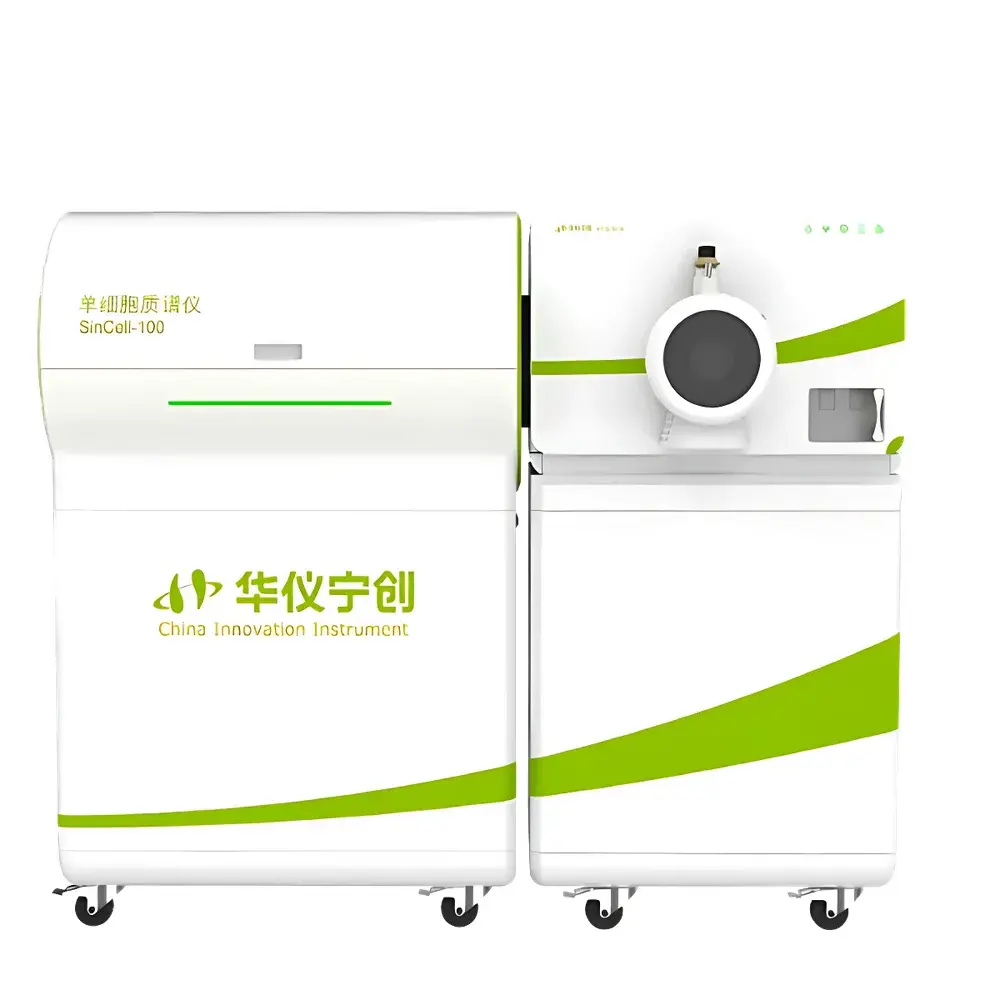
SinCell-100 Organic Mass Spectrometer by China Innovation Instrument
| Brand | China Innovation Instrument |
|---|---|
| Origin | Zhejiang, China |
| Manufacturer Type | Authorized Distributor |
| Country of Origin | China |
| Model | SinCell-100 |
| Pricing | Available Upon Request |
Overview
The SinCell-100 Organic Mass Spectrometer, developed by China Innovation Instrument, is a purpose-built analytical platform engineered for label-free, high-sensitivity metabolic profiling at the single-cell level. It integrates automated microscale liquid extraction, nanoelectrospray ionization (nano-ESI), and high-resolution time-of-flight mass spectrometry (TOF-MS) into a unified workflow. Unlike conventional bulk-tissue or population-level metabolomics systems, the SinCell-100 enables direct sampling from individual adherent or suspended mammalian cells—without cell lysis pooling or enzymatic amplification—thereby preserving native metabolic stoichiometry and minimizing intercellular averaging artifacts. Its core architecture follows the principles of ambient ionization mass spectrometry, where spatially resolved extraction is coupled with real-time ion detection under controlled vacuum conditions (operating pressure ≤5 × 10⁻⁷ mbar in the TOF analyzer region). This design supports quantitative comparability across heterogeneous cell populations and facilitates longitudinal monitoring of metabolic dynamics during perturbation experiments.
Key Features
- Automated single-cell targeting and microextraction via motorized XYZ stage with optical feedback (±0.5 µm positional repeatability)
- Integrated nano-ESI source with sub-nL/min flow control and low-noise high-voltage supply (0–5 kV, <0.1% ripple)
- Reflectron-based TOF mass analyzer delivering mass resolution >25,000 (FWHM at m/z 500) and mass accuracy <3 ppm RMS over 24 h
- Full-scan acquisition range: m/z 50–1500 with 10 Hz spectral acquisition rate
- Onboard calibration using internal lock-mass reference (e.g., cesium iodide cluster ions) for continuous mass axis stabilization
- Modular vacuum system with dual-stage turbomolecular pumping and cryo-trapping for enhanced signal stability in trace metabolite detection
Sample Compatibility & Compliance
The SinCell-100 accepts standard microscope slides, Petri dishes (35 mm and 60 mm), and multi-well plates (up to 96-well format) with optional stage adapters. Compatible sample types include fixed or live adherent cells (e.g., HeLa, MCF-7, primary neurons), suspension cells (PBMCs, Jurkat), and tissue cryosections (10–20 µm thickness). All hardware and software modules comply with ISO/IEC 17025:2017 general requirements for competence of testing and calibration laboratories. Data acquisition firmware supports audit trail logging per FDA 21 CFR Part 11 requirements—including user authentication, electronic signatures, and immutable record retention—for regulated environments engaged in preclinical biomarker discovery or GLP-compliant toxicology studies.
Software & Data Management
Control and data processing are performed using the proprietary SinCell Suite v3.2, a Windows-based application built on .NET Framework 6.0 with integrated Python 3.9 scripting support. The suite provides real-time spectral preview, automated peak deconvolution using constrained non-negative matrix factorization (cNMF), and retention-time-aligned multivariate statistical analysis (PCA, OPLS-DA). Raw data files adhere to the open mzML 1.1.0 standard, ensuring interoperability with third-party platforms including XCMS Online, MetaboAnalyst, and Skyline. All processed datasets can be exported as annotated CSV or HDF5 files with embedded metadata (cell ID, coordinates, acquisition timestamp, instrument parameters). Database integration supports SQL Server 2019+ for centralized project management and cross-experiment querying.
Applications
- Single-cell metabolic heterogeneity mapping in tumor spheroids and circulating tumor cell (CTC) isolates
- Time-resolved monitoring of redox metabolites (e.g., NAD+/NADH, GSH/GSSG) during drug-induced apoptosis
- Identification of metabolic resistance markers in antibiotic-treated bacterial subpopulations
- Metabolic phenotyping of patient-derived organoids for precision oncology applications
- Quantitative comparison of mitochondrial TCA cycle intermediates across stem cell differentiation lineages
- Validation of CRISPR-Cas9–mediated metabolic gene edits via targeted pathway flux inference
FAQ
What sample preparation is required prior to analysis?
Minimal preparation is needed: cells are cultured directly on conductive ITO-coated slides or standard glass substrates; no derivatization, labeling, or extraction solvents are introduced prior to onboard microextraction.
Can the SinCell-100 perform tandem MS (MS/MS)?
No—it operates exclusively in high-sensitivity full-scan TOF mode. Structural confirmation of metabolites requires orthogonal validation via LC-MS/MS on complementary instrumentation.
Is live-cell analysis supported?
Yes, under controlled environmental chamber integration (optional accessory): temperature (20–40 °C), CO2 (0–10%), and humidity (30–80% RH) can be maintained during acquisition.
How is cell identity preserved during analysis?
Each spectrum is tagged with precise XY coordinates, acquisition timestamp, and optional user-defined annotation (e.g., morphological class, treatment group), enabling post-hoc correlation with brightfield or fluorescence imaging data.
What maintenance intervals are recommended?
Ion source cleaning every 40 hours of operation; TOF reflectron alignment verification every 200 hours; annual vacuum system performance certification by certified service engineers.






