
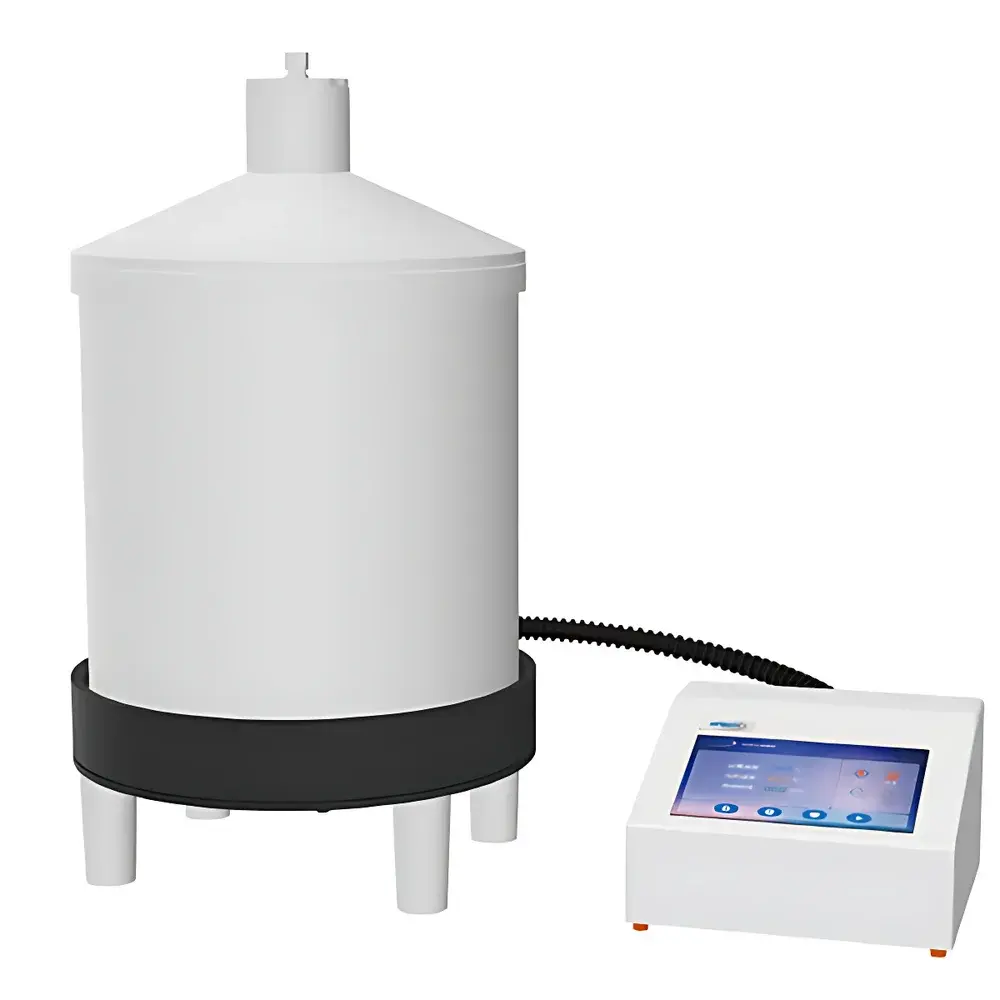
Sineo AAC54 PLUS Acid Counterflow Cleaner
| Brand | Sineo |
|---|---|
| Origin | Shandong, China |
| Manufacturer Type | Direct Manufacturer |
| Model | AAC54 PLUS |
| Automation Level | Fully Automatic |
| Max Capacity | 60 positions |
| Cleaning Time | ≤ 4 hours |
| Temperature Range | Room Temp +5°C to 260°C (Heating Module) |
| Temperature Accuracy | ±0.1°C |
| Uniformity in Chamber | ≤ ±1°C |
| Chamber & Rack Material | PTFE |
| Compatible Acids | HF, HCl, HNO₃, H₂SO₄, and H₂O |
| Power Supply | AC 220 V, 50 Hz |
| Rated Power | 1.5 kW |
| Cooling Method | Ambient Air Cooling |
| Control Interface | 7-inch Color Touchscreen (External Modular Design) |
| Pressure Management | Auto-regulated Vent with Acid Vapor Capture System |
| Heating Element | Graphite Block with Anti-oxidation Coating & PTFE Encapsulation |
| Compliance | Designed for ISO/IEC 17025-compliant trace metal laboratories |
| Software Capability | Standalone control with temperature calibration & over-temperature protection |
Overview
The Sineo AAC54 PLUS Acid Counterflow Cleaner is a fully automated, high-purity laboratory cleaning system engineered specifically for trace-metal analysis workflows. It employs a precisely controlled acid vapor counterflow principle within a sealed, chemically inert chamber to remove sub-picomolar-level metallic contaminants from quartz, PTFE, borosilicate glass, and other acid-resistant labware—including microwave digestion vessels, ICP-MS sample introduction components (e.g., nebulizer chambers and burner tubes), and low-volume reaction vials. Unlike open-beaker or ultrasonic acid baths, the AAC54 PLUS utilizes thermal gradient-driven vapor circulation: concentrated acid (e.g., ultra-pure HNO₃ or HF/HNO₃ mixtures) is heated at the base of the chamber, generating ascending vapor that condenses on cooler upper surfaces—including sample walls—and flows downward under gravity, continuously renewing the cleaning interface. This counterflow mechanism ensures uniform, reproducible surface contact without mechanical agitation or liquid immersion, minimizing risk of cross-contamination and preserving fragile substrates.
Key Features
- Fully automated operation with programmable temperature ramping, dwell time, and cooling cycles—no manual intervention required during cleaning sequence.
- 60-position capacity accommodates standard microwave digestion rotors (e.g., Milestone ETHOS, CEM Mars), 50-mL quartz vials, and custom PTFE racks—scalable for routine QC or high-throughput research labs.
- PTFE-lined cleaning chamber and support rack ensure full compatibility with aggressive reagents including hydrofluoric acid (HF), enabling decontamination of silica-based components without etching or residue formation.
- Graphite heating block with proprietary anti-oxidation treatment and dual-layer PTFE encapsulation delivers stable thermal output across the full 25–260°C range, with PID-controlled precision (±0.1°C) and automatic over-temperature cutoff.
- Integrated pressure-regulated venting system maintains slight negative pressure inside the chamber while actively capturing and condensing acid vapors—reducing ambient acid exposure and meeting OSHA PEL and local fume hood safety guidelines.
- Detachable 7-inch color touchscreen controller mounted externally eliminates contamination risk to electronics and supports intuitive parameter entry, real-time temperature logging, and calibration verification.
Sample Compatibility & Compliance
The AAC54 PLUS is validated for cleaning a broad spectrum of trace-analysis consumables: quartz ICP-MS sample bottles, fused-silica cyclonic spray chambers, nickel or platinum torches, PTFE digestion vessels (including closed-vessel rotors), and low-background borosilicate glassware. All wetted surfaces are constructed from ASTM D4897-grade PTFE or passivated graphite, ensuring non-leaching performance per USP and ISO 3534-2 requirements for analytical cleanliness. The system supports GLP/GMP-aligned documentation through optional timestamped event logs (start/end time, max temperature, pressure status), and its closed-vapor architecture facilitates compliance with EPA Method 1638 and ASTM D5686 for trace metal decontamination protocols.
Software & Data Management
The AAC54 PLUS operates via embedded firmware—not cloud-dependent software—ensuring deterministic response and uninterrupted operation in regulated environments. The touchscreen interface records all critical process parameters (setpoint, actual temperature, elapsed time, pressure status) into non-volatile memory with user-accessible export via USB. Built-in temperature calibration mode allows lab personnel to verify sensor accuracy against NIST-traceable reference thermometers, and the system retains calibration offsets for ongoing correction. Audit trail functionality meets FDA 21 CFR Part 11 requirements when paired with institutional electronic signature policies and secure network storage.
Applications
- Preparation of ultra-low background containers for ICP-MS, ICP-OES, and GF-AAS analysis of environmental water, biological fluids, and geological digests.
- Routine decontamination of microwave-assisted digestion systems prior to sequential multi-element analysis.
- Cleaning of quartz combustion tubes used in TOC analyzers where sodium or potassium carryover must be suppressed below 10 pg/mL.
- Reconditioning of PTFE-lined autosampler vials and caps after high-salinity or fluoride-rich sample runs.
- Validation of cleaning efficacy per ISO 15197:2013 Annex B for clinical trace element testing platforms.
FAQ
What acid concentrations and types are validated for use with the AAC54 PLUS?
Ultra-pure nitric acid (≥69%), hydrochloric acid (≥37%), and hydrofluoric acid (40%) are routinely used; mixed acids (e.g., 3:1 HNO₃:HF) are supported with appropriate safety protocols.
Can the system be integrated into a laboratory LIMS or ELN?
Yes—via optional RS-232 or Ethernet module, enabling trigger commands and retrieval of completion status and temperature logs.
Is operator training required for safe HF handling in this system?
Yes. While the AAC54 PLUS contains HF vapor effectively, users must complete institutionally mandated HF safety certification prior to operation.
How often does the PTFE chamber require replacement?
Under normal use (≤5 cycles/week with HNO₃), the chamber demonstrates >5 years of service life; visual inspection for discoloration or microcracking is recommended quarterly.
Does the system meet CE or UL safety certification standards?
The AAC54 PLUS complies with IEC 61010-1:2010 for electrical safety and EN 61326-1:2013 for EMC; full CE marking applies to EU-distributed units.



