
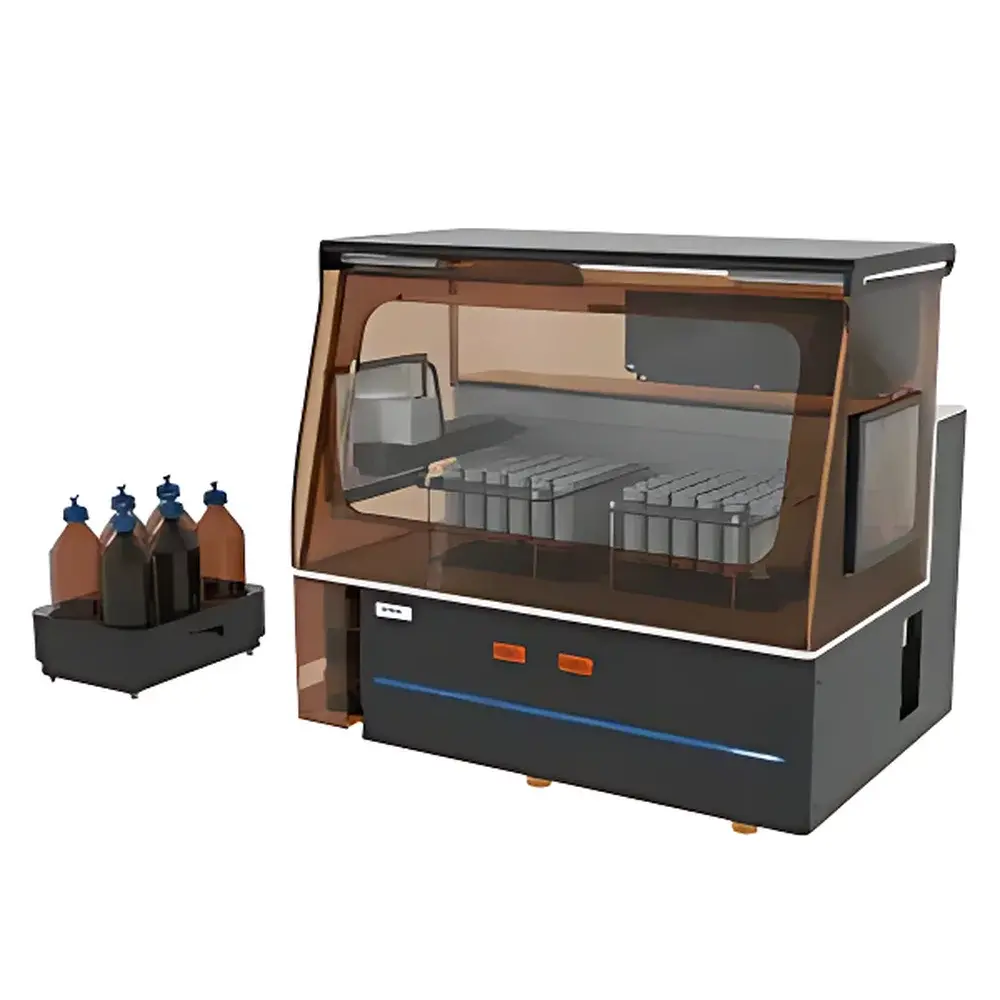
Sineo SH60A Fully Automated Microwave-Free Digestion System
| Brand | Sineo |
|---|---|
| Origin | Shandong, China |
| Manufacturer Type | Direct Manufacturer |
| Instrument Type | Electric Heating Digestion System |
| Automation Level | Fully Automatic |
| Digestion Capacity | 2 × 30 positions |
| Temperature Range | Ambient to 240 °C |
| Temperature Control Accuracy | ±0.1 °C |
| Heating Principle | Graphite Block Resistive Heating |
| Reagent Channels | 10 PTFE-lined reagent lines |
| Power Supply | 220 V AC / 50 Hz |
| Rated Power | 3 kW |
| Dimensions (W×D×H) | 860 × 610 × 520 mm |
| Weight | Not specified |
| Sample Vessel Volume | 50 mL |
| Liquid Dispensing Accuracy | <1% error (at 50 mL) |
| Dispensing Speed | ≥2 mL/s |
| Inter-hole Temperature Uniformity | ≤±1 °C |
Overview
The Sineo SH60A Fully Automated Microwave-Free Digestion System is an engineered solution for high-throughput, reproducible wet-chemical digestion of solid and semi-solid samples prior to elemental analysis by ICP-OES, ICP-MS, AAS, and HG-AFS. Unlike microwave-assisted systems, the SH60A employs precision-controlled graphite block heating combined with robotic liquid handling and multi-sensor feedback loops to execute complete digestion workflows—including reagent addition, shaking, temperature ramping, reflux, open-vessel acid evaporation (‘ashing’), cooling, and final volumetric定容—without manual intervention. Its design adheres to core principles of analytical sample preparation: thermal uniformity, reagent delivery fidelity, process traceability, and operator safety. The system is optimized for regulatory-compliant laboratories requiring GLP/GMP-aligned documentation, repeatable method execution, and minimal analyst exposure to hazardous acids (e.g., HNO₃, HClO₄, HF, KMnO₄) and fumes.
Key Features
- Dual Independent Digestion Modules: Two 30-position graphite blocks operate autonomously—enabling parallel processing of heterogeneous sample types (e.g., food matrices vs. soil digests) or divergent digestion protocols (e.g., EPA Method 3050B vs. GB 5009.15-2014) within a single run.
- PTFE-Encapsulated 10-Channel Reagent Delivery: All fluidic pathways—including pump tubing, valves, and dispensing nozzles—are constructed from chemically inert polytetrafluoroethylene (PTFE), ensuring compatibility with aggressive reagents such as hydrofluoric acid, perchloric acid, and hot concentrated nitric acid.
- X-Y Robotic Arm with Sub-milliliter Dispensing Precision: High-resolution stepper motor control enables accurate, programmable delivery of reagents (5 mL HNO₃ + 0.5 mL HClO₄ typical) with <1% volumetric error at 50 mL and ≥2 mL/s throughput—validated per ISO 8655-6 gravimetric standards.
- Multi-Sensor Process Intelligence: Integrated ultrasonic level sensors enable real-time endpoint detection during final dilution; colorimetric sensors identify reaction completion in chromogenic digestions (e.g., vanadium oxidation state transitions); HD visual monitoring provides remote verification of sample homogeneity and reflux behavior.
- Thermal Architecture with ±0.1 °C Stability: Patented cavity-style graphite heating blocks deliver uniform thermal energy across all 60 positions, maintaining inter-hole deviation ≤±1 °C at 240 °C—critical for minimizing matrix-induced volatility losses of volatile elements (As, Hg, Se).
- Corrosion-Resistant Construction: Work surface fabricated from machined PTFE sheet; robotic arm components, exhaust ducting, and fan housings feature electropolished stainless steel with fluoropolymer coatings—designed for >5-year service life under continuous acidic vapor exposure.
Sample Compatibility & Compliance
The SH60A supports digestion of diverse sample classes including cereals (e.g., wheat flour per GB 5009.15-2014), pharmaceutical excipients, environmental soils (EPA 3050B), animal feed, cosmetics, and polymer additives. It meets functional requirements outlined in ISO/IEC 17025:2017 for method validation, and its automated log generation—including timestamped temperature profiles, reagent lot tracking, and user authentication—supports audit readiness for FDA 21 CFR Part 11, EU Annex 11, and CNAS accreditation. All digestion vessels are borosilicate glass or quartz-compatible; custom graphite block configurations accommodate alternative vessel geometries (e.g., 30 mL conical, 100 mL tall-form).
Software & Data Management
The embedded Windows-based control software features drag-and-drop protocol builder, real-time graphing of temperature ramps and reagent addition events, and full audit trail export (CSV/PDF). Each run generates a digital record containing operator ID, method version, calibration logs, sensor readings, and exception flags (e.g., low reagent warning, overflow alert). Optional integration with LIMS via OPC UA or REST API enables automated result handoff to downstream QA/QC systems. Software complies with ALCOA+ data integrity principles: attributable, legible, contemporaneous, original, accurate, complete, consistent, enduring, and available.
Applications
- Food safety testing: Cd, Pb, As quantification in grains, vegetables, and infant formula per ISO 17294-2, GB 5009.x series
- Environmental monitoring: Total metal recovery from sediments, sludges, and airborne particulates (PM₂.₅ filters)
- Pharmaceutical quality control: Residual catalyst metals (Pd, Pt, Ni) in active pharmaceutical ingredients (APIs)
- Geochemical analysis: Multi-element digestion of geological reference materials (e.g., GBW07301–GBW07312)
- Regulatory compliance: Method validation support for USP /, ICH Q2(R2), and CLSI EP29-A
FAQ
Does the SH60A require microwave shielding or special facility modifications?
No. As a non-microwave, resistively heated system, it operates safely in standard laboratory fume hoods without RF containment or grounding upgrades.
Can the system be validated for GxP environments?
Yes. Full IQ/OQ documentation packages—including temperature mapping reports, pipetting accuracy verification, and alarm response testing—are available upon request.
Is remote monitoring supported over institutional networks?
Yes. Wi-Fi and RS-232 interfaces allow secure remote access via authenticated desktop clients; TLS 1.2 encryption is enforced for all data transmissions.
What maintenance intervals are recommended for long-term reliability?
PTFE reagent lines should be replaced every 12 months or after 500 runs; graphite blocks undergo annual emissivity recalibration using NIST-traceable blackbody references.
How does the system handle hazardous reagent vapors during open-vessel digestion?
Integrated high-flow corrosion-resistant exhaust (≥200 m³/h) routes vapors directly to external scrubbers or central lab ventilation—compliant with OSHA 1910.1200 and local chemical hygiene plans.



