
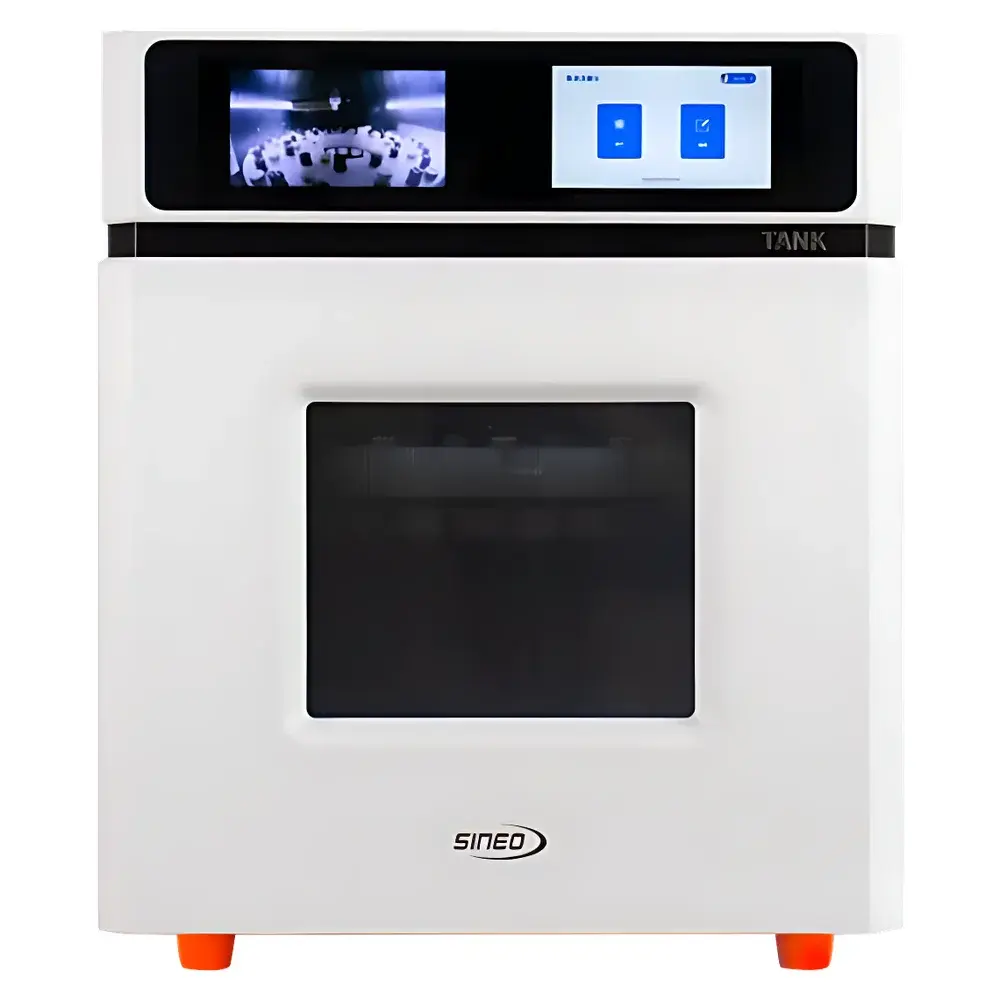
Sineo TANK Advanced Microwave Digestion System
| Brand | Sineo |
|---|---|
| Origin | Shanghai, China |
| Manufacturer Type | OEM Manufacturer |
| Regional Classification | Domestic (China) |
| Model | TANK |
| Price Range | USD 35,000 – 42,000 |
| Cavity Class | Industrial-Grade |
| Sample Capacity | 40 Positions |
| Microwave Source | 2450 MHz, Dual Magnetron, Non-Pulsed Frequency-Variable Control |
| Max Temperature | 300 °C |
| Temp Measurement Accuracy | ±0.1 °C |
| Temp Control Stability | ±1 °C |
| Max Pressure | 15 MPa |
Overview
The Sineo TANK Advanced Microwave Digestion System is an industrial-grade, high-throughput sample preparation platform engineered for trace-level elemental analysis in environmental, geological, clinical, food safety, and regulatory testing laboratories. It operates on the principle of closed-vessel microwave-assisted acid digestion—where controlled microwave energy (2450 MHz) rapidly heats acidic reagents (e.g., HNO₃, HCl, HF, H₂O₂) under elevated temperature and pressure, accelerating oxidative decomposition of organic matrices and mineral dissolution. The system’s dual-magnetron, non-pulsed frequency-variable control ensures uniform electromagnetic field distribution across the 40-position rotor, minimizing hot-spot formation and delivering high reproducibility in digestion efficiency—critical for ICP-OES, ICP-MS, and AAS sample introduction protocols.
Key Features
- Industrial 316L stainless steel cavity with multi-layer PTFE coating—resistant to aggressive acids (including HF) and warranted for 5 years against corrosion.
- Explosion-resistant safety door with choke groove design, interlocked mechanical/electrical cut-off, and automatic self-sealing upon closure to prevent microwave leakage (<1 mW/cm² at 5 cm distance).
- Composite fiber outer vessels rated to 70 MPa and 600 °C, enabling ultra-high-pressure applications beyond standard EPA/ISO digestion protocols.
- Non-contact mid-infrared full-vessel temperature monitoring—measuring real-time solution temperature in each of the 40 vessels independently, without optical interference from vessel walls or steam condensation.
- Intelligent pressure management: elastic self-sealing venting for routine operation; rupture-disk–based overpressure release (15 MPa threshold) with instantaneous resealing to maintain reaction integrity.
- Dual high-resolution LCD interface with color touchscreen—displaying real-time temperature bar charts, individual vessel heating curves, power profiles, and stepwise protocol progress.
- Integrated HD cavity video monitoring system—enabling remote visual verification of rotor rotation, vessel alignment, and condensate behavior during digestion cycles.
- Automated rotor recognition and position counting—eliminating manual input errors and supporting method-driven workflow execution.
Sample Compatibility & Compliance
The TANK system accommodates a broad range of sample types—including soils, sediments, biological tissues, polymers, pharmaceuticals, and food matrices—across five interchangeable rotor configurations (high-pressure, high-throughput, large-volume, ultra-high-pressure, and modular frame rotors). All consumables comply with ISO 17025 traceability requirements for calibration and validation. The instrument meets IEC 61000-4 electromagnetic compatibility standards and conforms to national safety regulations (GB 4793.6–2008). Optional semiconductor pressure sensors and multi-core fused-silica fiber optic temperature probes support GLP/GMP audit readiness. Full compliance with FDA 21 CFR Part 11 is embedded via electronic signature capability, audit trail logging (user action, timestamp, parameter change), and role-based access control within the Android-based OS.
Software & Data Management
The onboard Android 9.0 operating system hosts a validated software suite with 8 GB internal storage, preloaded with >120 certified digestion methods (EPA 3051A, 3052, ISO 14870, ASTM D5511, etc.) and interactive video tutorials. Users may select ramp-hold, power-controlled, or dynamic slope-based heating profiles. Built-in calibration routines verify temperature, pressure, and microwave output accuracy prior to each run. Cloud connectivity enables encrypted synchronization of methods, logs, and raw data to private or public cloud servers (AWS/Azure-compatible). Over-the-air firmware updates ensure long-term regulatory alignment. All data exports are structured in CSV/Excel format with metadata headers compliant with LIMS integration standards.
Applications
The TANK system supports digestion protocols required for regulatory submissions under US EPA, EU REACH, ISO, and Chinese MEE guidelines. Typical use cases include: heavy metal quantification in soil leachates (Cd, Pb, As, Cr); total mercury recovery from fish tissue per EPA 7473; rare earth element extraction from monazite sands; residual catalyst analysis in polymer additives; and phosphorus speciation in wastewater sludge. Its 40-position capacity and 200 samples/day.
FAQ
What safety certifications does the TANK system hold?
It complies with IEC 61000-4 (EMC), GB 4793.6–2008 (safety), and features third-party verified microwave leakage performance (<1 mW/cm²). Optional accessories meet ATEX Zone 2 classification for solvent-rich environments.
Can the system be integrated into a LIMS environment?
Yes—via USB or Ethernet, using standardized CSV export templates with full audit trail metadata. API support for HL7/FHIR is available upon request for enterprise deployments.
Is method validation documentation provided?
Sineo supplies IQ/OQ/PQ templates, traceable calibration certificates for IR sensors and pressure transducers, and application notes aligned with EPA and ISO validation criteria.
What maintenance is required for long-term reliability?
Annual cavity coating inspection, magnetron output verification, and sensor recalibration are recommended. The dual-magnetron architecture extends service intervals by ~40% versus single-source systems.
Does the system support mixed-acid digestion with hydrofluoric acid (HF)?
Yes—the TFMTM inner vessels and PTFE-coated cavity are chemically resistant to HF up to 20% concentration at 250 °C; users must follow strict PPE and neutralization protocols per OSHA 1910.1200.



