
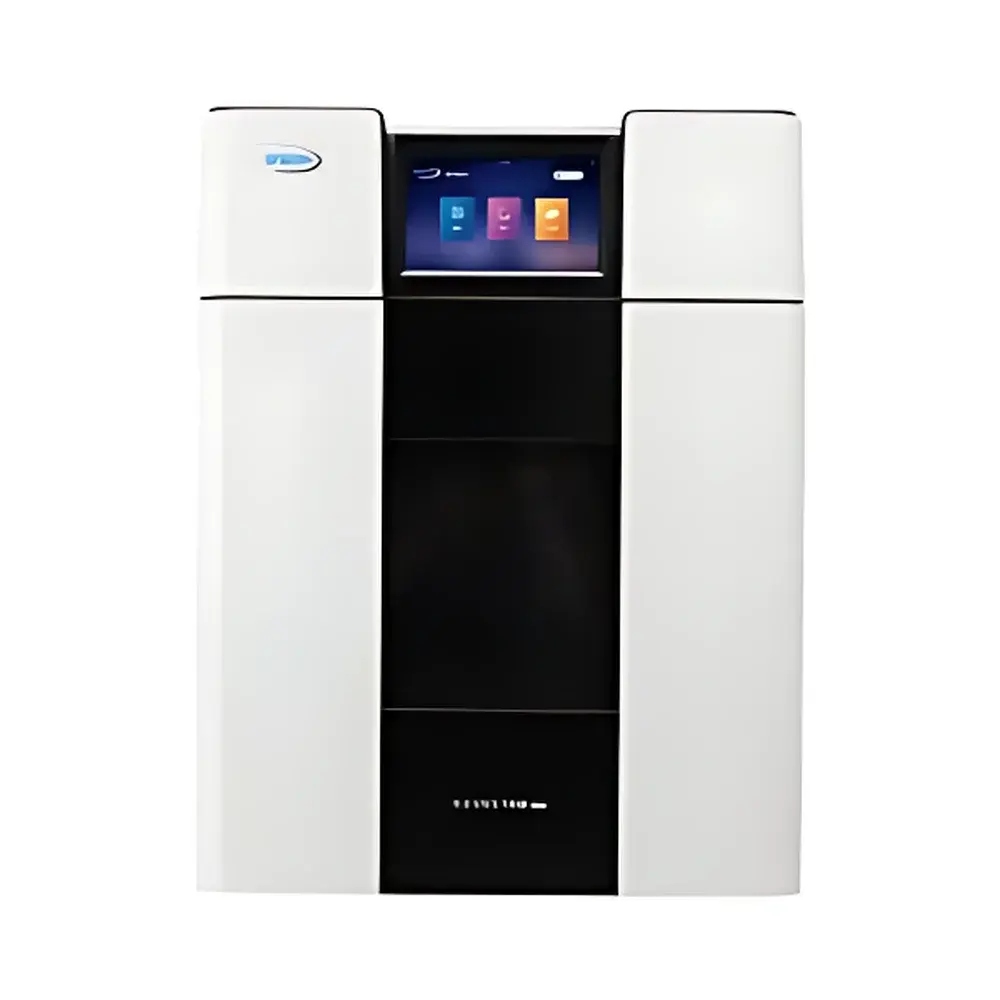
Sineo TANK eco Microwave Digestion System
| Brand | Sineo |
|---|---|
| Origin | Shanghai, China |
| Manufacturer Type | Direct Manufacturer |
| Product Category | Domestic (China-made) |
| Model | TANK eco |
| Price | Upon Request |
| Cavity Grade | Industrial-Grade |
| Sample Capacity | 6/8/10 positions |
| Max Temperature | 300 °C |
| Max Pressure | 15 MPa (≈2200 psi) |
| Power Supply | 220–240 VAC, 50/60 Hz, 20 A |
| Microwave Frequency | 2450 MHz, Variable-Frequency Magnetron |
| Installed Power | 1800 W |
| Cavity Material | 316L Stainless Steel with Multi-Layer PTFE Coating |
| Safety Door | Pop-Out Buffer Anti-Explosion Design with Dual Lock & Self-Check |
| Pressure Sensor | High-Precision Corrosion-Resistant Semiconductor Sensor |
| Temperature Monitoring | Mid-Infrared Full-Cavity Temperature Measurement |
| Control Interface | 7-inch LCD Touchscreen |
| Operating System | Android-based |
| Data Storage | 8 GB Onboard + Cloud Integration (Secure, Encrypted) |
| Compliance | FDA 21 CFR Part 11 (Audit Trail, Electronic Signatures, Role-Based Access) |
| Cooling System | High-Flow Corrosion-Resistant Fan, Auto-Adjustable Airflow, <15 min to Ambient |
| Dimensions (W×D×H) | 480 × 560 × 575 mm |
| Net Weight | 45 kg |
| Rotor Design | Independent Frame-Type High-Pressure Vessels |
| Vessel Options | Self-Venting or Non-Venting Configurations |
| Inner Vessel Material | TFM (Perfluoroalkoxy Alkane) |
| Inner Vessel Volume | 100 mL |
| Outer Vessel Material | Aerospace-Grade Composite Fiber with Full PTFE Coating |
| Design Temp/Pressure | 300 °C / 15 MPa |
| Additional Functions | Microwave-Assisted Extraction (MAE), Microwave Synthesis (Organic & Inorganic) |
Overview
The Sineo TANK eco Microwave Digestion System is an industrial-grade, CE-compliant microwave-assisted sample preparation platform engineered for reproducible, high-pressure, high-temperature closed-vessel digestion of complex matrices. It operates on the principle of dielectric heating—where microwave energy (2450 MHz) directly couples with polar molecules (e.g., HNO₃, HCl, HF) and ionic species in the sample, enabling rapid, volumetric, and uniform thermal energy transfer. Unlike open-vessel hotplate digestion or conventional reflux methods, the TANK eco’s fully sealed, pressure-controlled environment prevents volatile element loss (e.g., As, Hg, Se, Pb), ensures quantitative recovery, and accelerates reaction kinetics—critical for trace elemental analysis by ICP-OES, ICP-MS, AAS, and HG-AFS. Its design adheres to internationally recognized digestion protocols including EPA Method 3051A, 3052, ISO 15587-1, and ASTM D5511, supporting GLP/GMP-aligned laboratories requiring method traceability and data integrity.
Key Features
- Industrial-Class Resonant Cavity: Constructed from electropolished 316L stainless steel with multi-layer PTFE coating, ensuring long-term resistance to aggressive acid mixtures (aqua regia, HF-containing media) and minimizing cavity corrosion and arcing risks.
- Full-Cavity Pressure & Temperature Monitoring: Real-time, per-vessel pressure measurement via corrosion-hardened semiconductor sensors; mid-infrared optical pyrometry for non-contact, absolute temperature reading across all vessels simultaneously—eliminating thermal lag and positional bias.
- Aerospace Composite Outer Vessels: Reinforced carbon-fiber-reinforced polymer (CFRP) outer sleeves with full-surface PTFE encapsulation deliver burst resistance up to 70 MPa (10,000 psi) and thermal stability to 600 °C—exceeding ASTM E2894 requirements for pressure vessel safety margins.
- Intelligent Overpressure Management: Patented self-venting rupture disc mechanism activates only upon exceeding 15 MPa setpoint; mechanical lift action provides controlled, directional pressure release without vessel ejection—validated per ISO/IEC 17025 clause 5.4.3 for failure-mode predictability.
- Regulatory-Ready Software Architecture: Android-based OS with built-in audit trail, electronic signature support, user role management, and 21 CFR Part 11–compliant data handling—including immutable method logs, timestamped parameter changes, and encrypted local/cloud backup.
Sample Compatibility & Compliance
The TANK eco accommodates a broad spectrum of sample types—including soils, sediments, biological tissues (plant/animal), polymers, catalysts, geological materials, and electronic waste—across environmental, food safety, pharmaceutical, and materials research applications. Its TFM inner vessels (100 mL capacity) resist fluorination and halogen-induced degradation, making them suitable for HF-based digestions required for silicate dissolution. The system meets ISO/IEC 17025 calibration traceability requirements when used with NIST-traceable reference materials (e.g., SRM 2710a, BCR-680). All safety interlocks—including door position sensing, cavity temperature cutoff, and real-time microwave power modulation—are independently certified to IEC 61000-4-3 (EMC) and IEC 61010-1 (Electrical Safety).
Software & Data Management
The embedded software provides intuitive workflow navigation with dual-display capability: real-time numeric parameters (temperature, pressure, time, step) and dynamic graphical overlays (T–P curves, power ramp profiles). Automatic rotor recognition eliminates manual input errors; the system detects vessel count (6/8/10) and configures method parameters accordingly. Local 8 GB storage retains ≥10,000 complete digestion records with metadata (user ID, method name, timestamps, raw sensor outputs). Cloud synchronization uses TLS 1.3 encryption and AES-256 at rest; users may deploy private cloud instances or leverage Sineo’s ISO 27001–certified infrastructure. Remote firmware updates preserve regulatory compliance during instrument lifecycle—critical for FDA-audited QC labs maintaining validated methods.
Applications
The TANK eco supports three primary operational modes: (1) High-Throughput Digestion for routine heavy metal screening (Pb, Cd, Cr, Ni) in food contact materials per EU Regulation (EC) No. 1935/2004; (2) MAE (Microwave-Assisted Extraction) of PAHs, PCBs, and pesticides from soil/sediment using EPA Method 3546; and (3) Controlled Microwave Synthesis, including hydrothermal synthesis of metal oxides (e.g., Nd-doped ZnO photocatalysts) and solvothermal fabrication of silica nanospheres—enabling reproducible crystallinity control under inert or reducing atmospheres. Its modular rotor design allows seamless transition between digestion and synthesis configurations without hardware modification.
FAQ
Does the TANK eco comply with FDA 21 CFR Part 11 for regulated laboratories?
Yes—audit trail logging, electronic signatures, user authentication, and data immutability are natively implemented and configurable to meet Part 11 Subpart B requirements.
Can the system handle hydrofluoric acid (HF) digestions safely?
Yes—TFM inner vessels and PTFE-coated composite outer vessels provide full compatibility with HF concentrations up to 10% v/v; optional HF-resistant pressure sensors are available.
What is the cooling time between runs?
The high-capacity corrosion-resistant blower reduces rotor temperature to ambient in ≤15 minutes, enabling ≥60 digestions per 8-hour shift.
Is remote monitoring supported?
Yes—via secure HTTPS web interface or dedicated mobile application; real-time status, alerts, and historical data access require no on-site IT infrastructure.
How is method validation documented?
Each run generates a PDF report containing calibration certificates, raw sensor traces, operator ID, method version, and deviation flags—exportable in CSV/PDF for inclusion in analytical method validation packages (ICH Q2(R2)).



