
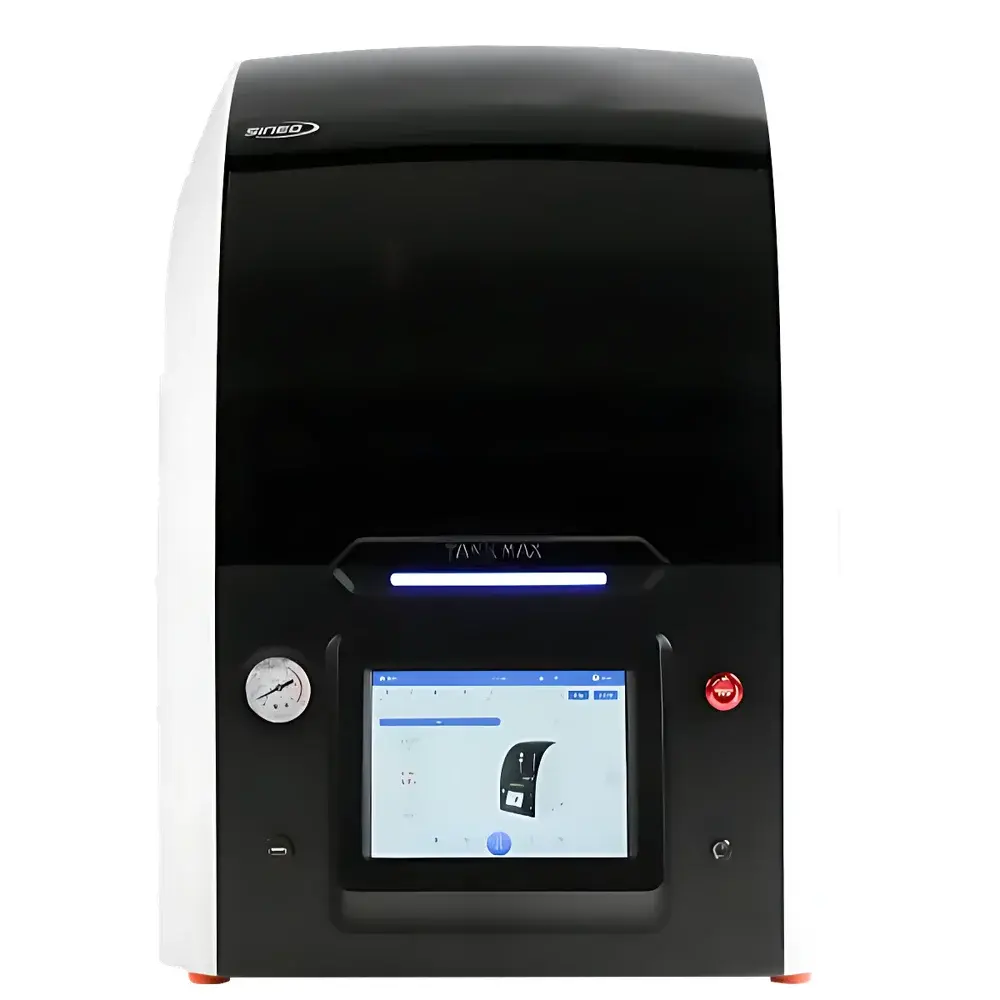
Sineo TANK MAX Super Microwave Digestion Platform
| Brand | Sineo |
|---|---|
| Origin | Shanghai, China |
| Manufacturer Type | Original Equipment Manufacturer (OEM) |
| Country of Origin | China |
| Model | TANK MAX |
| Microwave Source | 2450 MHz frequency-variable magnetron with non-pulsed continuous-wave high-energy microwave emission |
| Max Operating Temperature | 300 °C |
| Max Operating Pressure | 20 MPa |
| Power Output | 1500 W |
| Cooling System | Circulating water cooling (5–40 °C) |
| Control System | Embedded Android OS with graphical user interface |
| Sample Vessel Capacity Options | 6, 10, 18, 24, and 28 positions |
| Vessel Materials | PTFE-TFM, high-purity quartz, borosilicate glass |
| Input Voltage | 220–240 VAC, 50/60 Hz, 20 A |
| Ambient Operating Temperature | 0–40 °C |
| Relative Humidity Range | 15–80 % RH |
Overview
The Sineo TANK MAX Super Microwave Digestion Platform is an advanced, fully integrated sample preparation system engineered for high-efficiency, high-fidelity closed-vessel microwave-assisted acid digestion. It operates on the principle of controlled dielectric heating—where 2450 MHz non-pulsed continuous-wave microwaves interact directly with polar molecules (e.g., HNO₃, HF, aqua regia) to induce rapid, volumetric thermal energy transfer within sealed reaction vessels. Unlike conventional pulsed or low-power systems, the TANK MAX employs a single-source microwave coupling architecture with a large-diameter waveguide, ensuring uniform field distribution and high energy utilization efficiency (>85% typical). This enables reproducible ramp-and-hold temperature/pressure profiles under rigorously defined thermodynamic constraints—up to 300 °C and 20 MPa—making it suitable for complete dissolution of refractory matrices including silicates, ceramics, polymers, rare-earth oxides, and alloyed metals. Its monolithic cavity design with pre-pressurization eliminates vessel-to-vessel pressure differentials, guaranteeing identical thermal and mechanical conditions across all samples—critical for inter-sample comparability in regulated analytical workflows.
Key Features
- Monolithic reaction cavity with pre-pressurization architecture: Eliminates vessel wall stress during pressurization; enables simultaneous digestion of heterogeneous sample types (e.g., biological tissue + geological silicate) without cross-contamination or thermal lag.
- Non-pulsed continuous-wave 2450 MHz microwave source: Delivers stable, controllable power output up to 1500 W via frequency-variable magnetron—ensuring precise thermal ramp rates (up to 30 °C/s) and minimal thermal overshoot.
- Four-tier safety framework: Combines predictive pressure modeling (real-time ΔP/Δt forecasting), programmable active pressure relief, redundant passive overpressure release (micro-lift + terminal burst disc), and acid vapor containment (sealed door + automated exhaust scrubbing).
- Easy Load™ vessel insertion system: No alignment required for racks or liners; PTFE-TFM, quartz, or standard borosilicate glass tubes insert vertically into self-sealing caps—reducing operator error and setup time by >40%.
- Zero-post-digestion acid removal: Uses only 2 mL reagent per sample; digestates are directly diluted to volume post-cooling—eliminating time-consuming open-vessel evaporation steps and associated analyte loss or contamination risks.
- Corrosion-resistant fluidic pathway: Chemically inert, self-cleaning high-pressure tubing rated for prolonged exposure to HF, aqua regia, and perchloric acid—validated per ASTM D1193 Type I water purity standards for post-digestion rinse cycles.
Sample Compatibility & Compliance
The TANK MAX supports digestion of diverse solid and semi-solid matrices compliant with ISO 11885, EPA Method 3052, USP , and GB/T 5009 series protocols. Vessel material options—including PTFE-TFM (ASTM D4894-compliant), high-purity quartz (SiO₂ ≥ 99.995%), and Class A borosilicate glass—allow method flexibility across regulatory tiers. The system’s pressure- and temperature-controlled environment ensures adherence to GLP/GMP documentation requirements, with full audit trail logging (including timestamped setpoints, actuals, and safety event flags) meeting FDA 21 CFR Part 11 data integrity criteria. All digestion cycles are traceable to unique batch IDs, supporting full chain-of-custody reporting for environmental monitoring, pharmaceutical QC, and forensic trace metal analysis.
Software & Data Management
The embedded Android-based control interface provides intuitive graphical workflow navigation without external PC dependency. Users define multi-step methods (ramp/hold/cool phases) via drag-and-drop parameter mapping, with real-time visualization of temperature, pressure, and microwave power curves. All operational data—including vessel ID, reagent lot numbers, operator ID, and calibration logs—are stored locally in encrypted SQLite databases and exportable as CSV or PDF reports. Audit trails include digital signatures, session timestamps, and immutable event logs for pressure excursions or safety interventions—fully compatible with LIMS integration via RESTful API.
Applications
The TANK MAX is routinely deployed in accredited laboratories for elemental analysis prep prior to ICP-MS, ICP-OES, and AAS quantification. Key application domains include: heavy metal screening in foodstuffs (EU Commission Regulation (EC) No 1881/2006); total recoverable metals in soil/sediment (EPA SW-846 Method 3052); rare earth element profiling in battery cathode materials; Cr(VI) speciation in leather per ISO 17075; and residual catalyst analysis in polymer synthesis. Its ability to process up to 28 samples per run—without sacrificing temperature uniformity or pressure fidelity—makes it ideal for high-throughput QA/QC labs operating under ISO/IEC 17025 accreditation.
FAQ
What vessel materials are certified for use with hydrofluoric acid (HF)?
PTFE-TFM and high-purity quartz vessels are validated for repeated HF exposure at ≤200 °C and ≤12 MPa. Glass vessels are not recommended for HF-containing chemistries.
Does the system support remote monitoring or LIMS connectivity?
Yes—via built-in Ethernet/Wi-Fi and RESTful API endpoints for real-time status polling, method upload, and raw data retrieval.
How is temperature and pressure calibrated and verified?
Each unit ships with NIST-traceable dual-sensor calibration certificates (RTD + piezoresistive transducer); annual verification kits and SOPs are included for in-house recalibration per ISO/IEC 17025 Clause 6.5.
Can the TANK MAX be used for fusion digestion?
No—it is designed exclusively for closed-vessel acid digestion; alkaline fusion applications require dedicated fusion furnaces per ASTM C114.
Is the cooling system compatible with facility chilled water?
Yes—the circulating water module accepts external 5–15 °C coolant supply with flow-rate monitoring (0.8–2.0 L/min) and automatic shutdown on flow interruption.



