
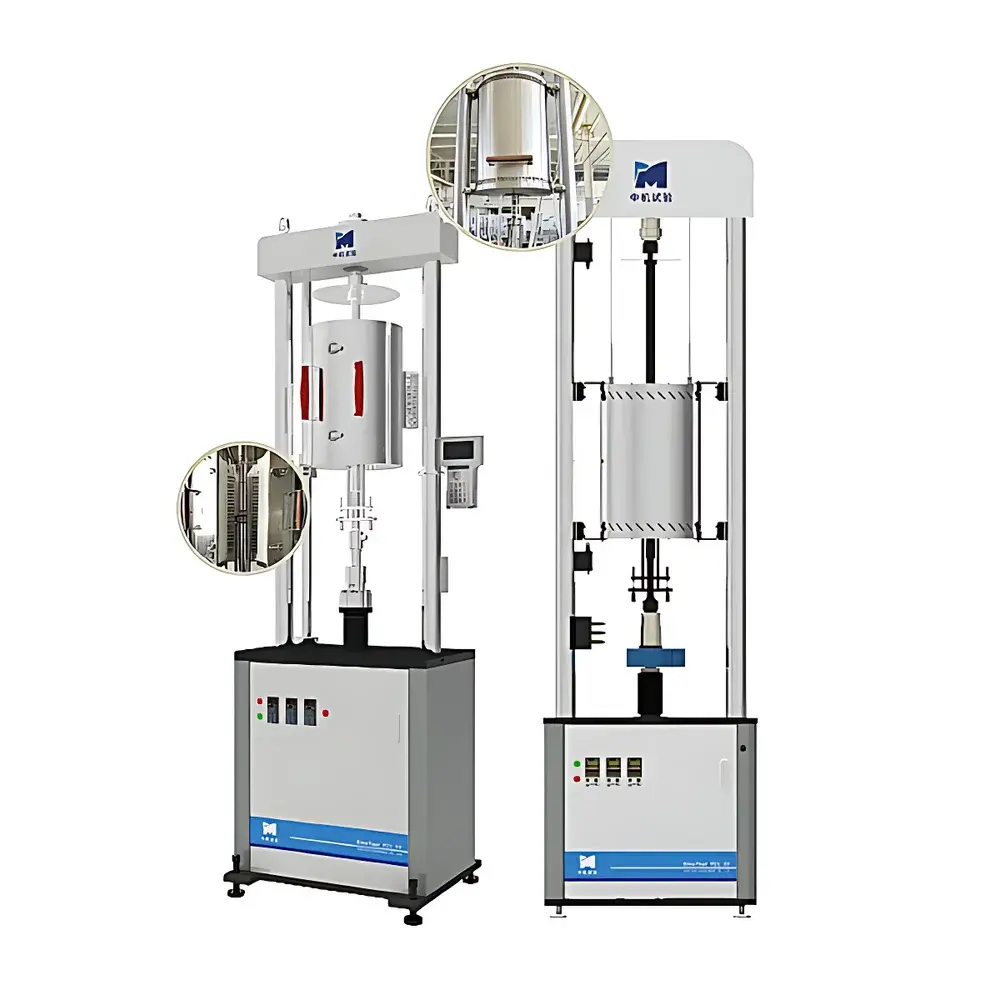
SINOTEST R-Series Electronic Creep and Stress Rupture Testing Machine
| Brand | SINOTEST |
|---|---|
| Origin | Jilin, China |
| Manufacturer Type | Direct Manufacturer |
| Equipment Type | Electromechanical |
| Max Test Load | 500 kN |
| Maximum Crosshead Travel | 180 mm |
| Dimensions (L×W×H) | 2220 × 710 × 540 mm |
| Host Weight | 500 kg |
Overview
The SINOTEST R-Series Electronic Creep and Stress Rupture Testing Machine is a high-precision, long-term mechanical testing system engineered for the standardized evaluation of time-dependent deformation and failure behavior in metallic and non-metallic materials under sustained load and elevated temperature conditions. Based on electromechanical actuation and closed-loop digital control architecture, the system implements uniaxial tensile, compressive, creep, stress rupture, stress relaxation, low-cycle fatigue, creep–fatigue interaction, and slow-strain-rate stress corrosion testing per internationally recognized methodologies. Since its commercial introduction in the 1980s—marking China’s first domestically developed long-duration mechanical testing platform—the R-Series has been continuously refined to meet stringent requirements of national infrastructure projects, aerospace component qualification, nuclear material certification, and energy-sector alloy development programs. Its design adheres to fundamental principles of viscoelastic and viscoplastic mechanics, enabling quantification of primary, secondary (steady-state), and tertiary creep stages, as well as time-to-rupture under constant load or constant stress conditions.
Key Features
- Integrated electromechanical loading frame with high-rigidity structural design and precision-ground load train, rated for continuous operation at up to 500 kN static load capacity.
- Modular thermal management architecture supporting furnace configurations for testing up to 1200 °C (customizable), with independent PID-controlled heating zones and calibrated thermocouple feedback (Type K or S).
- Digital controller options: EDC series (co-developed with DOLi, Germany) for RDL submodels; TMC-series proprietary controllers for RWS variants—both compliant with real-time deterministic sampling (≥100 Hz) and dual-channel synchronized data acquisition (load + displacement/strain).
- Unified host enclosure integrating load frame, controller electronics, and thermal subsystem interfaces—minimizing footprint (2220 × 710 × 540 mm) and enabling multi-unit parallel deployment without operational interference.
- Full-motion crosshead travel range of 180 mm with sub-micron positional resolution, compatible with extensometers (capacitive, clip-on, or laser-based) and high-temperature strain measurement accessories.
- Robust mechanical architecture with 500 kg mass optimized for vibration damping and long-term dimensional stability during tests extending from hours to over 10,000 hours.
Sample Compatibility & Compliance
The R-Series accommodates standard and custom specimen geometries per ASTM E139, ISO 204, GB/T 2039, and EN 10002-5 specifications—including round, flat, notched, and miniature specimens (e.g., miniaturized disk, small punch). It supports both force-controlled and displacement-controlled test modes, with automatic transition logic between creep and rupture phases. All systems are supplied with factory calibration certificates traceable to NIM (National Institute of Metrology, China) and include verification documentation aligned with JJG 276–2009 (Verification Regulation for High-Temperature Creep and Stress Rupture Testing Machines). The platform fully satisfies regulatory expectations for GLP-compliant data integrity, including audit-trail-enabled software logging, electronic signature support, and 21 CFR Part 11–ready configuration options upon request.
Software & Data Management
Two validated software environments are available: CreepTest (jointly developed with DOLi) and Creep Test Expert v2.0 (SINOTEST proprietary). Both provide ISO/IEC 17025-aligned test method templates, automated compliance checking against selected standards (e.g., ASTM E2714 for creep–fatigue, ASTM E328 for stress relaxation), and real-time visualization of creep curves (strain vs. log time), Larson–Miller parameter plots, and Monkman–Grant relationships. Data export supports CSV, XML, and HDF5 formats; offline analysis modules permit full test recovery—including force, temperature, extension, and elapsed time—even after unexpected power interruption. All software installations undergo version-controlled release management and are delivered with formal validation reports (IQ/OQ protocols available).
Applications
- Qualification of turbine blade alloys (Ni-based superalloys, Ti-aluminides) for aerospace propulsion systems.
- Long-term integrity assessment of pressure vessel steels and weldments in nuclear power generation (ASME Section III, Case N-758).
- Creep life modeling and constitutive law derivation for additive-manufactured metallic components.
- Stress relaxation behavior of polymer composites and ceramic matrix composites (CMCs) in high-temperature structural applications.
- Corrosion-assisted failure kinetics studies under combined mechanical and environmental loading (e.g., steam oxidation + tensile stress).
- Material certification for hydrogen transport infrastructure components operating under sustained internal pressure.
FAQ
What temperature ranges are supported by the R-Series?
Standard configurations accommodate ambient to 1100 °C using split-cylinder resistance furnaces; extended-range variants reach 1200 °C with molybdenum disilicide heating elements and water-cooled flanges.
Is the system compatible with third-party extensometers and load cells?
Yes—digital interfaces conform to LVDT, strain gauge, and optical encoder signal standards (±10 V analog, RS-422, or EtherCAT); OEM transducers require calibration file import and channel mapping within the controller firmware.
Can multiple R-Series units be centrally managed?
The EDC and TMC controllers support TCP/IP-based network integration via SINOTEST’s TestNet™ protocol, enabling synchronized start/stop, remote diagnostics, and aggregated database logging across up to 32 units.
Does the software support automated report generation per ASTM or ISO templates?
Yes—Creep Test Expert v2.0 includes configurable report engines with preloaded templates for ASTM E139, ISO 204, GB/T 2039, and EN 10002-5, including mandatory fields for uncertainty estimation, operator ID, and equipment traceability.
What maintenance intervals are recommended for long-term reliability?
Preventive maintenance is scheduled every 1,000 operational hours or annually—whichever occurs first—with emphasis on load cell zero-check, furnace insulation integrity verification, and controller firmware update validation.



