
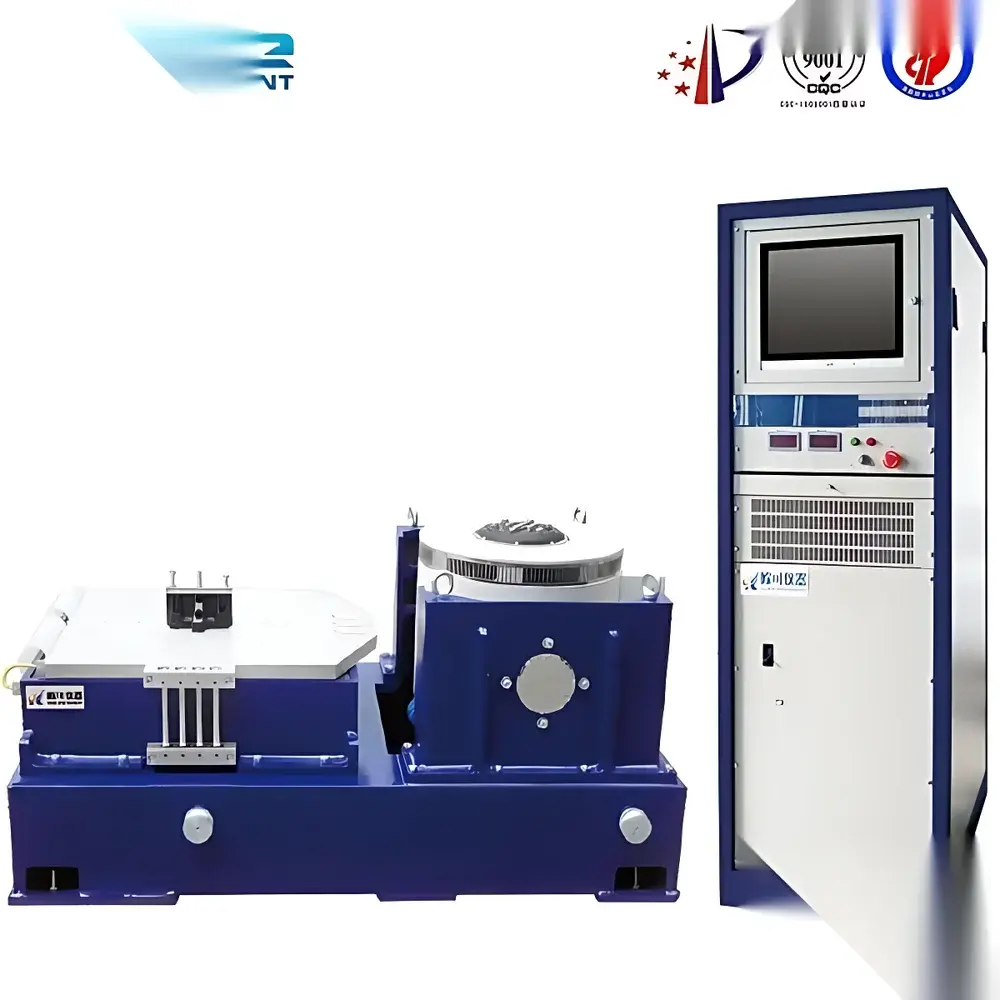
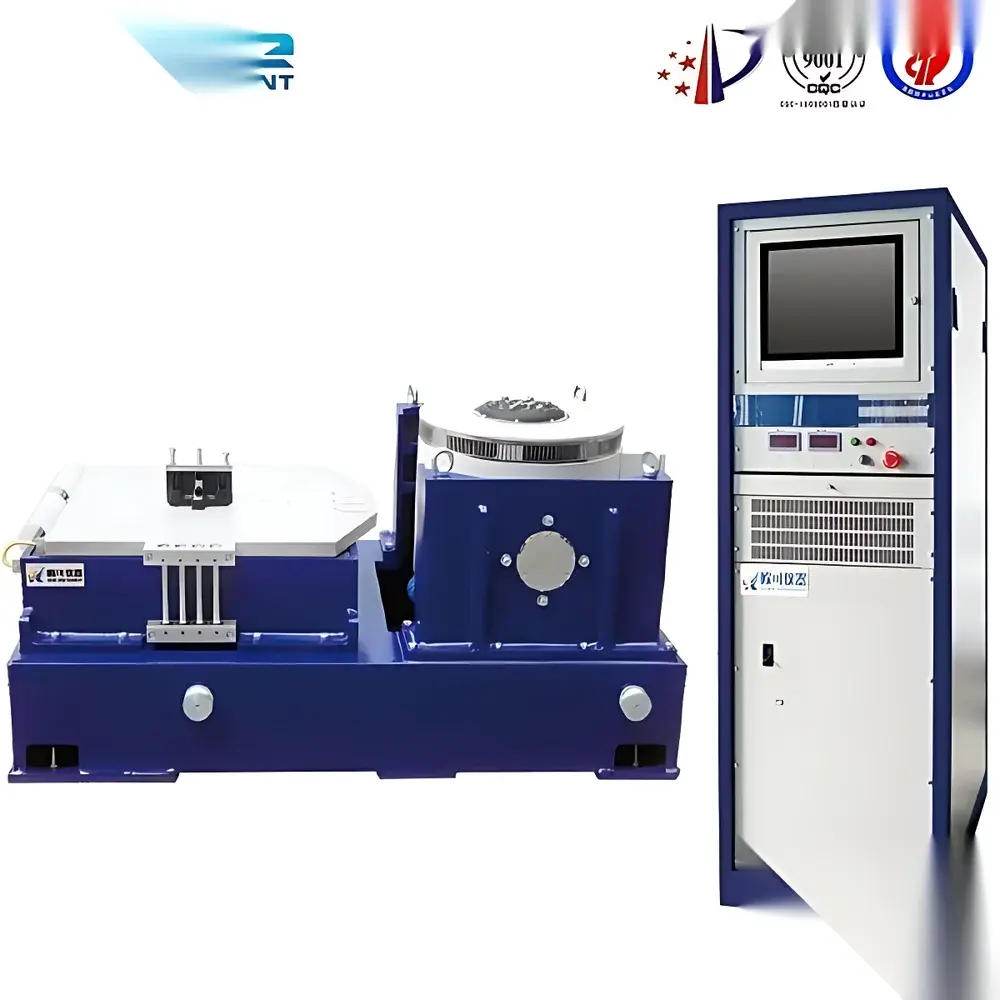
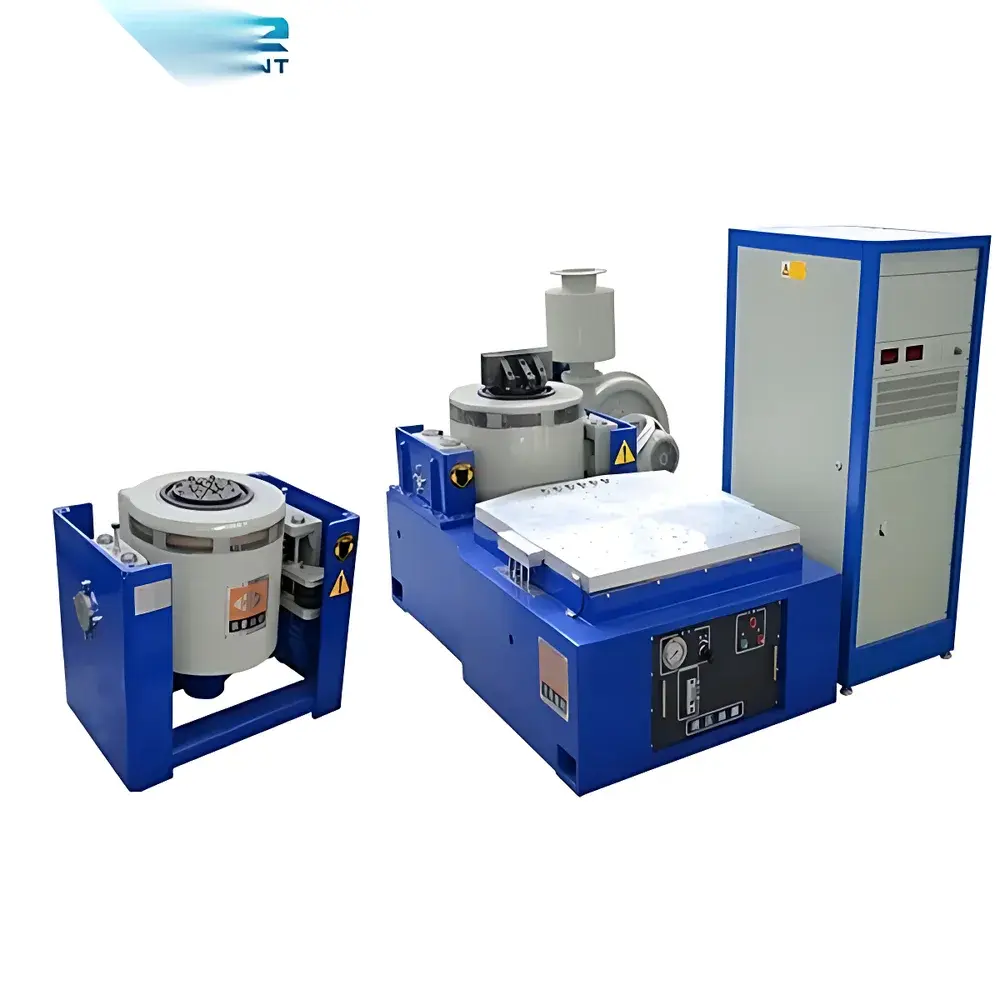
Sinusoidal Vibration Test System PK-1000
| Brand | Other Brands |
|---|---|
| Origin | Imported |
| Manufacturer Type | Authorized Distributor |
| Price | USD 13,800 (FOB) |
| Vibration Mode | Orbital (Circular) |
| Frequency Range (Sine) | 5–70 Hz |
| Max. Load Capacity | 100 kg |
| Table Surface Dimensions | 1000 × 1000 mm |
| Empty-Table Displacement Amplitude | 2–25 mm (adjustable) |
| Timer Range | 1–350,000 s |
| Operating Ambient Temperature | 0–45 °C |
| Power Supply | AC 220 V / 50 Hz ±2% |
| Rated Power | 1.5 kVA |
| Control Interface | Programmable Digital Controller with Real-Time Display of Time and Rotational Speed (rpm) |
| Compliance | ASTM D999, ASTM D3580, ISTA 1A/2A/3A, EN 1010-1, ANSI/UL 61010-1, ISO 13374-1, MIL-STD-810H Method 514.8 (Sine) |
Overview
The Sinusoidal Vibration Test System PK-1000 is an engineered laboratory-grade orbital shaker designed to replicate mechanical vibration environments encountered during terrestrial, maritime, and air transport of packaged goods. It operates on the principle of controlled sinusoidal excitation—generating repeatable, frequency-swept or fixed-frequency oscillatory motion in a horizontal circular (orbital) trajectory. Unlike linear shakers, this system applies multi-axis inertial loading that closely emulates real-world road roughness, rail jolts, and container stacking dynamics. Its core function is structural integrity evaluation: identifying resonant frequencies, assessing packaging robustness, detecting latent design weaknesses (e.g., loose fasteners, insufficient cushioning, or component fatigue), and verifying compliance with internationally recognized distribution simulation standards. The system is not intended for random vibration or shock testing; it is purpose-built for deterministic, amplitude- and frequency-controlled sine-wave profiles required by packaging validation protocols.
Key Features
- Orbital vibration mode with programmable radius and phase synchronization—ensuring uniform energy distribution across the full 1000 × 1000 mm test surface.
- Dual operational modes: precise fixed-frequency testing for resonance identification and calibrated sweep-mode operation (5–70 Hz) with logarithmic or linear rate control.
- High-load structural platform rated for 100 kg payload without amplitude drift or mechanical resonance coupling—validated via modal analysis at full load.
- Digital programmable controller featuring real-time display of elapsed time, rotational speed (rpm), and active frequency—supporting up to 99 programmable test segments per profile.
- Integrated safety architecture including over-current protection, thermal cutoff, emergency stop circuitry, and mechanical end-stop limit switches compliant with EN 60204-1.
- Electromagnetic compatibility (EMC) certified to IEC 61326-1:2023—ensuring stable operation in shared laboratory environments with sensitive instrumentation.
- Low-noise induction motor drive with precision-balanced eccentric mass assembly—minimizing harmonic distortion and enabling long-duration endurance tests (>24 h continuous).
Sample Compatibility & Compliance
The PK-1000 accommodates rigid and semi-rigid packaged units—including corrugated boxes, wooden crates, molded plastic carriers, and palletized loads—up to 1000 mm in width/depth and 100 kg in mass. Fixturing is achieved via non-slip rubber matting and optional T-slot anchoring points (M6 threaded inserts). The system conforms to critical regulatory and industry benchmarks: ASTM D999 (vibration testing of shipping containers), ASTM D3580 (vibration testing of products), ISTA Series 1–3 protocols for transport simulation, EN 1010-1 (safety requirements for laboratory equipment), and ISO 13374-1 (condition monitoring and diagnostics standards). While not FDA-regulated per se, its data traceability and programmable repeatability support GLP-compliant documentation workflows when paired with external audit-ready logging software.
Software & Data Management
The embedded controller supports standalone operation without PC dependency. For advanced traceability, optional RS-232/USB interface enables integration with third-party SCADA or LIMS platforms. All test parameters—including start/stop timestamps, frequency setpoints, dwell durations, and amplitude selections—are stored internally with timestamped logs (non-volatile memory, 10,000-cycle capacity). Exportable CSV reports include time-stamped rpm and duration metadata. When used in regulated environments, the system’s deterministic behavior, absence of stochastic variables, and deterministic profile execution satisfy foundational requirements for 21 CFR Part 11 alignment—provided external electronic records are maintained with appropriate access controls and audit trails.
Applications
- Pre-shipment qualification of consumer electronics packaging under ISTA 3A (parcel delivery) and ISTA 3E (mixed-SKU pallets).
- Validation of medical device carton integrity prior to FDA submission (per ISO 11607 Annex A guidance on distribution simulation).
- Automotive Tier-1 supplier PPAP documentation—verifying ECU housing durability against road-induced harmonics (5–55 Hz dominant band).
- Academic research in packaging engineering: correlation studies between finite element modeling (FEM) predictions and empirical resonance response.
- Quality assurance labs performing periodic requalification of outgoing shipments per internal SOPs aligned with ANSI/UL 61010-1 mechanical stress clauses.
FAQ
What standards does the PK-1000 explicitly support for transport simulation?
ASTM D999, ASTM D3580, ISTA 1A/2A/3A, EN 1010-1, ANSI/UL 61010-1, and ISO 13374-1. It does not perform random vibration per ISO 10816 or MIL-STD-810H Method 514.8 Random.
Can the system operate continuously for extended durations?
Yes—rated for uninterrupted operation up to 72 hours at ≤70 Hz and ≤15 mm amplitude, provided ambient temperature remains within 0–40 °C and ventilation clearance ≥150 mm is maintained.
Is calibration certification included with shipment?
A factory calibration report (traceable to NIST-equivalent national metrology institutes) is supplied. Full ISO/IEC 17025-accredited calibration requires third-party service and is recommended annually.
Does the controller support user-defined multi-step test sequences?
Yes—up to 99 sequential segments per program, each configurable for frequency, dwell time, amplitude, and sweep direction (log/linear).
What is the maximum allowable center-of-gravity height for 100 kg loads?
For stability and amplitude fidelity, the center of gravity must remain ≤300 mm above the table surface. Higher CoG configurations require custom dynamic balancing assessment.



