
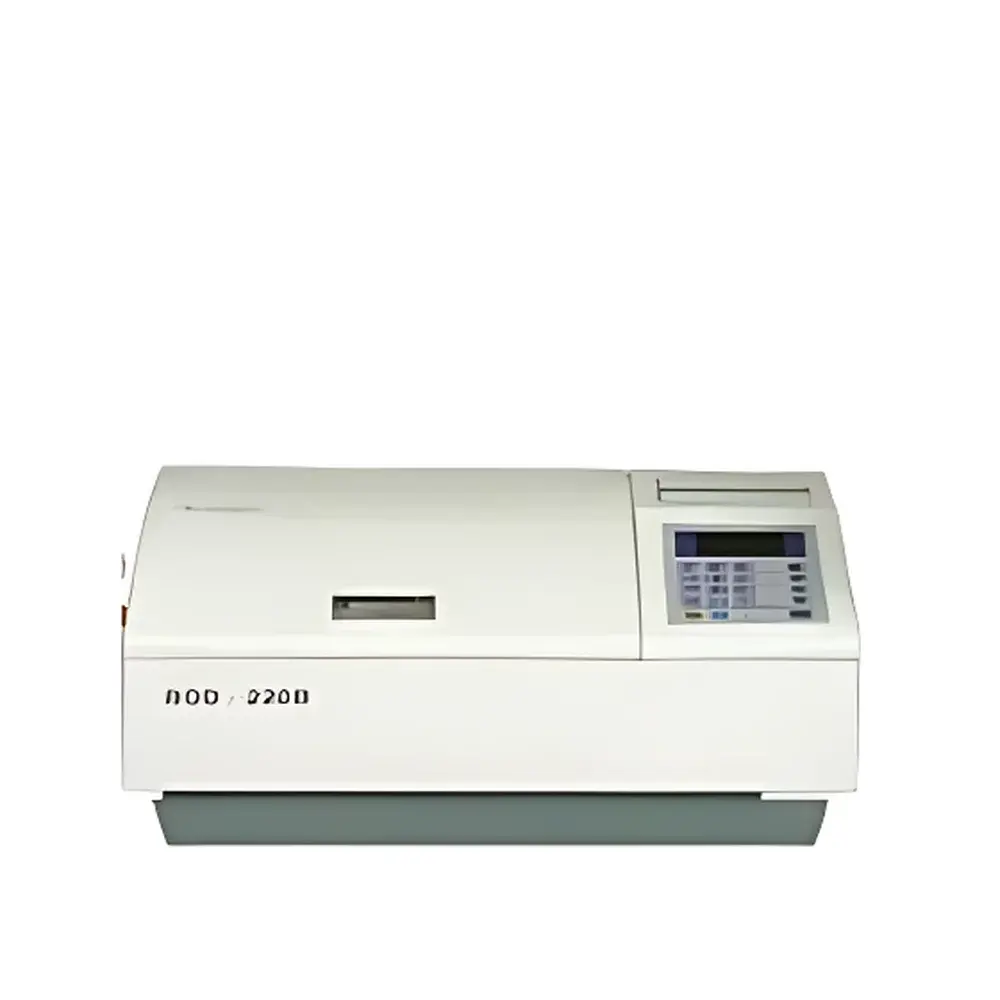
Sipo Environment BOD-220B Benchtop Biochemical Oxygen Demand Analyzer (Main Unit)
| Brand | Sipo Environment |
|---|---|
| Origin | Tianjin, China |
| Model | BOD-220B Main Unit |
| Instrument Type | Laboratory BOD Analyzer |
| Measurement Principle | Flow-through Microbial Electrode Method |
| Measurement Range | 2–4000 mg/L |
| Detection Limit | 2–4000 mg/L |
| Accuracy | ≤3% |
| Single-sample Analysis Time | 8 min |
| Repeatability | ±2% |
| Sensor Configuration | Integrated Triple-electrode Sensor with Reference Electrode |
| Sample Volume Requirement | >40 mL |
| Temperature Control Precision | ±0.1°C |
| Buffer Consumption | 270 mL/h |
| Dimensions | 540 × 370 × 225 mm |
| Weight | ~18 kg |
| Power Supply | AC 220 V, 50 Hz |
| Communication Interface | RS-232 (expandable for automated sampler integration) |
| Data Storage Capacity | 99 test records |
| Built-in Thermal Printer | Yes |
Overview
The Sipo Environment BOD-220B is a dedicated benchtop biochemical oxygen demand (BOD) analyzer engineered for rapid, reliable, and standardized determination of BOD5 in municipal wastewater, industrial effluents, surface water, and treated discharge streams. It operates on the flow-through microbial electrode principle—where immobilized, EPA-validated InterBio bacterial strains catalyze the oxidation of biodegradable organic matter under controlled aerobic conditions. The resulting oxygen consumption is electrochemically quantified via a triple-electrode sensor system (working, counter, and reference electrodes), enabling real-time current measurement (0–20 µA) proportional to BOD concentration. Unlike traditional 5-day dilution methods (e.g., ISO 5815-1, ASTM D5210), the BOD-220B delivers quantitative results in just 8 minutes per sample while maintaining compliance with Chinese national standard HJ/T 86–2002. Its design emphasizes operational robustness, minimal operator intervention, and suitability for routine QC/QA laboratories requiring high sample throughput without sacrificing metrological traceability.
Key Features
- Flow-through microbial electrode architecture with integrated triple-electrode sensor—including a stable Ag/AgCl reference electrode—for enhanced signal stability and long-term baseline reproducibility.
- Precision thermal regulation using a reflective heating jacket with ±0.1°C temperature control accuracy, ensuring consistent microbial activity across ambient lab conditions (5–40°C).
- Peristaltic pump-driven continuous-flow sampling at constant rate, eliminating manual pipetting errors and enabling unattended sequential analysis.
- Onboard data management: stores up to 99 complete test records with timestamp, sample ID, BOD value, and calibration status; supports direct thermal printing for GLP-compliant hardcopy reporting.
- RS-232 serial interface compliant with standard laboratory instrument protocols—enables bidirectional communication with LIMS or external controllers; designed for future integration with automated sample introduction modules.
- Dedicated InterBio BOD5-specific biocatalyst membrane with dormancy preservation capability, extending functional shelf life during non-operational periods.
Sample Compatibility & Compliance
The BOD-220B accommodates liquid samples with suspended solids ≤50 mg/L (pre-filtration recommended above this threshold) and chloride concentrations below 1000 mg/L to prevent sensor poisoning. It is validated for use with domestic sewage, activated sludge supernatants, river water, and secondary effluent—provided turbidity is reduced to <10 NTU prior to analysis. The instrument conforms to HJ/T 86–2002 “Determination of Biochemical Oxygen Demand (BOD5) in Water Quality — Microbial Electrode Method”, and its measurement uncertainty profile aligns with ISO/IEC 17025 requirements for accredited environmental testing laboratories. While not FDA 21 CFR Part 11-certified out-of-the-box, audit trails, user access logs, and electronic signature support can be implemented via optional firmware upgrades for regulated GMP/GLP environments.
Software & Data Management
The embedded firmware provides intuitive menu navigation via LCD display and tactile keypad. All calibration parameters—including zero point, span slope, membrane response time, and buffer depletion alerts—are stored internally with checksum validation. Raw sensor current data (µA), calculated BOD values (mg/L), and environmental metadata (temperature, elapsed time, buffer volume consumed) are logged per analysis cycle. Export is supported via RS-232 to CSV-compatible spreadsheet software or third-party LIMS platforms. No proprietary desktop application is required; ASCII-based command-response protocol ensures interoperability with common laboratory automation frameworks.
Applications
- Routine BOD5 monitoring in wastewater treatment plant process control labs.
- Regulatory compliance verification for NPDES or local discharge permits.
- Research studies evaluating biodegradability kinetics of novel organic compounds.
- Quality assurance in pharmaceutical manufacturing where effluent BOD must meet strict environmental release thresholds.
- Educational laboratories demonstrating rapid biological oxygen demand assessment principles.
FAQ
What is the recommended maintenance schedule for the microbial sensor membrane?
Replace the InterBio membrane every 30 days under continuous operation or after 200 analyses—whichever occurs first. Store spare membranes refrigerated (2–8°C) in sealed desiccant packaging.
Can the BOD-220B measure samples with high salinity or heavy metal content?
Samples exceeding 1000 mg/L chloride or containing >0.5 mg/L Cu²⁺, Cr⁶⁺, or Hg²⁺ require pre-treatment (e.g., dilution, chelation, or ion exchange) to avoid irreversible enzyme inhibition.
Is method validation documentation available for regulatory submission?
Yes—Sipo Environment supplies a comprehensive validation report including linearity (R² ≥0.998 over 2–4000 mg/L), limit of detection (LOD = 2 mg/L), precision (RSD ≤2% intra-day, ≤4% inter-day), and interference testing per HJ/T 86–2002 Annex B.
Does the instrument support multi-point calibration?
It performs two-point calibration (zero and span) using certified BOD standards traceable to NIM (National Institute of Metrology, China); custom multi-point curve fitting is not implemented in base firmware.
What buffer solution is required for continuous operation?
Use phosphate-buffered saline (PBS, pH 7.2 ±0.1) prepared according to HJ/T 86–2002 Section 6.3; consumption is 4.5 mL/min (270 mL/h) during active analysis mode.







