
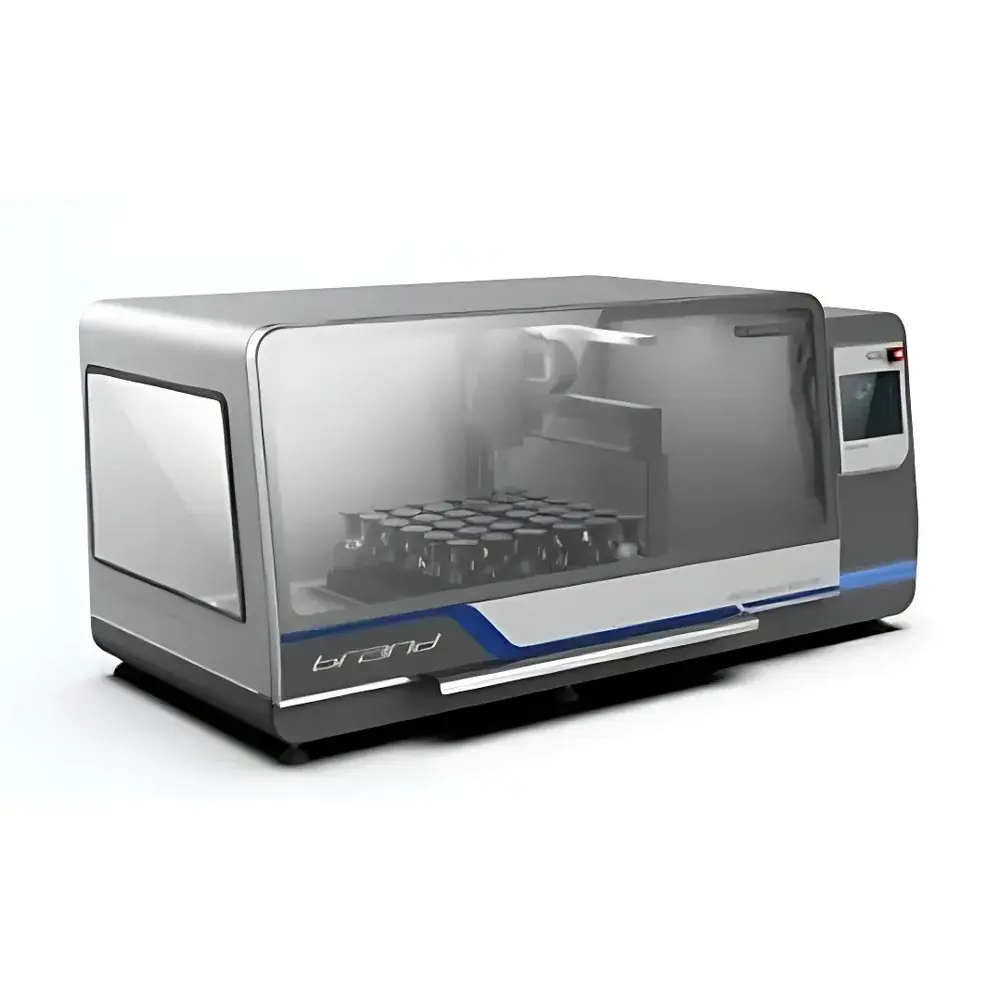
Sipo Environment BODAuto-2100 Automated BOD₅ Measurement System
| Brand | Sipo Environment |
|---|---|
| Origin | Tianjin, China |
| Model | BODAuto-2100 |
| Instrument Type | Laboratory BOD Analyzer |
| Principle | Dissolved Oxygen (DO) Method (5-Day Incubation) |
| Measurement Range | 2–6000 mg/L |
| Detection Limit | 0.1 mg/L |
| Accuracy | ±5% |
| Single-Sample Measurement Time | <60 s |
| Reproducibility | ±0.1 mg/L (per 54-bottle batch) |
| DO Electrode Range | 0–20.00 mg/L |
| DO Resolution | 0.01 mg/L |
| DO Response Time | ≤30 s (90% at 25 °C) |
| Temperature Compensation | Automatic (0–45 °C) |
| Salinity Compensation | Automatic (0–45 ppt) |
| Barometric Pressure Compensation | Automatic (80–105 kPa) |
| Sample Capacity | 54 positions per tray, modular multi-tray support |
| Power Supply | AC 220 V, 50 Hz, 350 W |
| Dimensions | 1500 × 650 × 650 mm |
| Operating Environment | 5–45 °C, non-corrosive atmosphere |
Overview
The Sipo Environment BODAuto-2100 Automated BOD₅ Measurement System is an integrated laboratory platform engineered for precise, high-throughput determination of biochemical oxygen demand over a standard 5-day incubation period (BOD₅), in strict accordance with ISO 5815-1:2019, ASTM D5210-92(2021), and Chinese national standard HJ 505-2009. It implements the dissolved oxygen (DO) depletion method—measuring the difference in dissolved oxygen concentration before and after aerobic microbial degradation under controlled temperature (20 ±1 °C) and dark incubation conditions. Unlike manometric or titrimetric alternatives, this system employs a high-stability polarographic membrane DO electrode with real-time environmental compensation (temperature, salinity, barometric pressure), eliminating manual correction steps and minimizing operator-induced variability. The instrument is designed for routine compliance testing in municipal wastewater treatment plants, environmental monitoring stations, third-party laboratories, and industrial effluent QA/QC facilities where regulatory traceability, audit readiness, and GLP-aligned workflow integrity are mandatory.
Key Features
- Fully automated sample handling: Robotic arm with high-precision electro-mechanical positioning performs bottle opening/closing, water seal addition, DO probe insertion/retraction, and post-measurement probe cleaning—all without human intervention.
- Intelligent dilution architecture: Dual-pump system—peristaltic pump for dilution water (flow rate: 1.2 L/min) and dual syringe pumps for precise inoculum (0–100 mL) and allylthiourea (ATU) inhibitor (0–100 mL) dosing—enabling programmable serial dilution across the full 2–6000 mg/L range.
- Modular 54-position sample trays: Standard 300 mL BOD glass bottles arranged in 3×6 configurations; trays are interchangeable and stackable to support unlimited batch size scaling.
- Self-calibrating DO sensor: Integrated IQMC (Intelligent Quasi-Membrane Calibration) technology enables automatic, film-based zero/span verification without manual calibration solutions—calibration parameters stored permanently with timestamped audit logs.
- Real-time environmental compensation: Onboard sensors continuously monitor ambient temperature, salinity (via conductivity input), and barometric pressure to dynamically adjust DO readings per ISO 5814:2012 requirements.
- Robust data governance: All measurements, instrument events, calibration records, and user actions are timestamped and stored locally on encrypted internal flash memory—immune to power loss and compliant with 21 CFR Part 11 data integrity principles.
Sample Compatibility & Compliance
The BODAuto-2100 accepts standard 300 mL BOD glass bottles conforming to ISO 5815-1 and EPA Method 405.1 specifications. It accommodates raw sewage, treated effluent, surface water, groundwater, and industrial process streams—including samples with suspended solids up to 1000 mg/L (with optional pre-filtration module). The system supports both seeded and unseeded BOD protocols and handles ATU-amended nitrification-inhibited measurements per USP and APHA Standard Methods 5210B. Its firmware embeds configurable pass/fail logic aligned with regional discharge limits (e.g., EU Urban Wastewater Directive Annex I, China’s GB 8978-1996), and generates PDF reports with embedded digital signatures for regulatory submission.
Software & Data Management
The system operates via a dual-interface architecture: a 10.1″ capacitive HMI touchscreen for standalone operation and a Windows-compatible desktop application (BODControl Suite v3.2) for centralized fleet management. The software enforces role-based access control (RBAC), maintains full electronic lab notebook (ELN) functionality—including instrument metadata, sample IDs, dilution factors, incubation timestamps, and raw DO time-series—and exports structured CSV/Excel files compatible with LIMS integration (ASTM E1482-22). Audit trails meet GLP/GMP requirements: every parameter change, calibration event, or result override is logged with user ID, timestamp, and pre-/post-value. Data encryption at rest (AES-256) and TLS 1.2 secure communication ensure HIPAA/FDA-aligned data sovereignty.
Applications
- Regulatory compliance monitoring for municipal wastewater treatment plants (WWTPs) reporting to national environmental authorities.
- Industrial pretreatment program verification (e.g., food processing, pharmaceutical, pulp & paper sectors).
- Environmental impact assessment (EIA) studies requiring multi-site, multi-season BOD₅ profiling.
- Research laboratories investigating biodegradability kinetics of novel organic compounds or wastewater treatment additives.
- Academic teaching labs performing standardized BOD methodology training with full procedural transparency and error-reduction safeguards.
FAQ
Does the BODAuto-2100 comply with ISO/IEC 17025 requirements for accredited testing laboratories?
Yes—the system’s automated calibration logging, environmental compensation traceability, and electronic record retention fully support method validation and uncertainty budgeting per ISO/IEC 17025:2017 Clause 7.7.
Can the system be integrated into an existing LIMS environment?
Yes—it provides ODBC-compliant database export and RESTful API endpoints for bidirectional data exchange with major LIMS platforms (e.g., LabWare, STARLIMS, Thermo Fisher SampleManager).
What maintenance intervals are recommended for the DO electrode and fluidic system?
The DO membrane requires replacement every 6 months under continuous use; the entire fluidic path (tubing, valves, syringes) is validated for 12 months of operation—maintenance schedules are auto-generated and logged within the software.
Is remote diagnostics supported?
Yes—optional secure VPN-enabled remote support allows certified engineers to perform firmware updates, configuration audits, and sensor diagnostics without on-site visits.
How does the system handle high-turbidity or low-DOM samples?
It applies adaptive stirring profiles (Hall-effect controlled magnetic stirrer) to maintain homogeneity and prevent localized oxygen depletion artifacts; for extreme cases, optional optical turbidity pre-screening can trigger dilution protocol overrides.
Related Products







