
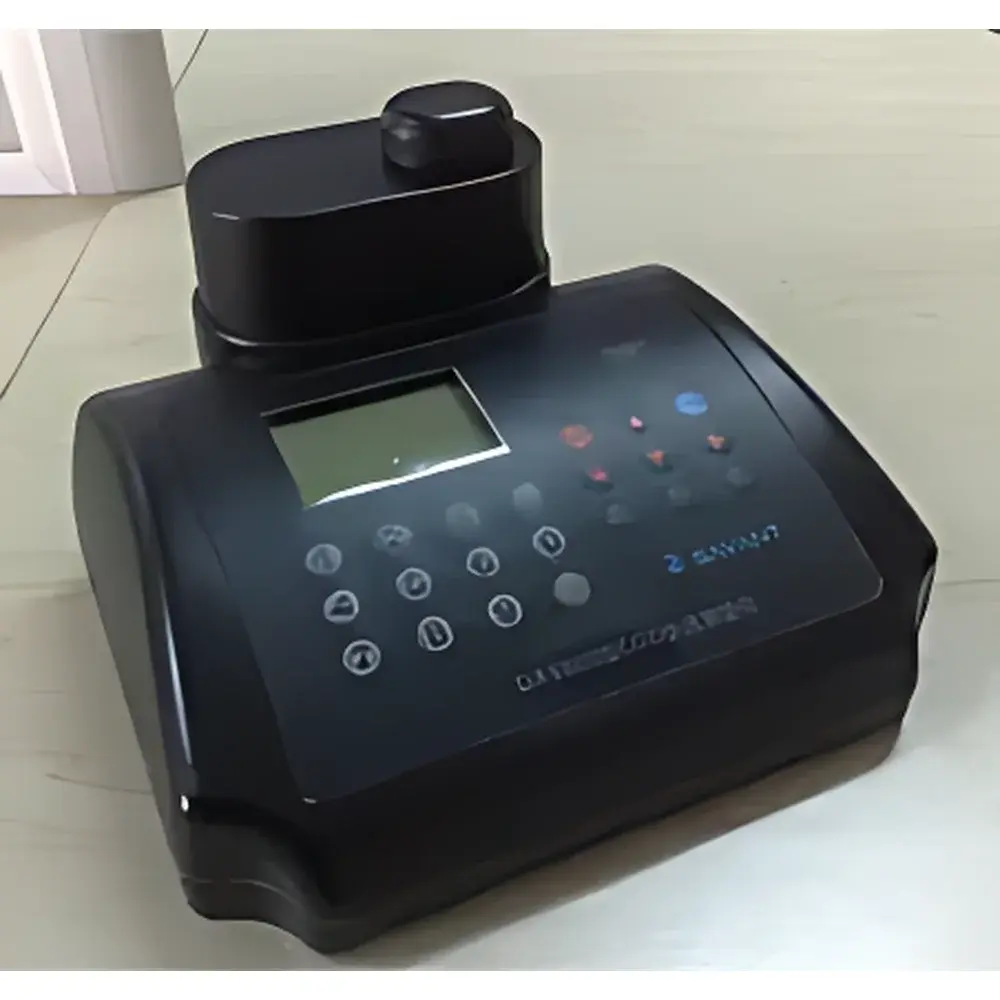
Sipo Environment DR8800 Laboratory-Grade COD Analyzer
| Brand | Sipo Environment |
|---|---|
| Origin | Tianjin, China |
| Model | DR8800 |
| Instrument Type | Benchtop Laboratory Analyzer |
| Detection Principle | Rapid Closed-Vessel Catalytic Digestion Coupled with Dual-Wavelength Photometry (440 nm & 600 nm) |
| Detection Range | 10–250 mg/L (Low Range), 100–2500 mg/L (High Range) |
| LOD | 3 mg/L |
| Accuracy | ±5% (Low Range), ±4% (High Range) |
| Repeatability | RSD ≤2% (5–100 mg/L) |
| Chloride Interference Tolerance | ≤2000 mg/L Cl⁻ |
| Wavelengths | 440 nm (low-range), 600 nm (high-range) |
| Optical Stability | ≤0.001 A/60 min |
| Data Storage | 9999 measurements, 99 calibration curves |
| Power Supply | 220 V AC, 50 Hz |
| Operating Temperature | 5–40 °C |
| Dimensions (DR8800) | Not specified |
| Weight (DR8800) | Not specified |
| Complies With | HJ/T 399–2007 |
Overview
The Sipo Environment DR8800 is a benchtop laboratory-grade Chemical Oxygen Demand (COD) analyzer engineered for precision, reproducibility, and regulatory alignment in environmental water quality laboratories. It implements the rapid closed-vessel catalytic digestion method—standardized under China’s HJ/T 399–2007—and integrates dual-wavelength photometric detection to quantify COD concentration via the reduction of hexavalent chromium (Cr⁶⁺) to trivalent chromium (Cr³⁺) in acidic, high-temperature digests. This principle ensures robustness against matrix variability while maintaining compliance with internationally recognized oxidation-demand measurement frameworks. The system operates on a 220 V AC power supply and is optimized for high-throughput batch analysis of municipal wastewater, industrial effluents, surface water, and treated discharge samples. Its optical architecture features temperature-compensated photodiodes and stabilized light sources, delivering consistent absorbance readings across ambient lab conditions (5–40 °C). The DR8800 is not a field-portable unit; it is expressly designed for controlled laboratory environments where traceability, audit readiness, and method validation are critical operational requirements.
Key Features
- Dual-wavelength photometric detection (440 nm for low-range: 10–250 mg/L COD; 600 nm for high-range: 100–2500 mg/L COD) enables accurate quantification across broad concentration gradients without manual range switching.
- Integrated temperature compensation algorithm corrects for thermal drift in optical path and detector response, improving long-term measurement stability (optical drift ≤0.001 A/60 min).
- Comprehensive data integrity architecture: stores up to 9999 test records with timestamp, sample ID, calibration curve ID, and operator code—supporting GLP-compliant documentation workflows.
- Onboard calibration curve management supports 99 user-defined or preloaded curves, facilitating multi-analyte adaptation (e.g., COD, total phosphorus, nitrate) using shared digestion protocols.
- Designed for interoperability with the Sipo 5B-25 digestion block: accepts standard Φ16 × 100 mm glass digestion tubes and accommodates parallel processing of up to 25 samples per cycle.
- Robust hardware design includes over-temperature protection, auto-shutdown on timer expiration, and EMI-resistant analog signal conditioning for stable operation in shared lab infrastructure.
Sample Compatibility & Compliance
The DR8800 is validated for use with raw and treated wastewater, river and lake water, leachate, and process influents/effluents typical of municipal and industrial treatment facilities. It demonstrates reliable performance in the presence of chloride concentrations up to 2000 mg/L—a key interference in COD determination—without requiring mercury sulfate masking agents, thereby reducing hazardous waste generation. Method validation adheres strictly to HJ/T 399–2007, which aligns with fundamental principles of ISO 6060 (1989) and ASTM D1252–05 (Standard Test Methods for Chemical Oxygen Demand of Water). While not certified to FDA 21 CFR Part 11 out-of-the-box, its audit trail functionality (including immutable timestamps and operator identification) provides foundational support for laboratories implementing electronic record controls under GLP or ISO/IEC 17025 accreditation programs.
Software & Data Management
The DR8800 operates via an embedded firmware interface with a 2-button control panel and LCD display—designed for intuitive navigation and minimal training overhead. All measurement data are stored locally with full metadata: date/time stamp, selected wavelength, applied calibration curve, digest temperature/time, and result uncertainty flags. Data export is supported via USB interface (device-class storage mode), enabling direct transfer to LIMS or spreadsheet applications without proprietary software dependencies. No cloud connectivity or remote access capabilities are included—consistent with secure laboratory network policies. Audit-ready reports can be generated manually by exporting CSV-formatted logs, including raw absorbance values, calculated COD concentrations, and pass/fail indicators relative to user-defined QC limits.
Applications
- Routine compliance monitoring of wastewater discharge permits (e.g., national pollutant discharge standards, local environmental bureau reporting requirements).
- Process control in activated sludge, MBR, and anaerobic digestion systems—enabling real-time feedback on organic loading and biodegradability trends.
- Method comparison studies between dichromate reflux (Standard Methods 5220C) and rapid digestion approaches for method validation and equivalency assessment.
- Supporting total nitrogen (TN) and total phosphorus (TP) analysis when paired with the 5B-25 digester, leveraging shared heating profiles and tube formats for cross-parameter workflow efficiency.
- Educational use in university environmental engineering labs, where standardized, repeatable COD methodology reinforces core principles of redox chemistry and instrumental analysis.
FAQ
Does the DR8800 require external PC software for operation or data export?
No. All functions—including calibration, measurement, data storage, and USB-based file export—are fully self-contained within the instrument firmware.
Can the DR8800 measure samples with chloride concentrations above 2000 mg/L?
Chloride interference exceeds acceptable limits beyond 2000 mg/L Cl⁻; dilution or alternative methods (e.g., mercury-free chloride correction algorithms or titrimetric back-titration) are recommended for highly saline matrices.
Is the 5B-25 digestion block compatible with non-COD applications?
Yes—the 5B-25 supports standardized digestion protocols for total phosphorus (GB 11893–89), total nitrogen (HJ 636–2012), and hexavalent chromium (GB 7467–87), provided appropriate reagents and cooling steps are implemented post-digestion.
What is the warm-up time required before first measurement?
The DR8800 achieves optical and thermal equilibrium within 15 minutes of power-on; no extended stabilization period is needed under normal lab conditions.
How often must calibration curves be verified or renewed?
Per HJ/T 399–2007, calibration verification using certified reference materials (CRMs) is required at least once per analytical batch—or every 20 samples—whenever traceability to national standards is mandated.
Related Products







