
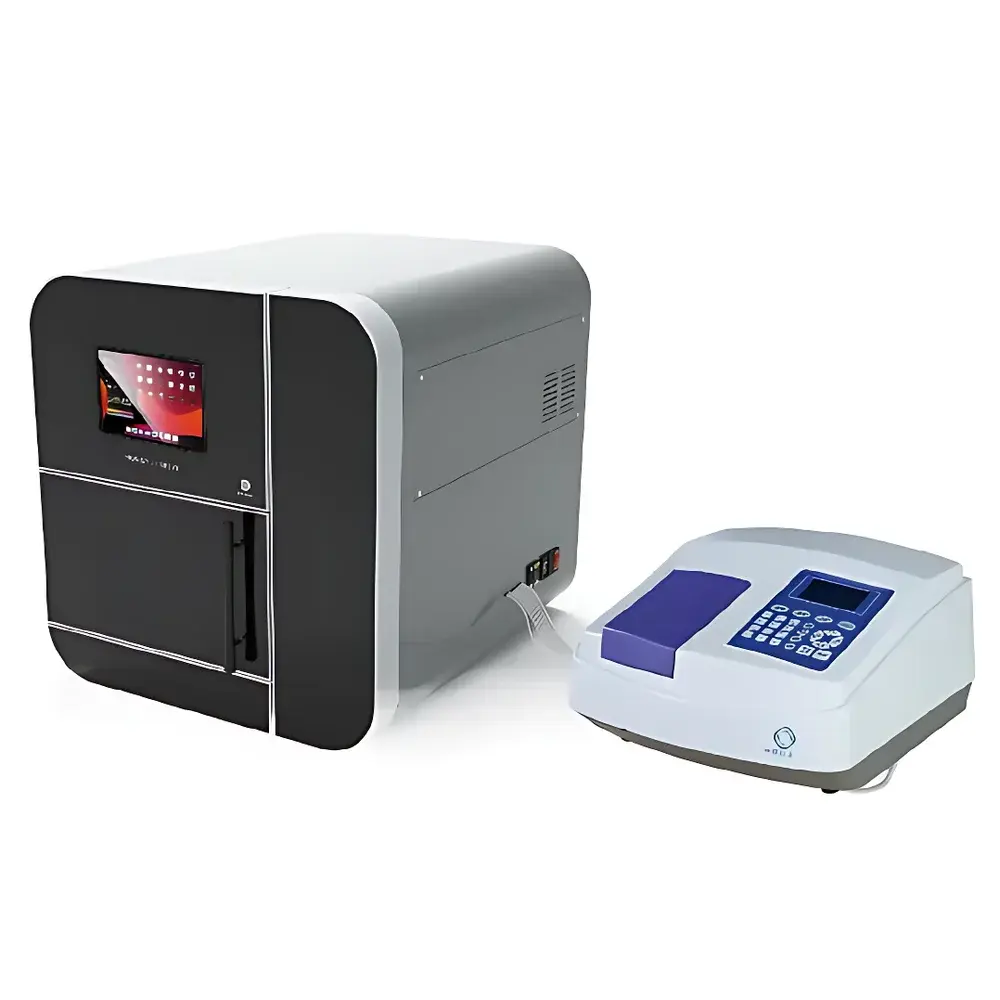
Sipo Environment OILAutoTM-UV-14 Fully Automated UV Spectrophotometric Oil Analyzer
| Brand | Sipo Environment |
|---|---|
| Origin | Tianjin, China |
| Model | OILAutoTM-UV-8/10/12/14 |
| Instrument Type | Laboratory-Based |
| Principle | UV Spectrophotometry (225 nm) |
| Measurement Range | 0–60 mg/L |
| Detection Limit | 0.005 mg per measurement (equivalent to 0.001 mg/L at 1 L sample volume) |
| Accuracy | ±2% of full scale |
| Wavelength Resolution | 1 nm |
| Optical System | Czerny-Turner monochromator with holographic grating |
| Light Sources | Deuterium lamp (190–350 nm), Tungsten lamp (350–1100 nm) |
| Absorbance Range | –0.30 to 3.0 A |
| Spectral Bandwidth | 1.8 nm |
| Wavelength Accuracy | ±1 nm |
| Linearity (R²) | >0.999 |
| Sample Throughput | ≤8 min per sample (including extraction, phase separation, adsorption cleanup, and photometric measurement) |
| Sample Volume | 100–700 mL (user-selectable) |
| Extraction Solvent | HPLC-grade n-hexane (transmittance ≥90% at 225 nm) |
| Sample Capacity | 6–14 positions (configurable sequence, infinite loop mode supported) |
| Separation Method | Three-stage: liquid–liquid extraction → separation tube phase separation → hydrophobic membrane dehydration |
| Adsorbent Cleanup | Automated MgSiO₃ cartridge exchange with reverse-flush regeneration |
| Compliance | HJ 970–2018 “Determination of Petroleum Hydrocarbons in Water by Ultraviolet Spectrophotometry” |
| Software | Windows-compatible (XP and later), FDA 21 CFR Part 11–ready audit trail, GLP/GMP-compliant data handling, report export to PDF/Word/Excel |
Overview
The Sipo Environment OILAutoTM-UV-14 is a fully automated, laboratory-grade UV spectrophotometric oil analyzer engineered for precise, high-throughput quantification of petroleum hydrocarbons in aqueous environmental matrices. It implements the standardized methodology defined in China’s HJ 970–2018, which specifies ultraviolet absorbance measurement at 225 nm following acidified (pH ≤ 2) liquid–liquid extraction with n-hexane and subsequent cleanup using magnesium silicate (MgSiO₃) adsorption. The instrument operates on the fundamental principle of the Lambert–Beer law: petroleum hydrocarbon concentration in the final extract exhibits linear correlation with absorbance at the characteristic 225 nm wavelength. Unlike manual or semi-automated systems, the OILAutoTM-UV-14 integrates all critical steps—sample positioning, reagent dosing, extraction agitation, phase separation, adsorbent column conditioning, solvent filtration, photometric measurement, waste disposal, and system rinsing—into a single unattended workflow. Its architecture is purpose-built for regulatory water quality laboratories requiring trace-level detection (LOD = 0.001 mg/L), metrological traceability, and full compliance with quality management frameworks including ISO/IEC 17025 and EPA-aligned QA/QC protocols.
Key Features
- Triple independent robotic arms—one for sample handling, one for reagent delivery, and one for waste management—enabling concurrent operation across up to three samples without mechanical interference.
- Automated MgSiO₃ cartridge replacement with integrated reverse-flush regeneration, eliminating carryover and ensuring cross-contamination-free analysis between samples.
- Three-stage separation system: optimized liquid–liquid extraction (≥95% efficiency via stirring or gas sparging), gravity-driven phase separation in dedicated separation tubes, and final dehydration using imported hydrophobic PTFE membranes with >90% water rejection.
- High-precision fluidics: imported multi-port rotary valve and syringe pump assembly enabling accurate volumetric delivery (±0.5% RSD) of n-hexane (10–50 mL) and acidified water samples (100–700 mL).
- Self-dilution capability: automatic dilution of over-range extracts (up to 10×) using calibrated diluent loops, extending effective dynamic range while preserving photometric linearity.
- Voice-guided operational feedback and real-time status display enhance operator situational awareness and reduce procedural errors.
- Compact footprint (≤1.2 m width) permits safe integration into standard fume hoods, minimizing operator exposure to n-hexane vapors and fulfilling occupational health and safety requirements (GBZ 2.1–2019).
Sample Compatibility & Compliance
The OILAutoTM-UV-14 is validated for direct analysis of raw, unfiltered water specimens—including surface water, groundwater, drinking water, and seawater—without pre-filtration or homogenization. It accommodates wide-mouth field sampling bottles (up to 1 L), eliminating transfer losses and contamination risks associated with secondary container handling. All analytical procedures strictly adhere to HJ 970–2018, including mandatory pH adjustment (HCl addition to ≤2), controlled extraction time (≥10 min), and spectral verification at 225 nm with bandwidth ≤2 nm. The system supports three pre-installed calibration curves corresponding to certified reference materials issued by the National Marine Environmental Monitoring Center, the Ministry of Ecology and Environment Reference Material Institute, and Tanmo Certified Reference Materials Center—each traceable to national primary standards. Users may also generate custom calibration curves (up to 10 stored profiles) with full metadata logging (date, operator, standard lot number, curve equation, R²). Instrument performance verification includes daily blank checks, continuing calibration verification (CCV), and matrix spike recovery assessments—all documented within the audit trail.
Software & Data Management
The embedded control software (registered copyright, CN2022SR0123456) provides a deterministic, role-based interface compatible with Windows XP through Windows 11. It enforces ALCOA+ data integrity principles: attributable, legible, contemporaneous, original, accurate, complete, consistent, enduring, and available. Every analytical event—including reagent batch IDs, environmental sensor readings (temperature/humidity), optical alignment diagnostics, and raw absorbance spectra—is timestamped and cryptographically hashed. Audit trails are immutable and exportable in CSV format for third-party review. Reporting modules auto-generate compliant output in PDF (with digital signature support), Word (.docx), or Excel (.xlsx), including instrument ID, analyst ID, sample ID, method version, calibration history, QC results, and uncertainty estimation per GUM (Guide to the Expression of Uncertainty in Measurement). Remote access is enabled via secure TLS 1.2–encrypted VNC tunneling, permitting off-site monitoring and intervention without compromising network segmentation policies.
Applications
This analyzer serves as a primary tool in municipal water utilities, environmental monitoring stations, third-party testing laboratories, and industrial effluent compliance units. Typical use cases include routine surveillance of petroleum hydrocarbon discharges from petrochemical facilities, post-spill assessment in coastal zones, baseline characterization of aquifer vulnerability, and regulatory reporting under China’s “Blue Sky and Clear Water Protection Campaign.” Its ability to resolve low-concentration petroleum signals (<0.01 mg/L) with <1% RSD makes it suitable for trend analysis in oligotrophic systems and early-warning detection in source-water protection zones. The system also supports method adaptation studies—for example, comparative evaluation of n-hexane versus alternative solvents (e.g., cyclohexane) under controlled validation protocols aligned with ISO 5667-3.
FAQ
Does the instrument comply with international standards such as ISO 9377-2 or ASTM D7066?
While designed to meet HJ 970–2018—the Chinese national standard equivalent in scope and rigor to ISO 9377-2—the OILAutoTM-UV-14 can be operationally aligned with ISO/ASTM methods via user-defined protocol configuration; formal equivalence certification requires site-specific method validation per ISO/IEC 17025.
Can the system quantify both total petroleum hydrocarbons (TPH) and petroleum-specific fractions separately?
It measures total extractable petroleum hydrocarbons as defined in HJ 970–2018. Differentiation of aliphatic vs. aromatic fractions requires GC-FID or GC-MS; this UV system does not provide speciation capability.
Is remote software update supported?
Yes—firmware and application updates are delivered via authenticated HTTPS package downloads with SHA-256 signature verification; no physical media or onsite technician required.
What maintenance intervals are recommended for the MgSiO₃ cartridges and separation membranes?
Cartridges are replaced automatically after every 20 analyses (configurable); membranes are rated for ≥500 extractions and monitored via real-time pressure differential sensing.
How is photometric accuracy verified during routine operation?
Daily verification uses NIST-traceable neutral density filters (OD 1.0 and 2.0 at 225 nm); wavelength accuracy is confirmed using holmium oxide solution (peaks at 241.1, 279.4, and 360.9 nm).







