
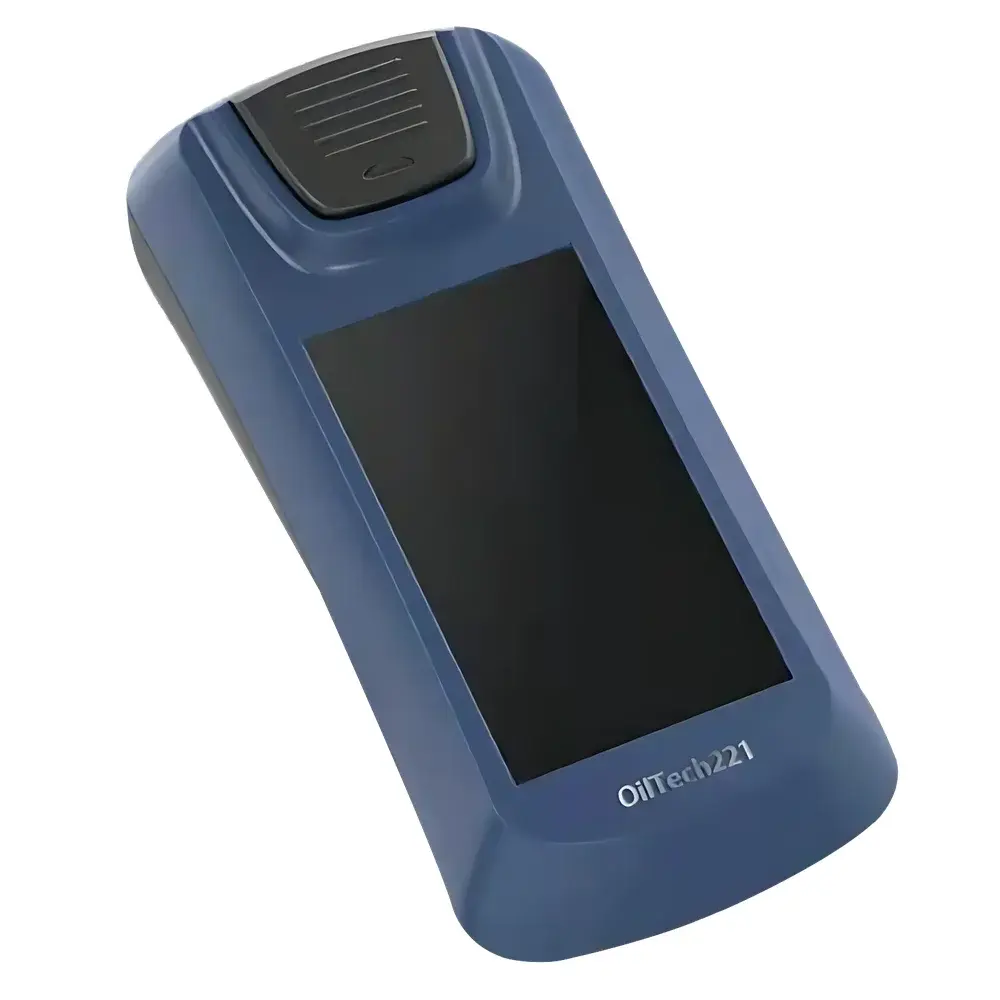
Sipo Environment OilTech221 Portable UV Absorption Oil Content Analyzer
| Brand | Sipo Environment |
|---|---|
| Origin | Tianjin, China |
| Model | OilTech221 |
| Instrument Type | Portable |
| Measurement Principle | UV Absorption Spectrophotometry at 225 nm |
| Measurement Range | 0–60 mg/L |
| Detection Limit | 0.01 mg/L |
| Accuracy | ±2% |
| Resolution | 1 nm |
| Wavelength | Fixed 225 nm monochromatic |
| Light Source | DFB semiconductor laser (225 nm) |
| Detector | MSM photodetector |
| Stray Light | ≤0.1% T |
| Baseline Stability | ±0.002 A/h |
| Calibration Options | Single-point, multi-point (1–6 points), certified reference material-based |
| Preloaded Calibration Curves | ≥10 |
| Extraction Unit | Handheld, 3-speed adjustable |
| Filtration | Disposable magnesium silicate cartridge |
| Power | Dual rechargeable Li-ion batteries, 8 h continuous operation |
| Display | 5.5-inch capacitive touchscreen |
| Data Export | USB interface |
| Compliance | HJ 970–2018 (China) |
Overview
The Sipo Environment OilTech221 Portable UV Absorption Oil Content Analyzer is a field-deployable instrument engineered for rapid, on-site quantification of petroleum hydrocarbons in aqueous matrices. It operates on the principle of ultraviolet absorption spectrophotometry at a fixed, highly selective wavelength of 225 nm — a spectral region where aromatic and olefinic components of petroleum exhibit strong and characteristic absorbance. Unlike infrared-based methods, which are susceptible to interference from surfactants, solvents, and suspended solids, UV absorption at 225 nm delivers superior specificity for total petroleum hydrocarbons (TPH) in clean to moderately turbid water samples. The instrument integrates a distributed feedback (DFB) semiconductor laser as its light source — a compact, thermally stable, and long-lifetime (<8,000 h) alternative to conventional deuterium lamps or LED-based systems. Its optical architecture minimizes stray light (≤0.1% T) and ensures baseline drift of no more than ±0.002 A/h, enabling reliable measurements without warm-up time — a critical advantage during emergency response or remote monitoring campaigns.
Key Features
- Fixed-wavelength DFB laser source at 225 nm: Delivers high spectral purity, exceptional intensity stability, and immunity to lamp aging effects common in broadband UV sources.
- MSM (metal–semiconductor–metal) photodetector: Optimized for low-noise, high-linearity response in the deep-UV range, supporting detection limits down to 0.01 mg/L.
- Integrated handheld extraction unit with three-speed control: Enables efficient liquid–liquid extraction using n-hexane or other approved solvents directly in the field; eliminates need for external vortexers or centrifuges.
- Disposable magnesium silicate cartridges: Provide consistent, operator-independent cleanup of extractants — preventing cross-contamination between samples and reducing maintenance overhead.
- 5.5-inch capacitive touchscreen interface: Supports intuitive navigation, real-time spectrum preview (where applicable), and on-device calibration management.
- Dual internal Li-ion battery system: Rated for 8 hours of continuous operation under typical field conditions; supports hot-swap capability when paired with optional external power bank.
Sample Compatibility & Compliance
The OilTech221 is validated for use with surface water, groundwater, wastewater effluents, and leachate samples per the methodology outlined in HJ 970–2018, the official Chinese standard for determination of petroleum hydrocarbons in water by UV spectrophotometry. While not formally certified to ISO 9562 or ASTM D3921, its optical design and calibration traceability align with foundational principles of UV–Vis quantitative analysis. Sample preparation follows standardized liquid–liquid extraction protocols using n-hexane (or equivalent UV-transparent solvent), followed by silica-magnesium filtration to remove polar interferences. The instrument’s fixed 225 nm configuration avoids wavelength selection errors and ensures method reproducibility across operators and sites — an essential requirement for regulatory field screening and trend monitoring programs.
Software & Data Management
Data acquisition, calibration, and reporting are managed through embedded firmware compliant with GLP-aligned operational constraints. Each measurement record includes timestamp, operator ID (optional), calibration status flag, background-corrected absorbance value, and concentration result derived from either single-point normalization or preloaded multi-point calibration curves (up to 10 stored). Background subtraction is automatically applied using blank solvent scans acquired via the integrated extraction module — eliminating manual offset corrections. Results and raw absorbance data can be exported via USB mass storage mode in CSV format, compatible with LIMS integration and third-party statistical software. Audit trail functionality logs all calibration events, parameter changes, and firmware updates — satisfying basic documentation requirements for environmental QA/QC workflows.
Applications
- Rapid assessment of oil spills and illegal discharge incidents in rivers, lakes, and coastal zones.
- Compliance monitoring at municipal wastewater treatment plant outfalls and industrial pretreatment facilities.
- Groundwater plume delineation during site investigations and remediation verification.
- Field validation of laboratory-generated TPH data prior to sample shipment.
- Teaching and training in environmental chemistry laboratories requiring robust, low-maintenance instrumentation.
FAQ
Does the OilTech221 require routine wavelength calibration?
No. As a fixed-wavelength instrument operating exclusively at 225 nm, it does not require wavelength calibration. Optical alignment and detector linearity are factory-verified and stable over the rated service life.
Can the instrument quantify oil in saline or high-turbidity water?
It is optimized for freshwater and low-salinity matrices. High turbidity (>50 NTU) or salinity (>10 g/L) may require additional filtration or dilution to avoid scattering artifacts; method validation under such conditions is recommended per project-specific QA/QC protocols.
Is the DFB laser replaceable in the field?
The laser module is designed as a sealed, non-user-serviceable component. Replacement requires return-to-factory service and recalibration against NIST-traceable standards.
What solvent is recommended for extraction?
n-Hexane is specified in HJ 970–2018 and is the default solvent used during factory validation. Alternatives such as cyclohexane or isooctane may be employed if validated for equivalence per local regulatory guidance.
How is instrument performance verified between calibrations?
Users may run certified reference materials (CRMs) traceable to national metrology institutes. The instrument supports CRM-based verification mode, logging recovery rates and flagging deviations exceeding ±5% from certified values.
Related Products







