
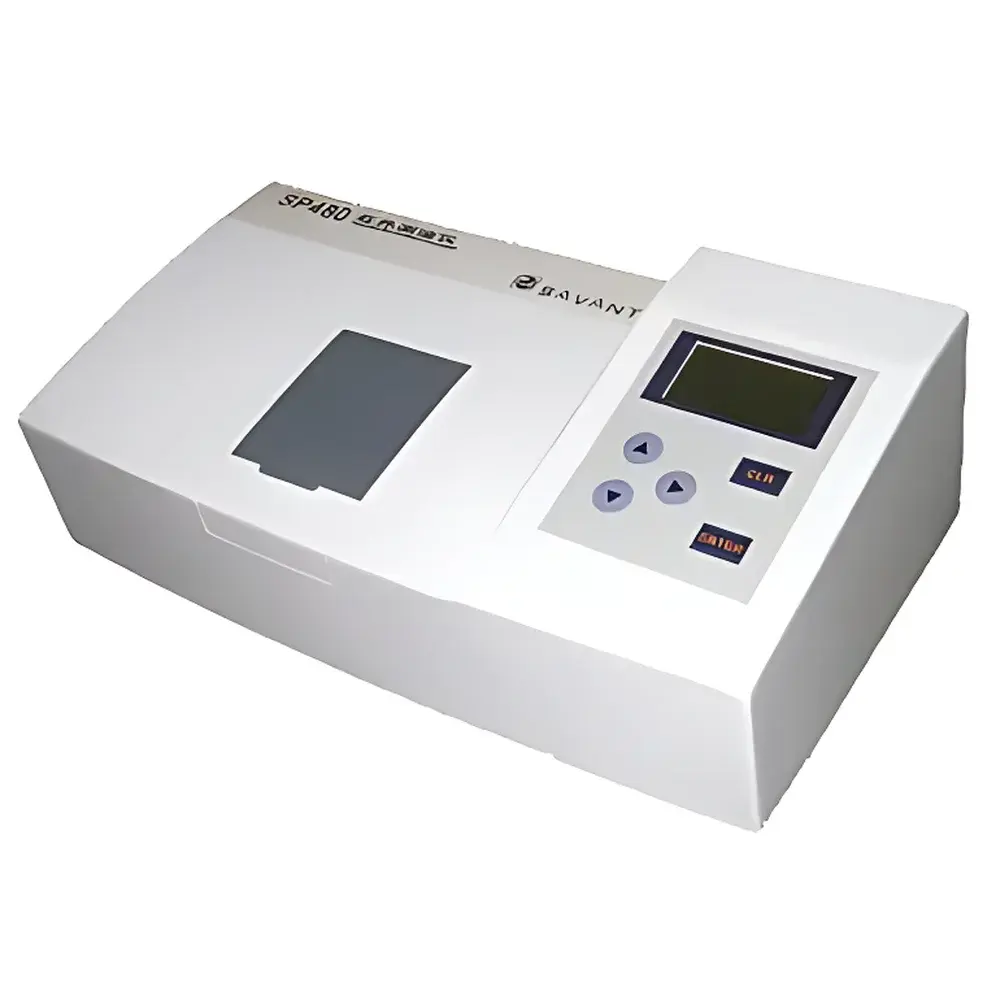
Sipo Environment SP480 Infrared Spectrophotometric Oil Content Analyzer
| Brand | Sipo Environment |
|---|---|
| Origin | Tianjin, China |
| Model | SP480 |
| Instrument Type | Laboratory Benchtop Analyzer |
| Measurement Principle | Infrared Absorption Spectrophotometry (Triple-Wavenumber Method) |
| Wavenumber Range | 3400–2400 cm⁻¹ |
| Wavenumber Accuracy | ±1 cm⁻¹ |
| Wavenumber Repeatability | <±1 cm⁻¹ |
| Baseline Drift | ≤0.005 AU/60 min |
| Absorbance Range | 0.0000–2.0000 AU |
| Transmittance Accuracy | ±0.5% T |
| Linearity Correlation Coefficient | r > 0.999 |
| Measurement Accuracy | <±5% (5–80 mg/L, 4-cm cell) |
| Repeatability (RSD) | <2% (5–80 mg/L, 4-cm cell) |
| Detection Limit | 0.2 mg (absolute, 4-cm cell, standard oil) |
| Minimum Detectable Concentration | 0.002 mg/L (4-cm cell, 100× extraction enrichment) |
| Maximum Measurable Concentration | 64,000 mg/L (0.5-cm cell, 100× dilution) |
| Scan Time | 30 s (full spectrum), <2 s (non-dispersive mode) |
| Zero Stability | ±0.5 AU/60 min |
| Power Supply | AC 220 V ±10 V, 50/60 Hz, 70 W |
| Operating Environment | 0–35 °C, 10–90% RH |
| Dimensions | 450 × 240 × 100 mm |
| Weight | 10 kg |
| Compliance | GB/T 16488–1996, GB 18483–2001 |
Overview
The Sipo Environment SP480 Infrared Spectrophotometric Oil Content Analyzer is a dedicated laboratory instrument engineered for quantitative determination of petroleum hydrocarbons and non-polar organic compounds—including animal and vegetable oils—in aqueous matrices and gaseous effluents. It operates on the principle of infrared absorption spectrophotometry, specifically utilizing the triple-wavenumber method defined in GB/T 16488–1996. The analyzer measures absorbance at three characteristic wavenumbers: 2930 cm⁻¹ (asymmetric C–H stretch in –CH₂– groups), 2960 cm⁻¹ (asymmetric C–H stretch in –CH₃ groups), and 3030 cm⁻¹ (aromatic C–H stretch). These spectral bands enable selective quantification of total extractable material (TEM), petroleum hydrocarbons (PHC), and the difference—representing biogenic oils—without chromatographic separation. Sample preparation follows standardized liquid-liquid extraction using carbon tetrachloride (CCl₄), followed by silica-magnesium adsorption to isolate non-polar hydrocarbon fractions. The SP480 integrates a high-throughput optical path with fixed-beam alignment, minimizing thermal drift and ensuring reproducible photometric performance across extended operational cycles.
Key Features
- Triple-wavenumber infrared measurement engine compliant with GB/T 16488–1996 and GB 18483–2001 for regulatory reporting
- Four interchangeable quartz cuvette options (0.5 cm, 1 cm, 2 cm, 4 cm) enabling dynamic range adaptation from 0.002 mg/L to 64,000 mg/L
- Integrated baseline correction optics with automatic zero-point stabilization (<±0.5 AU/60 min)
- High optical throughput design featuring monolithic beam path architecture and low-noise detector electronics
- Standalone operation capability: real-time three-point calibration, wavenumber validation, and concentration calculation without PC dependency
- Embedded LCD interface with full Chinese menu navigation; supports direct display of TEM, PHC, and biogenic oil concentrations
- Non-dispersive analysis mode for rapid screening (<2 s per sample); full-spectrum scanning mode (30 s) for spectral verification and method development
- User-configurable calibration coefficient adjustment to accommodate matrix-specific recovery corrections
Sample Compatibility & Compliance
The SP480 is validated for use with water samples—including surface water, groundwater, domestic wastewater, and industrial effluents—as well as airborne particulates collected on filters (e.g., cooking fume monitoring per GB 18483–2001). It supports analysis of benzene-series compounds in exhaust gas when coupled with appropriate sorbent tube desorption protocols. All measurement procedures align with national standard methodologies requiring CCl₄ extraction and silica-magnesium purification. While not certified to ISO/IEC 17025 or ASTM D7066, the instrument’s metrological specifications—including wavenumber accuracy (±1 cm⁻¹), linearity (r > 0.999), and repeatability (RSD < 2%)—meet analytical rigor thresholds required for environmental compliance testing under Chinese regulatory frameworks. Data integrity is maintained through internal audit logging of calibration events, operator ID entry, and timestamped measurement records.
Software & Data Management
A Windows-compatible desktop application enables advanced spectral visualization, batch processing, and report generation. The software supports raw absorbance export (CSV), calibration curve management, and multi-point standard addition workflows. All measurement data are stored with embedded metadata: date/time stamp, cuvette pathlength, operator ID, and calibration status. Audit trails record parameter modifications, zero/baseline resets, and calibration coefficient updates—supporting GLP-aligned documentation practices. Though not FDA 21 CFR Part 11-compliant out-of-the-box, the system permits manual export of traceable, time-stamped reports suitable for internal QA review and regulatory submission where electronic signature requirements are not mandated.
Applications
- Quantitative determination of petroleum hydrocarbons in municipal and industrial wastewater discharge monitoring
- Compliance assessment of cooking oil fume emissions from food service establishments (GB 18483–2001)
- Environmental site assessment of soil leachate and groundwater contamination plumes
- Process control in petrochemical, metalworking fluid, and textile dyeing facilities
- Research-grade characterization of biodegradation kinetics for hydrocarbon-contaminated media
- Method validation studies supporting ISO 9377-2 (petroleum hydrocarbons in water) and EPA Method 1664A (n-hexane extractable material)
FAQ
What extraction solvent is required for SP480 operation?
Carbon tetrachloride (CCl₄) is specified per GB/T 16488–1996. Alternative solvents such as hexane or Freon-113 are not supported due to spectral interference outside the 2400–3400 cm⁻¹ measurement window.
Can the SP480 distinguish between diesel, gasoline, and lubricating oil fractions?
No. It quantifies total petroleum hydrocarbons based on aliphatic and aromatic C–H absorption signatures. Compound-class resolution requires GC-MS or FTIR library matching, which is outside the scope of this dedicated photometric analyzer.
Is routine maintenance limited to optical cleaning and calibration verification?
Yes. No consumable optical components (e.g., gratings, filters) require replacement. Annual verification of wavenumber accuracy and absorbance linearity using NIST-traceable standards is recommended for sustained regulatory acceptability.
Does the instrument support automated sample handling?
No. The SP480 is a manual-load benchtop system. It does not integrate with autosamplers or robotic liquid handlers.
How is method validation documented for regulatory audits?
The embedded software generates PDF reports containing calibration curves, sample IDs, pathlength settings, measured absorbances (A2930, A2960, A3030), calculated concentrations, and operator-entered notes—sufficient for internal QA and provincial-level environmental authority reviews.
Related Products







