
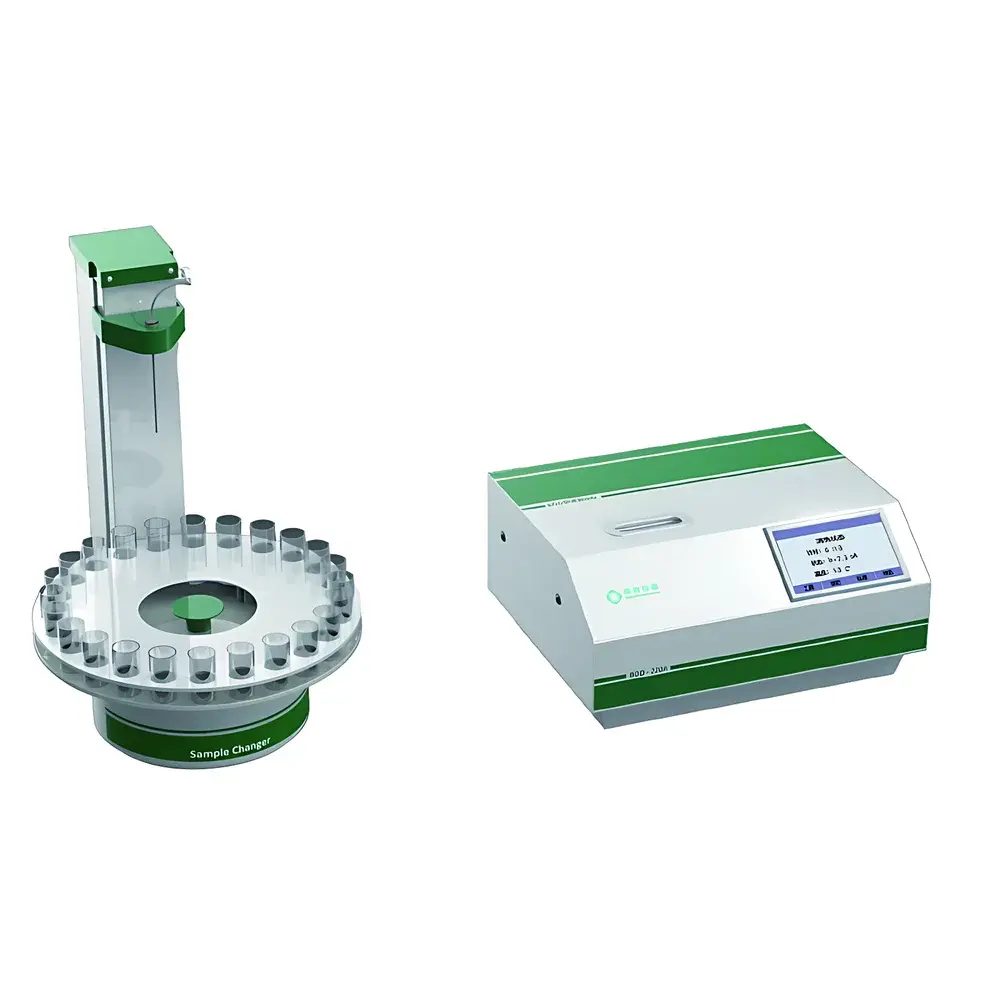
Sipo Environment SPN-BOD-220A Microbial Electrode-Based BOD Analyzer
| Brand | Sipo Environment |
|---|---|
| Origin | Tianjin, China |
| Manufacturer Type | Authorized Distributor |
| Product Category | Domestic |
| Model | SPN-BOD-220A |
| Instrument Type | Laboratory BOD Analyzer |
| Measurement Principle | Microbial Electrode Method |
| Measurement Range | 2–4000 mg/L |
| Detection Limit | 0.5 mg/L |
| Accuracy | ±1 mg/L |
| Single-Sample Analysis Time | 8 min |
| Repeatability | ≤3% |
| Power Supply | AC 220 V ±10%, 50 Hz |
| Operating Temperature | 10–35 °C |
| Humidity Range | 30–85% RH (non-condensing) |
| Dimensions (W×D×H) | 420 × 380 × 260 mm |
| Weight | 12.5 kg |
Overview
The Sipo Environment SPN-BOD-220A is a laboratory-grade biochemical oxygen demand (BOD) analyzer engineered for rapid, reliable quantification of biodegradable organic load in surface water, wastewater effluents, and drinking water sources. Unlike conventional 5-day BOD5 methods governed by ISO 5815-1:2019 and ASTM D5210–19, the SPN-BOD-220A employs a dual-sensor microbial electrode system grounded in electrochemical detection of oxygen consumption by immobilized, metabolically active microorganisms. This principle enables real-time monitoring of respiratory activity under controlled, standardized conditions—delivering results in just 8 minutes while maintaining traceable correlation to reference BOD5 values.
A core innovation lies in its patented dissolved oxygen (DO) compensation architecture (Patent No. CN201910069593.X). Conventional microbial electrode analyzers assume DO equilibrium between sample and buffer, introducing systematic negative bias when analyzing supersaturated surface waters—particularly problematic during winter sampling. The SPN-BOD-220A integrates a flow-through DO sensor upstream of the microbial electrode, enabling simultaneous measurement of absolute DO concentration and ΔDO (sample-to-buffer differential). These two parameters serve as independent variables in a validated correction function: BODcorr = F(DO) + F(ΔDO) + BODraw. Empirical validation across >1,200 field-collected surface water samples demonstrates <5% mean deviation from standard BOD5 results per ISO 5815-1, resolving long-standing accuracy limitations for low-concentration (<20 mg/L) environmental matrices.
Key Features
- Dual-electrode architecture with integrated flow-through DO sensor for real-time, algorithmic compensation of oxygen saturation artifacts
- Patented solid-state conductive hydrogel electrolyte (Patent ZL201420278587.8), eliminating liquid KCl leakage and extending sensor lifetime beyond 18 months under routine use
- Optimized BOD-specific microbial consortium: high-throughput screened strains with enhanced cold tolerance, toxicity resistance, and reproducible biofilm formation; rehydration viability ≥98%
- Automated 24-position sampler with servo-motor-driven optical encoder positioning—ensuring zero sample omission and positional repeatability ±0.05 mm
- Mass-flow-controlled aeration system with real-time gas flow monitoring (±1% FS) and dynamic alarm thresholding for inlet pressure or flow deviations
- 7-inch capacitive touchscreen HMI with embedded 32-bit flash microcontroller—enabling fully standalone operation without PC connectivity
- Modular firmware architecture compliant with FDA 21 CFR Part 11 requirements for electronic records and signatures (audit trail enabled)
Sample Compatibility & Compliance
The SPN-BOD-220A is validated for aqueous matrices including raw and treated surface water, groundwater, municipal and industrial wastewater, and potable water. It meets analytical performance criteria outlined in ISO 5815-1:2019 (Water quality — Determination of biochemical oxygen demand after n days — Part 1: BOD5), EPA Method 405.1 (Biochemical Oxygen Demand), and Chinese Standard HJ 505-2009. Sample pretreatment follows GLP-aligned protocols: filtration through 0.45 µm membrane filters (non-sterile), no dilution required for samples within 2–4000 mg/L range, and temperature equilibration to 20 ±1 °C prior to analysis. The instrument’s automated calibration routine supports daily verification using certified glucose-glutamic acid (GGA) standards traceable to NIST SRM 1001.
Software & Data Management
The embedded operating system and Windows-compatible upper-level software (compatible with Windows 7–10, 64-bit) support full method configuration, sequence programming, data export (CSV, PDF, XML), and LIMS integration via HL7 v2.5 or ASTM E1394-compliant interfaces. All measurement events—including sensor diagnostics, calibration logs, user actions, and alarm triggers—are timestamped and stored with immutable audit trails meeting GLP/GMP documentation requirements. Software features include customizable pass/fail thresholds, automatic outlier flagging based on ICH Q2(R2)-aligned robustness criteria, and batch-level statistical summaries (mean, SD, CV%, recovery %). Data encryption complies with AES-256 standards; local storage retains ≥10,000 test records with auto-archiving options.
Applications
- Routine compliance monitoring of surface water bodies under EU Water Framework Directive (2000/60/EC) and China’s “Blue Sky & Clear Water” Action Plan
- Wastewater treatment plant (WWTP) influent/effluent BOD tracking for process optimization and discharge reporting
- Environmental impact assessment (EIA) studies requiring high-temporal-resolution BOD profiling
- Drinking water source surveillance for early detection of organic contamination events
- Research laboratories conducting biodegradability screening of novel chemical compounds per OECD 301 series guidelines
- Academic teaching labs demonstrating kinetic respiration principles and sensor-based environmental analytics
FAQ
How does the SPN-BOD-220A achieve correlation with 5-day BOD5 despite its 8-minute measurement cycle?
The instrument correlates via empirically derived, matrix-specific correction functions—not extrapolation. Its dual-sensor architecture measures actual microbial oxygen uptake kinetics under standardized temperature, nutrient, and flow conditions, then applies DO-compensated regression models trained against >3,500 paired BOD5/instrument datasets.
Is the microbial sensor reusable, and what is its expected service life?
Yes—the immobilized biofilm is designed for ≥200 analyses per sensor cartridge. With proper storage (4 °C, hydrated), functional lifespan exceeds 18 months. Solid-state hydrogel eliminates electrolyte evaporation and cross-contamination risks inherent in liquid-filled electrodes.
Does the system support unattended overnight operation?
Yes. The 24-position autosampler, combined with programmable start times and automatic shutdown, enables fully autonomous batch processing. System health monitoring includes low-reagent alerts, flow obstruction detection, and temperature drift compensation.
Can raw, unfiltered water be analyzed directly?
No. Per ISO 5815-1:2019, particulate matter must be removed via 0.45 µm membrane filtration prior to injection to prevent biofilm fouling and flow-path clogging. Turbid samples require additional centrifugation if suspended solids exceed 50 mg/L.
What regulatory documentation is provided for audit readiness?
Each unit ships with Factory Acceptance Test (FAT) report, IQ/OQ documentation templates aligned with ISO/IEC 17025, electronic calibration certificates traceable to national standards, and full 21 CFR Part 11 compliance package including digital signature implementation guide and audit log specifications.







