
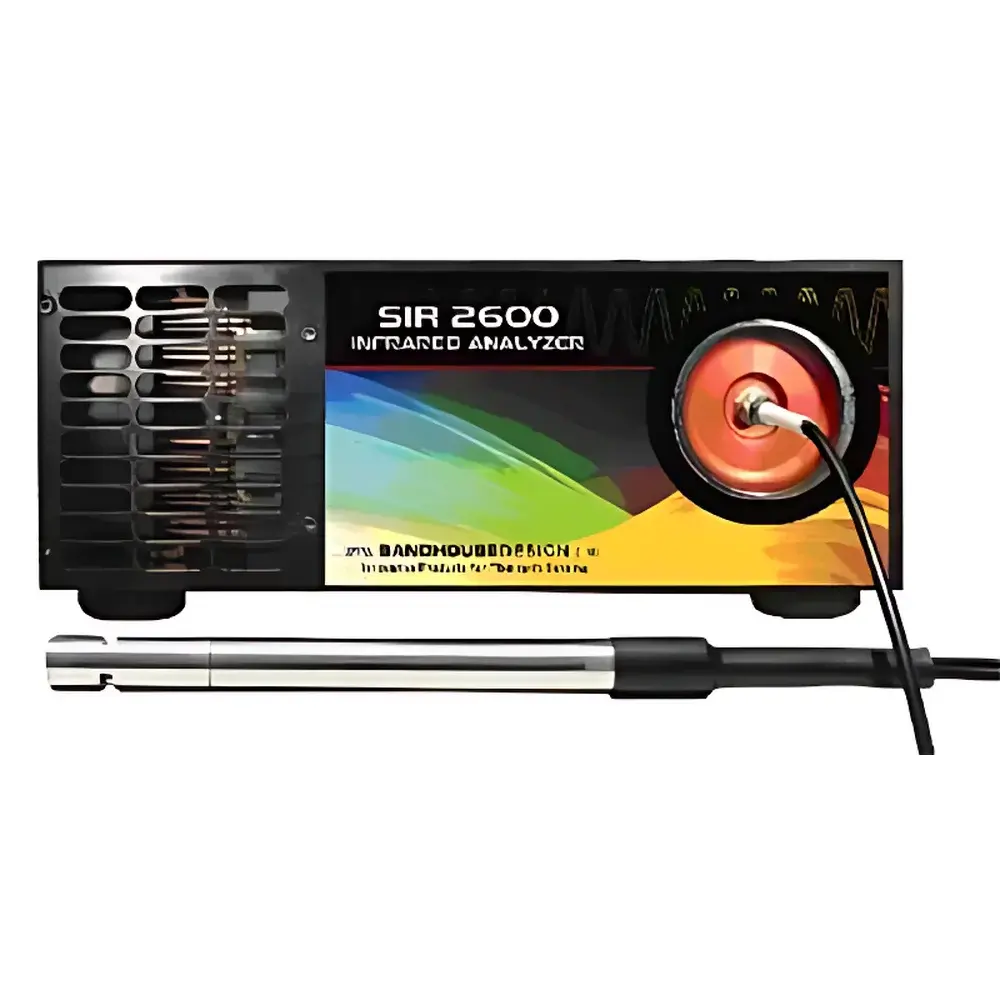
SIR Series Scanning Infrared Spectrometer
| Origin | USA |
|---|---|
| Manufacturer Type | Authorized Distributor |
| Origin Category | Imported |
| Model | SIR |
| Pricing | Available Upon Request |
| Wavelength Ranges | SIR-1700: 400–1700 nm |
| SIR-2600 | 0.9–2.6 µm |
| SIR-3400 | 1–3.4 µm |
| SIR-5000 | 2–5 µm |
| SIR-6500 | 3.0–6.5 µm |
| Interface | USB 2.0 |
| Software | Integrated control and spectral analysis suite |
Overview
The SIR Series Scanning Infrared Spectrometer is a robust, fiber-coupled analytical platform engineered for high-fidelity spectral acquisition across ultraviolet–visible–near-infrared (UV-VIS-NIR) and mid-infrared (MIR) spectral regions. Unlike array-based spectrometers, the SIR employs a precision mechanical scanning monochromator architecture—featuring a calibrated diffraction grating and synchronized detector motion—to deliver inherently high wavelength accuracy and exceptional signal-to-noise ratio (SNR) in sequential wavelength acquisition. This design eliminates pixel-to-pixel non-uniformity and fixed-pattern noise associated with CCD/CMOS detectors, making it especially suitable for quantitative applications requiring long-term stability and inter-instrument reproducibility. The system is optimized for integration into process analytical technology (PAT) workflows, laboratory-based method development, and research-grade spectroscopic characterization where trace-level spectral fidelity and thermal/mechanical drift resistance are critical.
Key Features
- Fiber-optic input interface compatible with standard SMA 905 connectors, enabling flexible probe coupling for remote or in-situ measurements (e.g., reaction vessels, flow cells, or hazardous environments).
- Thermally stabilized optical bench with low-expansion alloy housing, minimizing wavelength drift (<0.02 nm/°C typical) during extended acquisitions or ambient temperature fluctuations.
- High-efficiency holographic gratings with blaze optimization per model range—ensuring >65% diffraction efficiency across specified bands and reducing stray light to <0.05% at ±10 nm from peak.
- USB 2.0 high-speed interface supporting up to 100 spectra/sec (depending on resolution and integration time), with hardware-level trigger synchronization for time-resolved or pump-probe experiments.
- Detectors selected per spectral band: back-thinned Si CCD for SIR-1700; InGaAs photodiode arrays (TE-cooled) for SIR-2600 and SIR-3400; extended-range InSb for SIR-5000; and HgCdTe (MCT) cooled to 77 K for SIR-6500, ensuring optimal detectivity and dynamic range (up to 10⁵:1).
- Modular firmware architecture supporting user-defined scan protocols—including step-scan, continuous sweep, and multi-segment ramping—with real-time intensity normalization and dark-current subtraction.
Sample Compatibility & Compliance
The SIR series supports transmission, reflectance (specular/diffuse), and attenuated total reflectance (ATR) configurations via interchangeable optical accessories. Sample interfaces include liquid cuvette holders (1–10 mm pathlength), solid-sample stages with adjustable angle mounts, and gas-phase cells with sealed CaF₂ or BaF₂ windows (for UV–NIR models) or KBr/ZnSe windows (for MIR models). All systems comply with IEC 61000-6-3 (EMC emission standards) and IEC 61010-1 (safety requirements for electrical equipment for measurement). Data integrity features—including electronic audit trails, user access levels, and timestamped metadata embedding—support alignment with FDA 21 CFR Part 11, EU Annex 11, and GLP/GMP documentation requirements when used in regulated QC/QA environments.
Software & Data Management
The included SpectraControl Suite is a native Windows application built on a modular .NET framework, providing full instrument control, real-time spectral visualization, and advanced post-processing capabilities. It supports ASTM E1421-compliant spectral calibration (NIST-traceable reference standards), baseline correction (asymmetric least squares), peak deconvolution (Gaussian/Lorentzian fitting), and multivariate analysis (PCA, PLS regression). Raw data is saved in HDF5 format with embedded metadata (wavelength axis, integration time, detector temperature, calibration coefficients), ensuring FAIR (Findable, Accessible, Interoperable, Reusable) data principles. Export options include CSV, JCAMP-DX, and MATLAB-compatible MAT files. Remote operation via TCP/IP API enables integration into LabVIEW, Python (PyVISA), or SCADA systems for automated batch monitoring.
Applications
- Quantitative analysis of polymer composition and degradation kinetics using characteristic C–H, O–H, and C=O absorption bands in the 2.5–6.5 µm region.
- In-line monitoring of pharmaceutical crystallization processes via NIR (SIR-1700/SIR-2600) to track polymorphic transitions and solvent content in real time.
- Environmental water quality assessment through rapid detection of nitrate, phosphate, and organic contaminants using UV-VIS-NIR absorbance fingerprints.
- Materials science research involving thin-film thickness determination (via interference fringe analysis) and semiconductor bandgap evaluation (Tauc plot derivation).
- Forensic pigment identification and art conservation studies leveraging high-resolution reflectance spectroscopy from 400–1700 nm.
FAQ
What spectral resolution can be achieved with the SIR series?
Resolution is configurable via slit width selection and grating density; typical FWHM values range from 0.5 nm (SIR-1700, 10 µm slit) to 8 cm⁻¹ (SIR-6500, 4 cm⁻¹ nominal with 50 µm slit).
Is the system compatible with third-party chemometric software?
Yes—exported spectra retain full wavelength-intensity fidelity and metadata, enabling direct import into Unscrambler, Pirouette, or open-source tools such as scikit-learn and R chemometrics packages.
Can the SIR operate in vacuum or inert gas environments?
The optical head is hermetically sealed and rated IP54; optional purge ports allow continuous N₂ purging for moisture-sensitive MIR measurements, though full vacuum operation requires custom flange adaptation.
How is wavelength calibration maintained over time?
Each unit ships with factory-applied polynomial calibration using Hg/Ne/Ar spectral lines; users may perform field recalibration using optional NIST-traceable LED or laser line sources integrated into the software workflow.




