
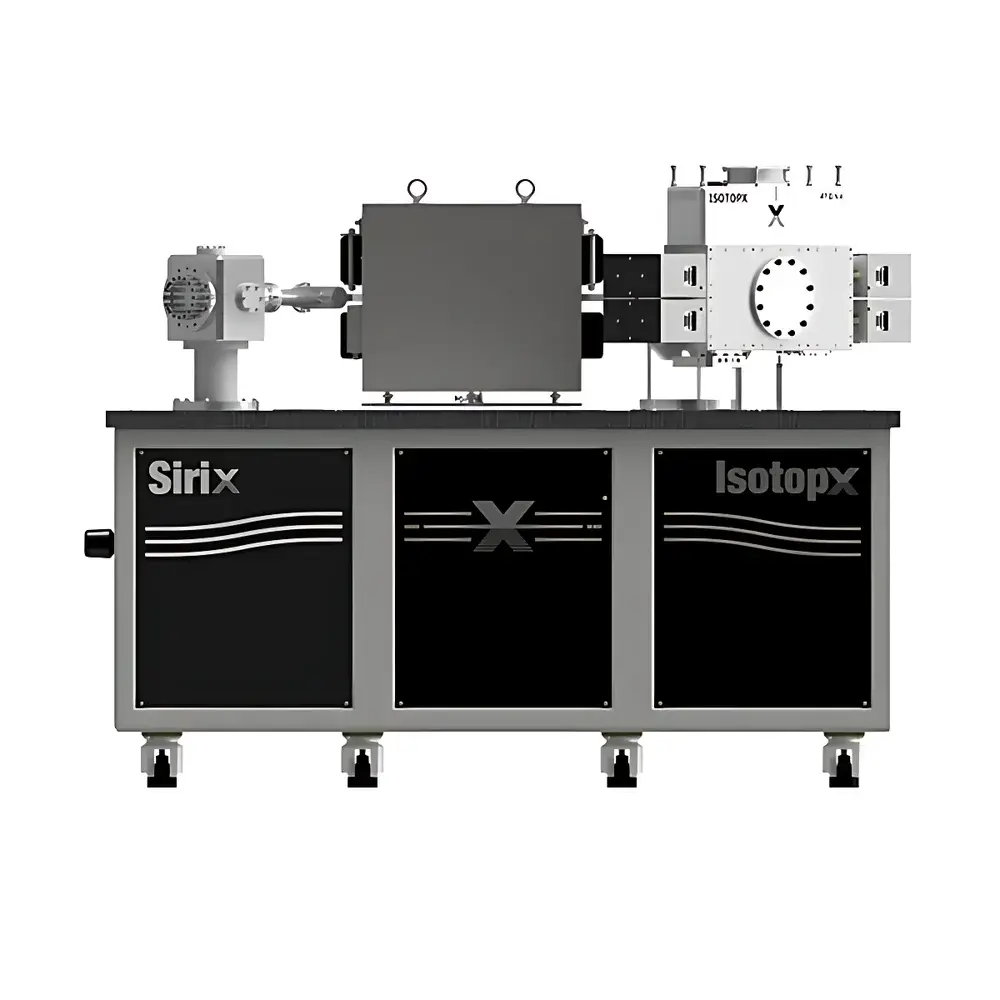
SIRIX High-Resolution Stable Isotope Ratio Mass Spectrometer
| Brand | ISOTOPX |
|---|---|
| Origin | United Kingdom |
| Model | SIRIX |
| Instrument Type | Stable Gas Isotope Ratio Mass Spectrometer |
| Resolution | >500 (10% valley) |
| Mass Resolving Power (MRP) | >5000 |
| Faraday Current Range | 1×10⁻⁷ A to <1×10⁻¹⁷ A |
| δ¹³C Precision for 48CO₂/44CO₂ | <10 ppm in 100 min |
| ATONA® Amplifier Drift | <1 ppm over 40 h |
| Background Noise | Extremely low |
| Ion Optics | 27 cm radius, 90° magnetic sector |
| Flight Tube | Large-diameter, reflection-free design |
| Detector Configuration | Up to 9 independently driven Faraday cups |
Overview
The SIRIX High-Resolution Stable Isotope Ratio Mass Spectrometer is a purpose-built magnetic sector instrument engineered for ultra-precise measurement of stable isotope ratios in gaseous samples—particularly CO₂, N₂O, CH₄, SO₂, and O₂. Operating on the principle of magnetic sector mass separation, the SIRIX leverages high-mass-resolving power (>5000 MRP) and exceptional signal stability to resolve isotopologues with minimal peak overlap and negligible background interference. Its core architecture integrates a 27 cm radius, 90° magnetic sector with a large-diameter flight tube designed to eliminate ion reflection artifacts—critical for achieving baseline separation of adjacent masses such as 44CO₂, 45CO₂, 46CO₂, 47CO₂, 48CO₂, and 49CO₂. This capability makes the SIRIX uniquely suited for clumped isotope analysis (e.g., Δ47, Δ48, Δ49) where accurate quantification of multiply substituted isotopologues demands both high mass resolution and long-term signal reproducibility.
Key Features
- Up to nine independently driven Faraday cup detectors, enabling simultaneous acquisition of multiple isotopic masses without scanning—essential for minimizing time-dependent instrumental drift during multi-cycle measurements.
- ATONA® (Advanced Transimpedance Operational Amplifier) technology delivering sub-picoamp current sensitivity (1×10⁻¹⁷ A) with <1 ppm drift over 40-hour continuous operation and ultra-low electronic noise floor.
- Mass resolution exceeding 500 (10% valley definition), validated across the m/z 44–49 range, ensuring complete deconvolution of hydrocarbon and oxide interferences from target CO₂ isotopologues.
- Optimized ion optics path with minimized scattering surfaces and differential pumping stages, reducing memory effects and enhancing signal-to-noise ratio for trace-level isotopic species.
- Robust vacuum architecture featuring dual-stage turbomolecular pumping and cryo-trapped foreline, maintaining base pressure <5×10⁻¹⁰ mbar during extended analytical sessions.
Sample Compatibility & Compliance
The SIRIX interfaces seamlessly with standard dual-inlet and continuous-flow preparation systems—including GasBench II, Kiel IV, and custom-built carbonate digestion lines—for automated, high-throughput analysis of CO₂ derived from carbonates, organic matter, and fluid inclusions. It meets the stringent requirements of geochemical reference material intercomparisons (e.g., IAEA-603, NBS-19, ETH-1, ETH-2) and supports full traceability under ISO/IEC 17025:2017 accreditation frameworks. While not FDA- or CLIA-regulated, its data integrity features—including hardware timestamping, audit-log-enabled detector configuration changes, and non-erasable raw signal archives—align with GLP-compliant laboratory practices for environmental and earth science applications.
Software & Data Management
Controlled via ISOTOPX’s proprietary SIRIX Control Suite, the system provides real-time mass calibration, automatic peak centering, and dynamic gain adjustment across all Faraday cups. Raw ion beam intensities are recorded at 10 Hz with 24-bit ADC resolution and stored in vendor-neutral HDF5 format. Post-acquisition processing includes offline baseline correction, mass-dependent fractionation normalization (using internal or external standards), and Δ-value calculation per the Brand et al. (2010) and Daëron et al. (2016) conventions. All processing scripts are exportable and version-controlled, supporting reproducible workflows compliant with FAIR (Findable, Accessible, Interoperable, Reusable) data principles.
Applications
- Clumped isotope thermometry (Δ47, Δ48) in carbonate minerals for paleotemperature reconstruction in marine sediments, speleothems, and fossil shells.
- Triple-oxygen isotope systematics (¹⁷O excess) in atmospheric CO₂ and sulfate aerosols for tracing stratospheric-tropospheric exchange and photochemical pathways.
- High-precision δ¹³C and δ¹⁸O analysis of biogenic methane sources (wetlands, ruminants, landfills) and anthropogenic emissions (fugitive natural gas).
- Multi-isotope fingerprinting of volcanic CO₂ and hydrothermal fluids to constrain mantle degassing and crustal contamination processes.
- Method development for novel clumping systems (e.g., Δ53Cr, Δ56Fe) requiring sub-ppm precision in low-abundance isotopic combinations.
FAQ
What sample introduction methods are compatible with the SIRIX?
The SIRIX is optimized for dual-inlet and continuous-flow configurations. It accepts standard 6-mm glass capillaries and integrates with common CO₂ purification lines, cryofocusing traps, and laser fluorination accessories for solid samples.
Does the SIRIX support automated data reduction for Δ47?
Yes—the SIRIX Control Suite includes built-in Δ47 calculation modules aligned with the latest community standards (e.g., I-CDES, U-CDES), including acid fractionation correction, temperature-dependent calibration, and uncertainty propagation.
Is remote monitoring and diagnostics supported?
Remote access is enabled via secure SSH tunneling and VNC-based GUI sharing, allowing instrument health checks, method validation, and troubleshooting without physical presence.
How is mass calibration maintained during long-term operation?
The system performs automated daily mass calibration using a reference gas (e.g., pure CO₂ or SF₆), with optional lock-mass correction using a dedicated reference ion beam for sub-ppm mass stability.
Can the SIRIX be upgraded to accommodate new isotopic systems beyond carbon and oxygen?
Yes—its modular detector array and configurable ion optics permit reconfiguration for sulfur, nitrogen, chlorine, and transition metal isotope systems, subject to source compatibility and vacuum performance validation.




