
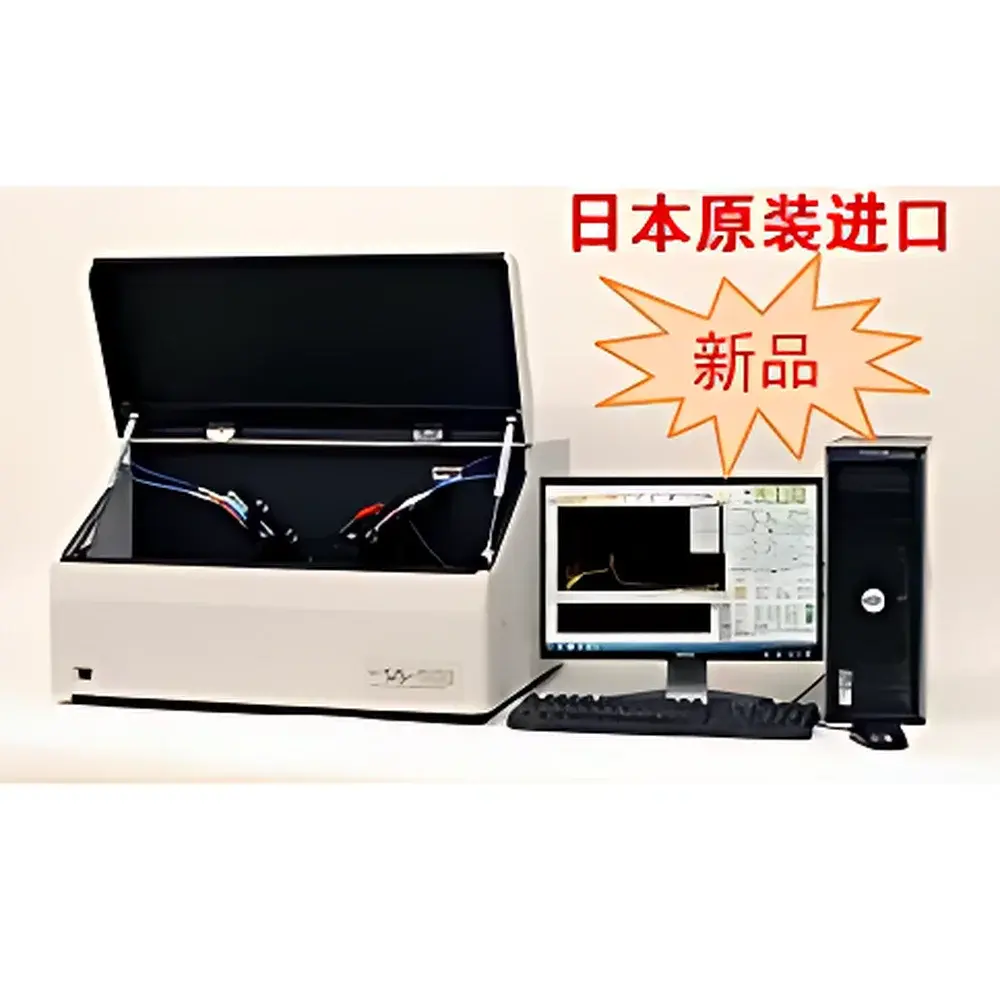
SIS-5100 Waveguide Spectrometer
| Origin | Japan |
|---|---|
| Manufacturer Type | Authorized Distributor |
| Origin Category | Imported Instrument |
| Model | SIS-5100 |
| Pricing | Upon Request |
Overview
The SIS-5100 Waveguide Spectrometer is a specialized optical spectroscopic platform engineered for label-free, real-time analysis of molecular adsorption, conformational changes, and interfacial dynamics at solid–liquid and solid–gas interfaces. It operates on the principle of waveguide-coupled evanescent field absorption spectroscopy: a guided light mode propagates through a high-refractive-index thin-film waveguide (typically Ta₂O₅ or Si₃N₄ on fused silica), generating an evanescent field extending 100–300 nm into the adjacent medium. Molecular species bound to or near the waveguide surface induce measurable changes in the effective refractive index and absorption coefficient—detected as shifts in resonance angle, intensity attenuation, or spectral derivative features across the UV–Vis–NIR range (typically 350–1000 nm). Unlike conventional transmission or ATR-FTIR methods, this configuration delivers exceptional surface sensitivity (sub-monolayer detection capability), minimal bulk interference, and intrinsic compatibility with liquid-phase and electrochemical environments.
Key Features
- High-sensitivity evanescent-field detection optimized for sub-nanometer interfacial layers and ultra-thin films (≤1 nm thickness resolution)
- Real-time kinetic acquisition at up to 10 Hz spectral frame rate, enabling monitoring of adsorption/desorption, conformational switching, and reaction progress
- Multi-modal synchronization interface supporting concurrent operation with surface plasmon resonance (SPR), fluorescence lifetime imaging (FLIM), and potentiostat-controlled electrochemical cells
- Integrated linear polarization optics for orientation-resolved spectroscopy—capable of distinguishing parallel vs. perpendicular transition dipole alignments relative to the waveguide surface
- Modular flow cell design with standardized 1/4″-28 UNF ports, compatible with microfluidic manifolds and automated sample handling systems
- Rugged optomechanical architecture with temperature-stabilized alignment (±0.02 °C) and active vibration damping for long-term measurement stability
Sample Compatibility & Compliance
The SIS-5100 accommodates a broad range of sample formats including immobilized biomolecular monolayers (e.g., antibody–antigen, DNA hybridization), organic semiconductor thin films (e.g., OLED emissive layers, perovskite precursors), dye-sensitized solar cell (DSSC) photoanodes, and electroactive polymer interfaces. Its open-flow configuration supports aqueous buffers (pH 2–12), organic solvents (THF, chloroform, DMF), and ionic liquids. The system complies with ISO/IEC 17025 requirements for calibration traceability and meets essential design criteria outlined in ASTM E2969 (Standard Guide for Surface Analysis Using Evanescent Wave Spectroscopy). All firmware and control software are validated for GLP/GMP environments and support FDA 21 CFR Part 11-compliant audit trails, electronic signatures, and role-based access control when deployed in regulated laboratories.
Software & Data Management
Control and analysis are performed via WaveGuide Studio™ v4.x—a dedicated Windows-based application built on a modular LabVIEW RT framework. The software provides synchronized multi-channel acquisition (absorbance, angle-resolved reflectivity, polarization ratio), real-time baseline correction using reference waveguide channels, and quantitative modeling via Fresnel-based transfer matrix simulations. Raw spectral datasets (in HDF5 format) include embedded metadata: timestamp, environmental conditions (T, RH), fluidic pressure, and external instrument triggers. Export options include CSV, MATLAB .mat, and JCAMP-DX for third-party chemometric tools (e.g., PCA, MCR-ALS). Data integrity is ensured through SHA-256 hashing and optional integration with enterprise LIMS via RESTful API.
Applications
- In situ characterization of organic light-emitting diode (OLED) layer formation and degradation mechanisms during operational stress testing
- Quantitative binding affinity determination (KD) and kinetics (ka/kd) for protein–ligand interactions under physiological flow conditions
- Time-resolved analysis of charge-transfer states in dye-sensitized TiO₂ photoanodes during photoelectrochemical cycling
- Molecular orientation mapping in Langmuir–Blodgett films and self-assembled monolayers using polarized excitation
- Correlative studies combining waveguide absorption with simultaneous cyclic voltammetry to resolve redox-coupled structural transitions
- Photothermal and photobleaching dynamics in photoswitchable azobenzene derivatives immobilized on functionalized waveguides
FAQ
What types of waveguide substrates are supported by the SIS-5100?
The system is pre-aligned for Ta₂O₅-on-fused-silica and Si₃N₄-on-SiO₂ planar waveguides (standard thicknesses: 120–180 nm). Custom substrate integration is possible upon request.
Can the SIS-5100 be used in air or only in liquid environments?
It operates in both gaseous and liquid phases; however, optimal evanescent coupling requires refractive index matching between waveguide and cladding—thus liquid measurements typically yield higher sensitivity.
Is spectral calibration traceable to NIST standards?
Yes—each instrument ships with a certified holmium oxide and didymium glass reference set, and wavelength accuracy is verified against NIST-traceable laser lines (632.8 nm HeNe, 780 nm DFB).
Does the system support automated temperature control of the sample cell?
An optional Peltier-cooled flow cell module (–10 to +80 °C, ±0.1 °C stability) is available as an accessory and fully integrated into WaveGuide Studio™ control logic.





