
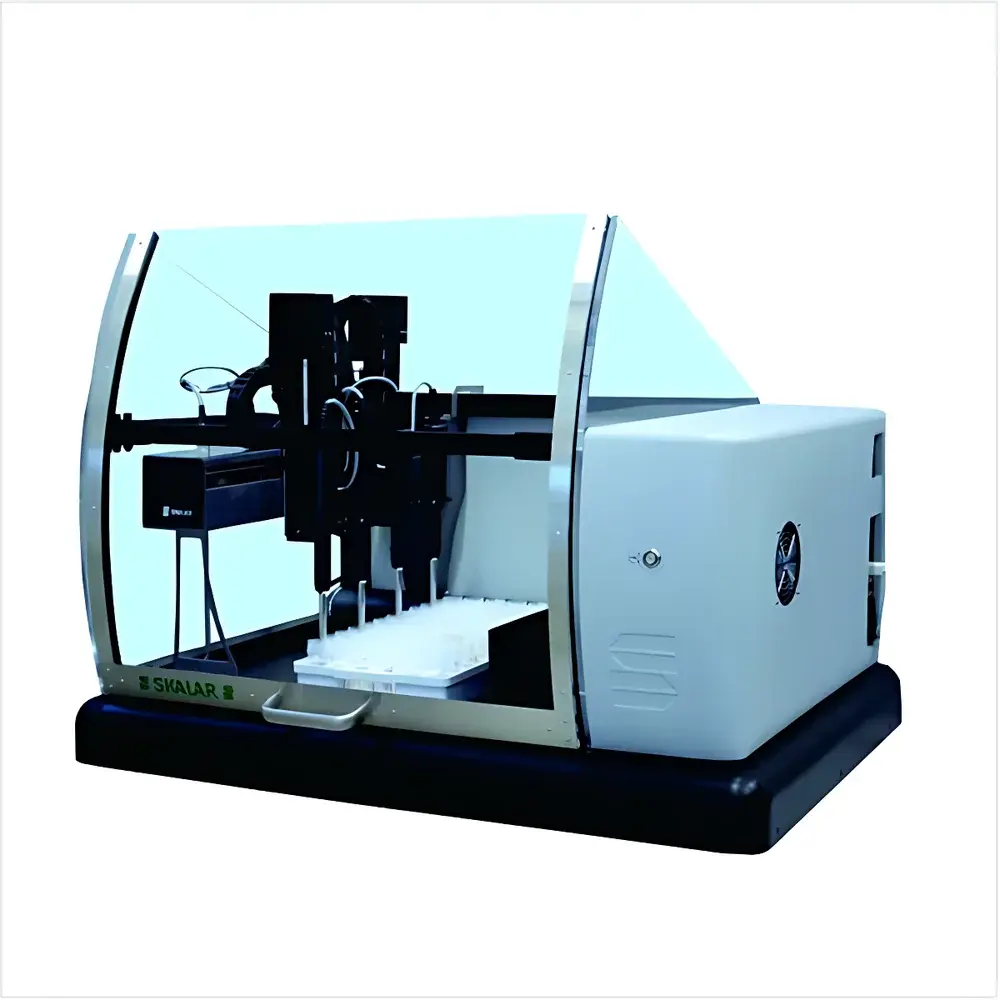
Skalar SP2000 Automated Sample Emulsification & Homogenization Robotic System
| Brand | Skalar |
|---|---|
| Origin | Shanghai, China |
| Manufacturer Type | Authorized Distributor |
| Country of Origin | China |
| Model | SP2000-Sample Emulsification |
| Price Range | USD 70,000 – 112,000 |
Overview
The Skalar SP2000 Automated Sample Emulsification & Homogenization Robotic System is an integrated laboratory platform engineered for high-throughput, reproducible mechanical dispersion and emulsification of heterogeneous samples. It operates on the principle of high-shear rotor-stator homogenization—where rotational energy from precision-engineered motors drives a rapidly spinning rotor within a closely toleranced stator, generating intense hydrodynamic shear forces, cavitation, and turbulent flow. These physical mechanisms disrupt interfacial tension between immiscible phases (e.g., oil–water, solid–liquid), enabling formation of stable dispersions, microemulsions, or uniformly homogenized suspensions with reduced particle or droplet size distribution. Designed for routine analytical sample preparation, the SP2000 bridges the gap between manual homogenization and fully automated lab workflows—supporting method standardization across environmental, agricultural, pharmaceutical, food safety, and clinical research laboratories.
Key Features
- Robotic arm-integrated platform with programmable XYZ-axis positioning for precise sample tube handling, tip alignment, and multi-position tray navigation.
- Modular high-shear homogenizer modules (up to four units) mounted on a shared gantry, enabling parallel processing of up to 24 samples per run (depending on rack configuration and vessel format).
- Variable-speed control (5,000–25,000 rpm) with real-time torque monitoring and automatic speed adjustment based on sample viscosity feedback—ensuring consistent energy input across diverse matrices.
- Interchangeable probe sets (stainless steel, PTFE-coated, and disposable polymer tips) compatible with volumes from 0.5 mL to 50 mL, supporting both microcentrifuge tubes and wide-mouth glass vials.
- Integrated cooling jacket interface for optional recirculating chiller connection (−10 °C to +25 °C), critical for heat-sensitive biological tissues or thermolabile active pharmaceutical ingredients (APIs).
- CE-marked electrical architecture with IP32-rated enclosure; emergency stop circuitry and lid-interlocked operation comply with IEC 61010-1 for laboratory equipment safety.
Sample Compatibility & Compliance
The SP2000 accommodates a broad spectrum of challenging sample types—including fibrous plant tissue, cohesive soil aggregates, viscous sludge, algal biomass, animal organ homogenates, and protein-rich food matrices—without requiring pre-dilution or chemical solubilizers. Its robust mechanical design minimizes cross-contamination risk via automated probe washing cycles (integrated solvent rinse station with waste aspiration). From a regulatory standpoint, the system supports GLP-compliant workflows through audit-trail-enabled software logging (timestamped operator ID, protocol version, runtime parameters, and error codes). While not FDA 21 CFR Part 11–certified out-of-the-box, its data export architecture (CSV, XML) facilitates integration into validated LIMS environments meeting ISO/IEC 17025 and ASTM D7218 (for environmental sample homogenization) requirements.
Software & Data Management
Control is executed via Skalar’s proprietary SP2000 Control Suite—a Windows-based application supporting method creation, scheduling, and remote monitoring via Ethernet or USB 3.0. Each homogenization protocol stores full parameter sets (speed ramp profile, dwell time per step, total cycle count, probe depth offset) and links directly to sample IDs in external databases. All operational logs are digitally signed and archived with SHA-256 hash verification. Raw torque and RPM time-series data can be exported for post-acquisition statistical analysis (e.g., coefficient of variation across replicates), supporting QC documentation per ISO 5725-2. Optional API access enables synchronization with electronic lab notebooks (ELNs) such as LabArchives or Benchling.
Applications
- Environmental analysis: Homogenization of sediment cores, wastewater sludge, and biofilm samples prior to metal speciation (ICP-MS) or organic contaminant extraction (EPA Method 3540C).
- Agricultural & food testing: Uniform dispersion of pesticide residues in leafy greens or mycotoxins in cereal grains for LC-MS/MS quantification.
- Pharmaceutical R&D: Preparation of nanoemulsion drug carriers and uniform suspension of poorly water-soluble APIs for dissolution testing (USP <711>).
- Biomedical research: High-fidelity lysis of tumor biopsies and adipose tissue for proteomic profiling, minimizing protease activation through controlled thermal management.
- Microbiology: Disaggregation of fungal hyphae and bacterial biofilms without inducing cell lysis—enabling viable colony-forming unit (CFU) enumeration.
FAQ
Is the SP2000 compatible with third-party homogenizer probes?
Yes—provided they conform to ISO 8503-2 mounting dimensions and maximum torque limits (≤ 1.2 N·m at 25,000 rpm); Skalar provides mechanical interface adapters upon request.
Can the system be validated for GMP environments?
The SP2000 supports IQ/OQ documentation packages; PQ validation must be performed in situ using user-defined reference standards (e.g., polystyrene latex suspensions per ISO 13320).
What maintenance intervals are recommended?
Rotor-stator assemblies require inspection every 500 operating hours; lubrication-free ceramic bearings eliminate routine greasing; annual calibration of speed and torque sensors is advised.
Does the system support unattended overnight operation?
Yes—via scheduled job queues and automatic shutdown upon completion or thermal fault detection; ambient temperature monitoring ensures safe extended-run conditions.



