
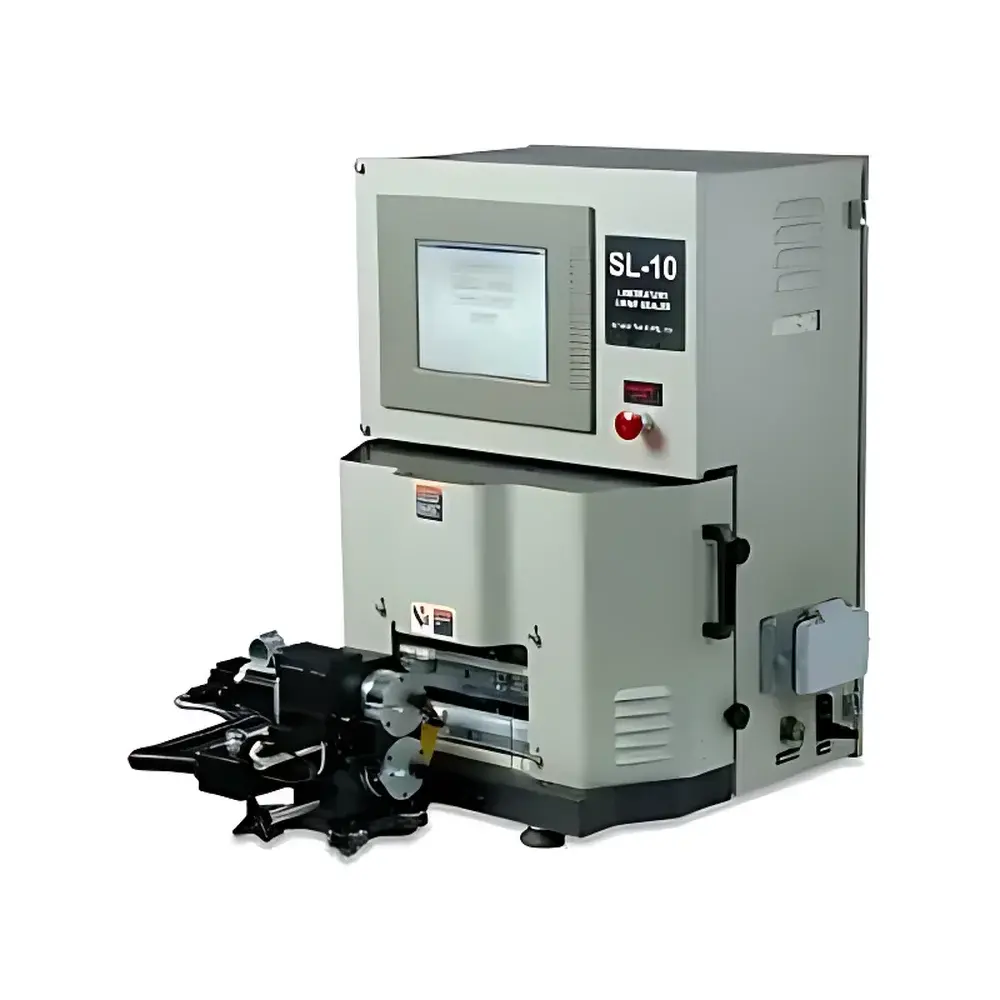
SL10 Advanced Heat Seal and Hot Tack Tester
| Origin | USA |
|---|---|
| Supplier Type | Authorized Distributor |
| Import Status | Imported |
| Model | SL10 |
| Pricing | Upon Request |
| Sealing Temperature Range | Ambient to 400 °C |
| Temperature Resolution | ±0.1 °C |
| Temperature Accuracy | ±0.15 °C |
| Temperature Control Stability | ±0.2 °C |
| Sealing Pressure Range | 5–700 psi (34.5–4830 kPa) |
| Pressure Resolution | 1 psi (7 kPa) |
| Sealing Time Range | 100 ms to 99 s |
| Time Resolution | 10 ms |
| Time Accuracy | ±1 ms |
| Time Repeatability | ±2 ms |
| Dual Load Cells (Left/Right) | Combined Capacity 362 kg (1000 lbf), Accuracy ≤0.09 kg (0.2 lbf), Repeatability ≤0.09 kg (0.2 lbf), Calibrated per ASTM E4 |
| Peel Load Cell | 11.34 kg (25 lbf) capacity, 0.1% FS accuracy, ASTM E4 calibrated |
| Seal Jaw Length Options | 50.8 mm (2 in) for hot tack or 127 mm (5 in) with auto-feed turntable |
| Jaw Width Options | 6.35–25.4 mm (0.25–1.00 in) |
| Jaw Surface Configurations | Flat, Grooved, Custom, or Standard Geometric Profiles |
| Power Supply | 230 V / 50 Hz |
| Compressed Air Requirement | 80–120 psi (recommended 90 psi), integrated pressure switch |
| Dimensions (W×D×H) | 584.2 × 508 × 794 mm |
| Weight | 79.3 kg |
Overview
The SL10 Advanced Heat Seal and Hot Tack Tester is an engineered precision instrument designed for quantitative evaluation of thermoplastic packaging seal integrity under controlled thermal, mechanical, and temporal conditions. It operates on the fundamental principles of thermal energy transfer, viscoelastic deformation, and interfacial adhesion kinetics—enabling measurement of both heat seal strength (post-cool) and hot tack strength (seal integrity during the critical cooling phase immediately after sealing). This dual-mode capability supports rigorous process validation in pharmaceutical blister packaging, food pouch manufacturing, medical device sterile barrier systems, and flexible laminated film production. The SL10 complies with core international test standards including ASTM F88 (Seal Strength), ASTM F1921 (Hot Tack), ASTM F2054 (Burst Test), and ISO 11607-2 (Packaging for Terminally Sterilized Medical Devices), making it suitable for regulated environments requiring documented traceability and audit-ready data integrity.
Key Features
- Independent dual-zone temperature control for upper and lower sealing jaws—enabling asymmetric thermal profiling essential for asymmetric laminates and multi-layer structures.
- Integrated dual load cells (left/right) delivering uniform, dynamically compensated sealing force across the entire jaw width—minimizing edge effects and ensuring reproducible pressure distribution per ASTM F1921 Annex A2.
- High-resolution timing system with 10 ms resolution and ±1 ms absolute accuracy—critical for capturing transient hot tack behavior within the narrow 100 ms–2 s window where polymer chain entanglement governs early-stage seal formation.
- Modular jaw system supporting interchangeable configurations: flat, grooved, custom-machined, or standardized geometries (e.g., ASTM F88 Type I or II), with selectable lengths (50.8 mm for hot tack, 127 mm with optional auto-feed turntable) and widths (6.35–25.4 mm).
- Full-color capacitive touchscreen interface with intuitive workflow navigation, real-time parameter monitoring, and embedded calibration verification prompts aligned with ISO/IEC 17025 metrological requirements.
- Hardware-integrated safety architecture: dual-channel emergency stop circuitry, pneumatic pressure interlock, and guarded access zones compliant with EN 61000-6-2 and ANSI B11.19.
Sample Compatibility & Compliance
The SL10 accommodates a broad spectrum of thermoplastic packaging substrates—including polyethylene (LDPE, HDPE, LLDPE), polypropylene (CPP, OPP), polyester (PET), ethylene-vinyl acetate (EVA), ionomers, and co-extruded multilayer films. Its configurable jaw geometry and wide pressure range (5–700 psi) support testing of thin gauge foils (<25 µm), high-barrier metallized laminates, and thick-gauge medical-grade pouches (up to 300 µm total thickness). All force transducers are calibrated per ASTM E4 using NIST-traceable deadweight standards; temperature sensors are verified against ITS-90 reference points. Instrument qualification documentation (IQ/OQ/PQ protocols) and full compliance reporting packages—including 21 CFR Part 11–compliant electronic signatures and audit trail generation—are available upon request for GMP/GLP-regulated laboratories.
Software & Data Management
The SL10 runs on embedded firmware with optional PC-based analysis software (SL10 Connect Suite) supporting automated test method storage, batch-level metadata tagging (operator ID, lot number, environmental conditions), and export to CSV, PDF, or XML formats compatible with LIMS and MES platforms. Raw force–time curves are sampled at ≥1 kHz, preserving dynamic event fidelity for peak hot tack detection and seal failure mode analysis. Software includes statistical process control (SPC) tools—Cp/Cpk calculation, trend charting, and outlier detection per ASTM E2709—and supports user-defined pass/fail criteria based on mean ± 3σ thresholds. All data files include embedded digital signatures, timestamped calibration logs, and version-controlled firmware revision history.
Applications
- Optimization of sealing parameters (temperature, pressure, dwell time) for new packaging formulations and converting processes.
- Stability assessment of seal performance across accelerated aging conditions (e.g., 40 °C/75% RH for 6 months per ISO 11607-1 Annex D).
- Root cause analysis of seal failures in complaint investigations—differentiating thermal degradation, insufficient melt flow, or contamination-induced weak boundary layers.
- Validation of sterilization compatibility for medical device pouches subjected to ethylene oxide, gamma, or steam sterilization cycles.
- Comparative benchmarking of sealant layer performance across supplier materials under identical process windows.
FAQ
Does the SL10 meet FDA requirements for use in pharmaceutical packaging validation?
Yes—the SL10 supports 21 CFR Part 11 compliance via optional software modules that enforce electronic signature workflows, audit trails, and role-based access controls required for cGMP documentation.
Can the instrument perform both hot tack and peel tests without hardware reconfiguration?
Yes—dual calibrated load cells and swappable jaw assemblies allow seamless transition between hot tack (ASTM F1921), seal strength (ASTM F88), and peel (ASTM F904) modes without recalibration.
Is compressed air supply mandatory for operation?
Yes—the pneumatic actuation system requires stable 90 psi compressed air with integrated pressure monitoring; failure triggers automatic shutdown per safety protocol.
What is the recommended calibration frequency for routine QC use?
Per ISO/IEC 17025 guidance, temperature sensors should be verified daily using NIST-traceable reference thermometers; force transducers require quarterly calibration with full ASTM E4 documentation.
Are jaw profiles available for non-standard seal geometries such as fin seals or lap seals?
Yes—custom jaw machining services are offered with dimensional drawings and material certification (e.g., hardened stainless steel, anodized aluminum) meeting ISO 8062 geometric tolerance class CT10.






