
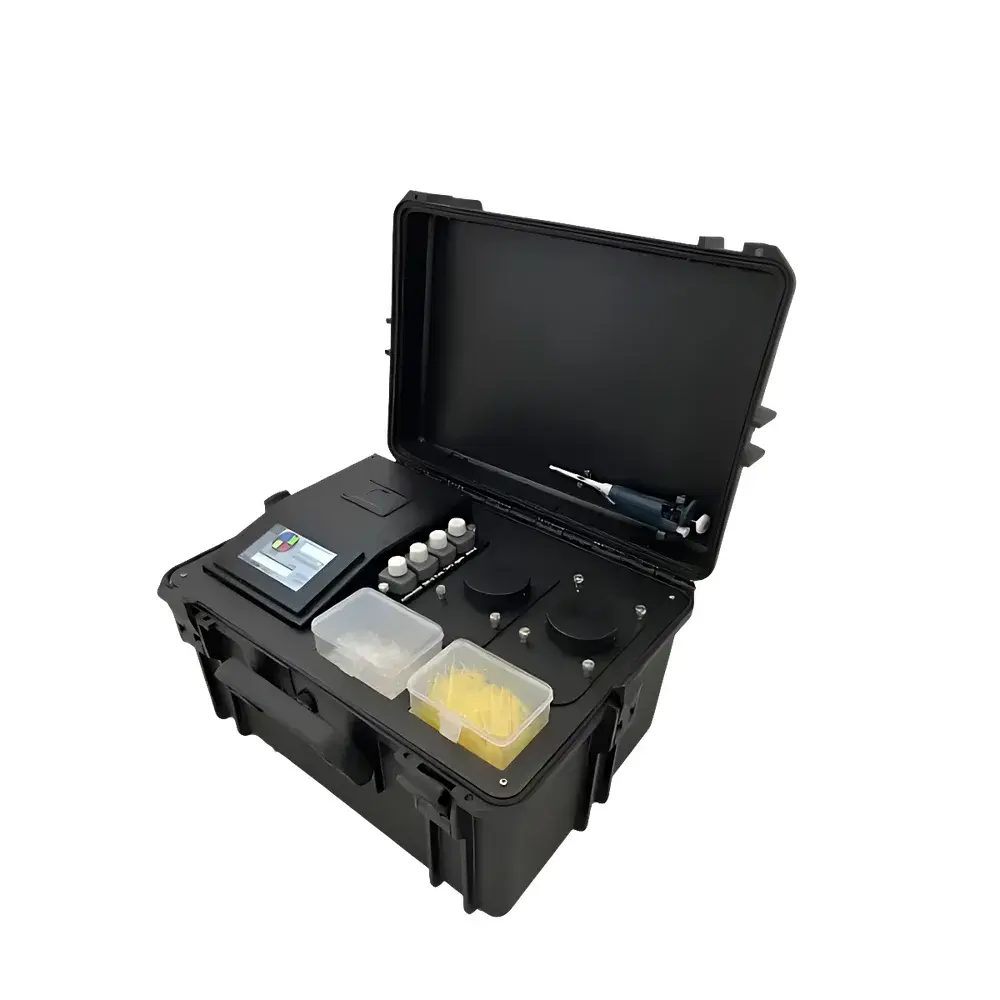
SmarTox Portable Bioluminescent Toxicity Analyzer
| Brand | SYSTEA |
|---|---|
| Model | SmarTox |
| Measurement Principle | Bioluminescence Inhibition Assay (using *Aliivibrio fischeri*, *Photobacterium phosphoreum*, or *Vibrio qinghaiensis* Q67) |
| Temperature Control | Refrigerated Reagent Compartment (4–8 °C) & Thermostatic Reaction Chamber (15–25 °C) |
| Detection Interval | 30 s per measurement |
| Data Storage Capacity | >1,000 test records |
| Power Supply | Rechargeable 12.6 V / 11,000 mAh Li-ion battery |
| Compliance | ISO 11348-3, GB/T 15441 |
| Display | Industrial-grade color LCD touchscreen with guided workflow interface |
| Output | Integrated thermal printer for on-site report generation |
| Connectivity | USB data export |
Overview
The SmarTox Portable Bioluminescent Toxicity Analyzer is an engineered field-deployable instrument designed for rapid, standardized assessment of acute aquatic toxicity in environmental water samples. It operates on the bioluminescence inhibition principle: viable luminescent bacteria—such as Aliivibrio fischeri (formerly Vibrio fischeri), Photobacterium phosphoreum, or Vibrio qinghaiensis Q67—emit light as a byproduct of cellular respiration. Exposure to toxicants disrupts metabolic activity, resulting in quantifiable reduction in light output. This photometric response is directly correlated with toxicity concentration and enables calculation of inhibition rates (%) and EC50 values. The SmarTox system implements this biological endpoint in strict alignment with internationally recognized protocols—specifically ISO 11348-3 (Water quality — Determination of the inhibitory effect of water samples on the light emission of Vibrio fischeri) and China’s national standard GB/T 15441—ensuring methodological equivalence with laboratory-based reference testing.
Key Features
- Integrated refrigerated reagent compartment (4–8 °C) maintains viability and consistent bioluminescent output of lyophilized or pre-rehydrated bacterial cultures during extended field deployment.
- Thermostatically controlled reaction chamber (15–25 °C) ensures optimal physiological conditions for bacterial metabolism, minimizing temperature-induced variability and enabling direct comparability with standard manual assays.
- High-frequency photometric detection at 30-second intervals supports real-time kinetic profiling of inhibition onset and progression—critical for distinguishing fast-acting versus delayed toxicants.
- Multi-mode analysis capability includes single-point inhibition rate (%), parallel sample comparison, and dose–response curve fitting for EC50 determination using built-in regression algorithms.
- Industrial-grade capacitive touchscreen interface delivers intuitive, step-by-step procedural guidance—even for non-specialist operators—reducing training burden and operator-induced error.
- Onboard thermal printer generates auditable, timestamped reports containing sample ID, test parameters, raw luminescence values, inhibition %, and compliance statement—facilitating immediate documentation in regulatory or emergency-response scenarios.
Sample Compatibility & Compliance
The SmarTox analyzer accepts raw or minimally filtered aqueous matrices without pretreatment, including surface water, drinking water sources, groundwater, municipal wastewater effluents, industrial discharges, and marine/estuarine samples. Turbidity and colored interferents are mitigated via dual-wavelength background correction and signal normalization routines embedded in firmware. All operational parameters—including incubation time, temperature setpoints, and dilution logic—are programmable to align with site-specific QA/QC requirements. The instrument satisfies analytical validation criteria outlined in ISO/IEC 17025 for field instrumentation and supports audit-ready data integrity through internal timestamping, user login tracking, and immutable record storage. While not certified under FDA 21 CFR Part 11, its data export architecture (USB-based .csv files) permits integration into validated LIMS environments governed by GLP or GMP frameworks.
Software & Data Management
Data acquisition, processing, and reporting are handled entirely onboard via embedded firmware optimized for low-power ARM architecture. Each test record stores raw relative light units (RLU), normalized inhibition percentage, ambient temperature, reagent lot ID, operator code, and GPS-tagged location metadata (when paired with optional external GNSS module). Internal flash memory retains ≥1,000 full assay records with automatic overwrite protection for flagged critical results. Export is performed via standard USB-A interface to FAT32-formatted drives; no proprietary software installation is required on host systems. Raw datasets include column headers compliant with ISO 11348-3 Annex D reporting templates, enabling seamless import into statistical packages (e.g., R, GraphPad Prism) or enterprise environmental databases.
Applications
- Rapid screening of wastewater treatment plant influent/effluent for acute toxicity spikes during process upsets or chemical spills.
- Field verification of drinking water safety following distribution system maintenance or source contamination events.
- Regulatory compliance monitoring for industrial discharge permits requiring periodic whole-effluent toxicity (WET) assessment.
- Ecotoxicological surveys of rivers, lakes, and coastal zones to map spatial gradients of anthropogenic stressors.
- Emergency response triage—providing actionable toxicity data within minutes at incident sites where lab turnaround times exceed decision windows.
FAQ
What bacterial strains are supported, and how is strain selection managed?
The SmarTox platform accommodates three validated strains: Aliivibrio fischeri (ISO 11348-3 reference organism), Photobacterium phosphoreum, and Vibrio qinghaiensis Q67. Strain-specific calibration curves and protocol parameters are preloaded; users select the appropriate strain prior to assay initiation via the touchscreen interface.
Is calibration traceable to NIST or other metrological standards?
While biological assays do not rely on physical reference standards, the instrument’s photometer is factory-calibrated against luminance reference sources traceable to national metrology institutes. Routine user verification uses supplied non-toxic control solutions to confirm baseline RLU stability and inter-unit reproducibility.
Can the device operate continuously on battery power during multi-day field campaigns?
Yes—the integrated 12.6 V / 11,000 mAh lithium-ion battery provides ≥12 hours of continuous operation under typical usage (including refrigeration, measurement cycles, and display backlight), extendable via optional external power banks compatible with USB-C PD 3.0 input.
Does the system support remote data transmission or cloud synchronization?
No native wireless connectivity is included to preserve electromagnetic compatibility in sensitive field environments and ensure data sovereignty. All data transfer occurs via physically secured USB media—a design choice aligned with cybersecurity best practices for environmental monitoring infrastructure.







