
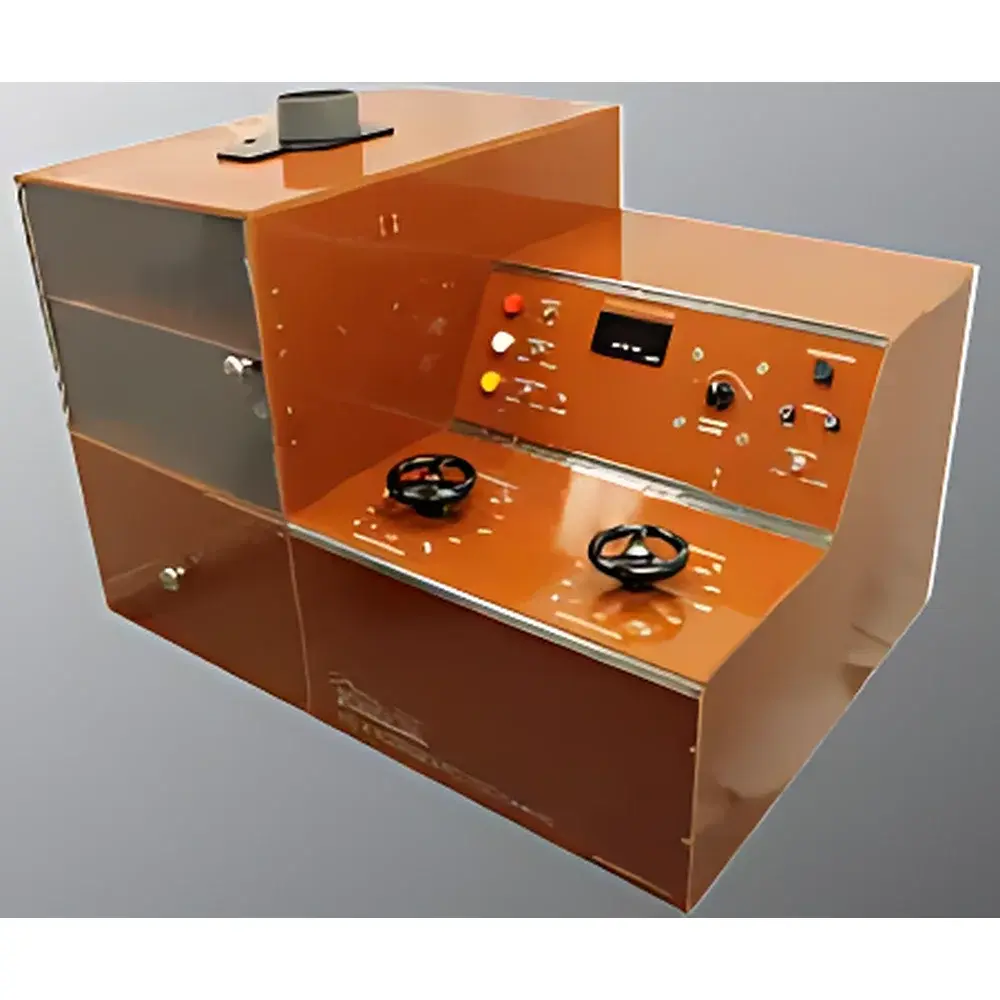
SMS ABL Static Discharge Sensitivity Tester
| Brand | SMS |
|---|---|
| Origin | USA |
| Manufacturer Type | Authorized Distributor |
| Origin Category | Imported |
| Model | ABL |
| Pricing | Available Upon Request |
Overview
The SMS ABL Static Discharge Sensitivity Tester is a precision-engineered electrostatic discharge (ESD) initiation test system designed for quantitative assessment of energetic materials’ sensitivity to electrostatic spark stimuli. It operates on the fundamental principle of controlled electrostatic energy transfer—generating reproducible, calibrated spark discharges between a high-voltage electrode and a grounded sample holder—to simulate real-world static ignition hazards encountered during handling, processing, or storage of propellants, explosives, pyrotechnics, and other sensitive energetic compounds. Unlike generic ESD simulators, the ABL system is purpose-built for hazard classification under military and NATO standards, delivering traceable, physics-based energy thresholds (in millijoules) that directly correlate with process safety boundaries. Its design adheres to the electrostatic spark initiation paradigm defined in MIL-STD-1751 (Methods 1031, 1032, and 1033) and STANAG 4490, ensuring data compatibility with international safety certification workflows.
Key Features
- Compliant dual-test methodology: Supports both “proximity needle” and “fixed-gap” discharge configurations per MIL-STD-1751 and STANAG 4490 requirements.
- Pneumatically actuated high-speed electrode positioning: Enables precise, repeatable spark gap control with sub-millisecond response time and mechanical stability under vacuum or inert atmosphere conditions.
- Calibrated energy delivery: Integrates certified high-voltage pulse generators with adjustable capacitance and voltage settings to deliver discrete, traceable discharge energies from <1 mJ to >100 mJ.
- Modular integration interface: Designed for seamless coupling with auxiliary instrumentation—including gas chromatography–mass spectrometry (GC-MS) for decomposition product analysis and the SMS GoDetect-ESD high-speed imaging system (up to 1 Mfps) for reaction onset timing and flame propagation characterization.
- Robust safety architecture: Includes interlocked chamber access, real-time arc current monitoring, redundant grounding verification, and fail-safe discharge termination circuits compliant with NFPA 70E and IEC 61000-4-2 test environment guidelines.
Sample Compatibility & Compliance
The ABL tester accommodates solid, granular, and pressed pellet forms of Class 1.1–1.4 explosive materials, insensitive munitions (IM) formulations, and novel energetic binders. Sample holders are configurable for mass ranges from 10 mg to 5 g and support temperature-controlled stages (−40 °C to +70 °C) for thermal sensitivity correlation studies. All test protocols and calibration procedures conform to ASTM E680 (Standard Test Method for Autoignition Temperature of Liquids and Solids), ISO 8007-2 (Explosives – Sensitivity Tests – Part 2: Electrostatic Discharge Sensitivity), and US Department of Defense Handbook MIL-HDBK-338B (Electronic Reliability Design Handbook) Annex D for ESD hazard modeling. Data outputs satisfy GLP audit requirements and are structured for FDA 21 CFR Part 11–compliant electronic record retention when paired with validated software modules.
Software & Data Management
The ABL system operates under SMS Energetic Safety Suite (ESS) v3.x firmware, providing instrument control, real-time spark parameter logging (voltage, current rise time, peak current, energy integral), and automated Bruceton up-and-down statistical analysis for sensitivity threshold determination (e.g., 50% probability of initiation, E50). Raw oscilloscope traces, high-speed video timestamps, and GC-MS peak area integrations are synchronized via IEEE 1588 Precision Time Protocol (PTP). Export formats include CSV, HDF5, and XML metadata-compliant archives suitable for integration into LIMS platforms (e.g., LabVantage, Thermo Fisher SampleManager) and regulatory submission dossiers.
Applications
- Determination of electrostatic discharge initiation thresholds for qualification of new energetic formulations under DoD, NATO, and UN transport regulations (UN TDG, ADR/RID).
- Process safety validation for dry milling, pneumatic conveying, and solvent recovery operations where triboelectric charging poses ignition risk.
- Root-cause analysis of field incidents involving unintended energetic material ignition attributed to static accumulation.
- Development of IM compliance packages supporting Joint Service Specification DOD-STD-2105D (Insensitive Munitions Requirements).
- Training and procedural validation for ESD mitigation programs in ammunition production facilities certified to AS9100 and ISO/IEC 17025.
FAQ
What standards does the ABL tester fully support for ESD sensitivity testing?
MIL-STD-1751 Methods 1031 (proximity needle), 1032 (fixed gap), and 1033 (capacitive discharge); STANAG 4490; ISO 8007-2; and ASTM E680.
Can the ABL system operate inside a glovebox or inert atmosphere chamber?
Yes—the electrode actuation mechanism and sample stage are compatible with N₂- or Ar-purged enclosures rated to IP54; optional feedthroughs support HV cabling and optical access.
Is GoDetect-ESD imaging data time-synchronized with electrical discharge parameters?
Yes—hardware-level PTP synchronization ensures ±100 ns alignment between high-speed video frames and oscilloscope waveforms.
Does the system provide automated statistical analysis for sensitivity threshold calculation?
Yes—ESS software implements Bruceton, Neyer D-optimal, and logistic regression algorithms per IEC 60079-0 Annex E for confidence-interval reporting of E50 and E1 values.
Are calibration certificates provided with traceability to NIST standards?
Each unit ships with a factory calibration report traceable to NIST SRM 2803 (high-voltage reference divider) and NIST SRM 2801 (capacitance standard), valid for 12 months.




