
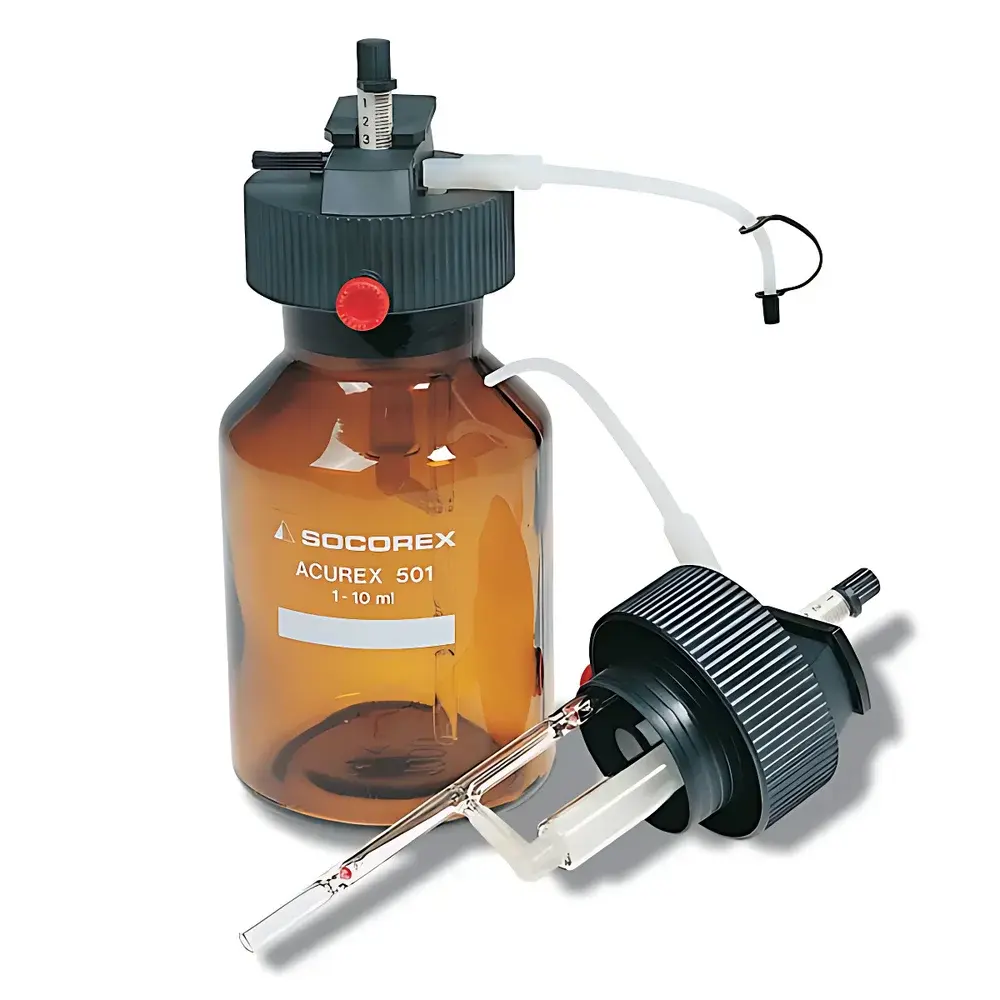
SOCOREX Acurex 501 Compact Bottle Top Dispenser
| Brand | SOCOREX |
|---|---|
| Origin | Switzerland |
| Model | 501 |
| Type | Manual Bottle Top Dispenser |
| Volume Range | 0.2–30 mL |
| Minimum Increment | 0.1–1.0 mL (model-dependent) |
| Accuracy | ±0.1 mL |
| Coefficient of Variation (CV) | < 0.5% at max volume |
| Sterilization | Autoclavable (121°C, 20 min) |
| Liquid Contact Materials | PTFE, FEP, ETFE, borosilicate glass, amber glass |
| Bottle Options | 250 / 500 / 1000 / 2000 mL |
Overview
The SOCOREX Acurex 501 Compact Bottle Top Dispenser is an ergonomically engineered, manually operated precision liquid handling device designed for reproducible volumetric dispensing in constrained laboratory environments. Built upon SOCOREX’s decades-long heritage in Swiss precision fluid mechanics, the Acurex 501 employs a spring-loaded piston-driven metering mechanism with integrated air displacement control—ensuring consistent delivery across its full operational range without reliance on external power sources or complex calibration routines. Its ultra-low profile design—achieved via a retractable scale sleeve and vertically optimized actuation geometry—enables seamless integration into refrigerated storage units (4°C), cold rooms, and water bath setups where vertical clearance is limited. All wetted components are constructed exclusively from chemically inert, USP Class VI-certified fluoropolymers (PTFE, FEP, ETFE) and high-purity borosilicate or amber glass, eliminating metallic leaching risks and ensuring compatibility with aggressive solvents, strong acids, bases, and light-sensitive reagents.
Key Features
- Ultra-compact footprint: Total height reduced by up to 35% when scale sleeve is fully retracted—optimized for placement inside standard 4°C refrigerators and under fume hood sashes.
- Full autoclavability: Entire assembly—including piston cylinder, dispensing head, and glass bottle—validated for repeated sterilization at 121°C for 20 minutes per ISO 17665-1, supporting GLP/GMP-compliant workflows requiring sterile liquid transfer.
- Chemical resistance architecture: No metal parts in fluid path; PTFE seals and FEP-coated piston rods resist corrosion from HCl, HNO₃, NaOH, acetone, DMSO, and acetonitrile—validated per ASTM D543-20 exposure testing protocols.
- Modular bottle system: Interchangeable bottles available in four capacities (250, 500, 1000, 2000 mL) and two material grades—Duran® borosilicate glass (thermal shock resistant up to ΔT = 160°C) and amber glass (UV-VIS blocking >99.9% at λ < 450 nm).
- Precision dispensing extension: Optional 60 cm PTFE tubing with Jet Pen™ dispensing tip (Order No. 1.523) enables controlled gravity-fed delivery into narrow-necked or deep-well vessels while maintaining CV < 0.35% at mid-volume.
Sample Compatibility & Compliance
The Acurex 501 supports broad sample compatibility across analytical, pharmaceutical, and life science applications. Its inert fluid path meets USP and EP 3.1.1 requirements for plastic components in contact with parenteral preparations. When used with amber glass bottles, it satisfies ICH Q5C photostability testing guidelines (Q5C Annex 2) for light-sensitive biologics and APIs. The device complies with ISO 8655-3:2022 for piston-operated dispensers, with certified CV values independently verified per ISO/IEC 17025-accredited calibration reports. All models conform to RoHS 2011/65/EU and REACH SVHC thresholds. Documentation packages include EU Declaration of Conformity and traceable calibration certificates compliant with ISO/IEC 17025.
Software & Data Management
As a manual mechanical dispenser, the Acurex 501 operates without embedded electronics or software interfaces—eliminating firmware validation requirements and ensuring long-term operational stability without obsolescence risk. However, its metrological performance integrates seamlessly into digital lab ecosystems: volume settings and usage logs can be recorded in ELN platforms (e.g., LabArchives, Benchling) using standardized SOP templates aligned with FDA 21 CFR Part 11 Annex 11 principles. Each unit ships with a unique serial-numbered calibration record, enabling full audit trail traceability for QA/QC departments conducting periodic verification per ASTM E2758-21.
Applications
- Preparation of calibration standards and QC reference solutions in environmental testing labs (EPA Method 502.2, ISO 11843-2).
- Dispensing of cytotoxic compounds and radiolabeled tracers in radiochemistry suites—leveraging amber glass protection and zero-metal construction.
- Buffer and media preparation for cell culture workflows under ISO 5 cleanroom conditions, where autoclave compatibility ensures sterility assurance.
- High-throughput assay setup in genomics core facilities, particularly for enzymatic reaction mixes requiring sub-milliliter precision across 96-well plates.
- Teaching laboratories emphasizing hands-on volumetric technique training—its tactile feedback and visible piston travel reinforce pipetting fundamentals without electronic dependency.
FAQ
Is the Acurex 501 compatible with organic solvents such as chloroform or THF?
Yes—wetted materials (PTFE, FEP, ETFE, borosilicate glass) exhibit excellent resistance to halogenated and ether-based solvents per ASTM D543-20 immersion testing.
Can I use the same dispenser with both amber and clear glass bottles interchangeably?
Yes—the bottle mounting interface is standardized across all Acurex 501 configurations; no recalibration is required when switching bottle types.
Does the device require routine recalibration?
No—mechanical calibration is factory-set and stable over time; users perform only periodic performance verification per ISO 8655-3 using gravimetric methods.
What is the maximum operating temperature for continuous use with warm liquids?
Borosilicate glass bottles support sustained use up to 120°C; PTFE components remain dimensionally stable up to 260°C, though recommended liquid temperature limit is 60°C for optimal seal longevity.
Is the Jet Pen™ dispensing tip suitable for viscous solutions (>500 cP)?
For viscosities above 200 cP, we recommend reducing dispensing speed and verifying CV performance empirically; optional low-flow nozzles (Order No. 1.524) are available for enhanced control.



