
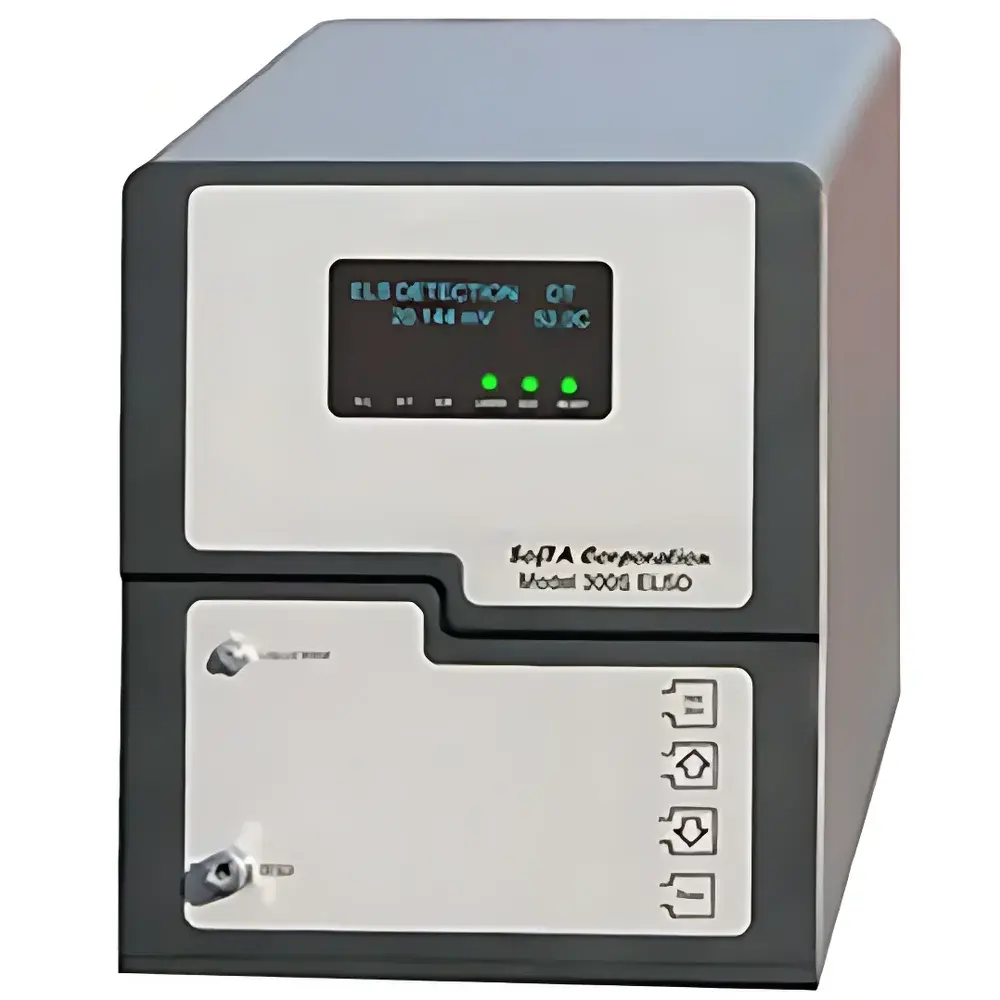
SofTA M300s Evaporative Light Scattering Detector
| Brand | SofTA |
|---|---|
| Model | M300s |
| Detector Type | Evaporative Light Scattering Detector (ELSD) |
| Wavelength Range | 195–600 nm |
| Detection Method | Dual-Beam |
| Light Source | Deuterium Lamp |
| Nebulizer Material | PTFE (Teflon®) |
| Drift Tube Temperature Range | Ambient to 120 °C |
| Nebulization Zone Temperature Range | 10–70 °C |
| Light Source for Scattering Detection | 650 nm Near-Infrared Laser (<5 mW, FCC Eye-Safe) |
| Minimum Detectable Mass | 100 pg (Glucopyranoside, Micro-HPLC, 2 µL direct injection) |
| Peak Width (10% height) | 3 s |
| Dynamic Range (Normal/Low Gain) | 3 decades |
| Extended Dynamic Range | 4–4.5 decades |
| Maximum Liquid Flow Rate | 5 mL/min |
| Gas Supply | N₂ or other inert gas, 50 psi |
| Gas Consumption | ≤2.5 L/min |
| Gas Pressure Regulation | Integrated pressure regulator and overpressure protection |
| Auto Shut-off Valve | Delayed closure after operation |
| Wetted Materials | PTFE, stainless steel, alumina, borosilicate glass |
| Signal Output | Fixed 10 mV or 5 V |
| Interface | RS-232 (rear panel) |
| Power | 120/240 V, 50/60 Hz, 600 W |
| Dimensions (W×D×H) | 25 × 45 × 29 cm |
| Weight | 15 kg |
Overview
The SofTA M300s Evaporative Light Scattering Detector (ELSD) is a precision-engineered, thermally regulated detection system designed for universal, non-destructive quantification of non-volatile and semi-volatile analytes in liquid chromatography workflows. Operating on the principle of nebulization, solvent evaporation, and light scattering detection, the M300s converts eluting solutes into fine particles within a controlled drift tube, where they scatter light from a stable 650 nm near-infrared laser. Unlike UV-Vis absorbance detectors, ELSD provides uniform response across compounds lacking chromophores—making it indispensable for carbohydrates, lipids, polymers, surfactants, and natural product analysis. Its dual-beam optical architecture enhances baseline stability and minimizes drift caused by solvent gradient transitions or temperature fluctuations. The instrument complies with fundamental requirements for GLP-compliant laboratories and supports method validation per ICH Q2(R2) guidelines when integrated into HPLC systems.
Key Features
- Thermal分流 (Thermal Split) Technology: SofTA’s proprietary heat-controlled nebulization zone enables precise particle size modulation—optimizing sensitivity and reproducibility across volatile, non-volatile, and gradient-elution applications.
- Cryogenic-Ready Operation: Capable of sub-ambient nebulization zone temperatures (as low as 10 °C), the M300s maintains consistent detection performance with both organic and aqueous mobile phases—including high-salt buffers commonly used in ion-pairing or HILIC separations.
- Chemically Inert Fluid Path: All wetted components—including the PTFE nebulizer tip, stainless-steel capillary, alumina drift tube liner, and borosilicate optical lens—are selected for corrosion resistance, minimizing carryover and extending service life under aggressive solvent conditions.
- Intelligent Gas Management System: Integrated pressure regulation, overpressure protection, and programmable auto-shutoff valve prevent gas waste and ensure operational safety—eliminating manual pressure tuning and mitigating risks associated with unattended shutdowns.
- Embedded Method Storage: Supports up to 10 user-defined detection protocols, each preserving optimized parameters for temperature, gain, filter constant, and signal scaling—enabling rapid method recall and cross-laboratory protocol standardization.
- Vacuum Fluorescent Display (VFD): High-contrast, wide-view-angle interface with real-time diagnostics—including temperature status, gas pressure, lamp health, and self-test results—enhances operational transparency and troubleshooting efficiency.
Sample Compatibility & Compliance
The M300s detects analytes independent of UV absorbance or electrical charge, accommodating a broad spectrum of compound classes including glycosides, triglycerides, phospholipids, peptides, oligonucleotides, and synthetic polymers. It is routinely employed in pharmacopeial testing per Chinese Pharmacopoeia (ChP) monographs requiring HPLC-ELSD quantification (e.g., polysaccharide content in herbal extracts). While not inherently 21 CFR Part 11 compliant, its RS-232 interface supports integration with validated LIMS or CDS platforms that implement electronic signature, audit trail, and data integrity controls. Instrument design adheres to IEC 61010-1 for laboratory electrical safety and meets CE marking requirements for EMC and low-voltage directives.
Software & Data Management
The M300s operates as a standalone detector with local control via front-panel buttons and VFD display. Analog outputs (0–5 V or fixed 10 mV / 5 V) interface directly with third-party data acquisition systems—including Agilent ChemStation, Waters Empower, Thermo Chromeleon, and open-source chromatography software. RS-232 serial communication enables remote configuration of temperature setpoints, gain levels, and filter constants through ASCII command protocol. For regulated environments, raw signal files are captured externally; the detector itself does not store chromatograms or perform peak integration—ensuring separation of acquisition responsibility from processing, in alignment with ALCOA+ data governance principles.
Applications
- Quantitative analysis of non-chromophoric excipients in pharmaceutical formulations (e.g., lactose, mannitol, hydroxypropyl cellulose)
- Stability-indicating assays for degradation products lacking UV activity
- Characterization of natural product fractions from preparative HPLC, especially in traditional medicine QC
- Method development support for HILIC and Aqueous Normal Phase (ANP) chromatography
- Microbore and capillary LC-ELSD coupling, enabled by low dead-volume flow cell and <100 pg detection limit
- Quality control of surfactant purity and polydispersity in cosmetic and agrochemical manufacturing
FAQ
Does the M300s require column heating or post-column derivatization?
No. ELSD detection is inherently post-column and label-free; no derivatization chemistry or heated transfer lines are needed.
Can the M300s be used with gradient elution methods?
Yes. Thermal split technology and active drift tube temperature control (up to 120 °C) suppress baseline noise during solvent composition changes.
What gases are compatible with the M300s?
Nitrogen is recommended for optimal sensitivity and safety; argon or other inert gases may be used if nitrogen supply is unavailable.
Is the 650 nm laser eye-safe?
Yes. The Class 1 laser emitter (<5 mW) conforms to FCC and IEC 60825-1 safety standards for enclosed optical systems.
How often does the PTFE nebulizer require replacement?
Under typical use with filtered, particle-free mobile phases, the PTFE nebulizer demonstrates >12 months of service life—significantly exceeding stainless-steel alternatives in corrosive solvent environments.





