
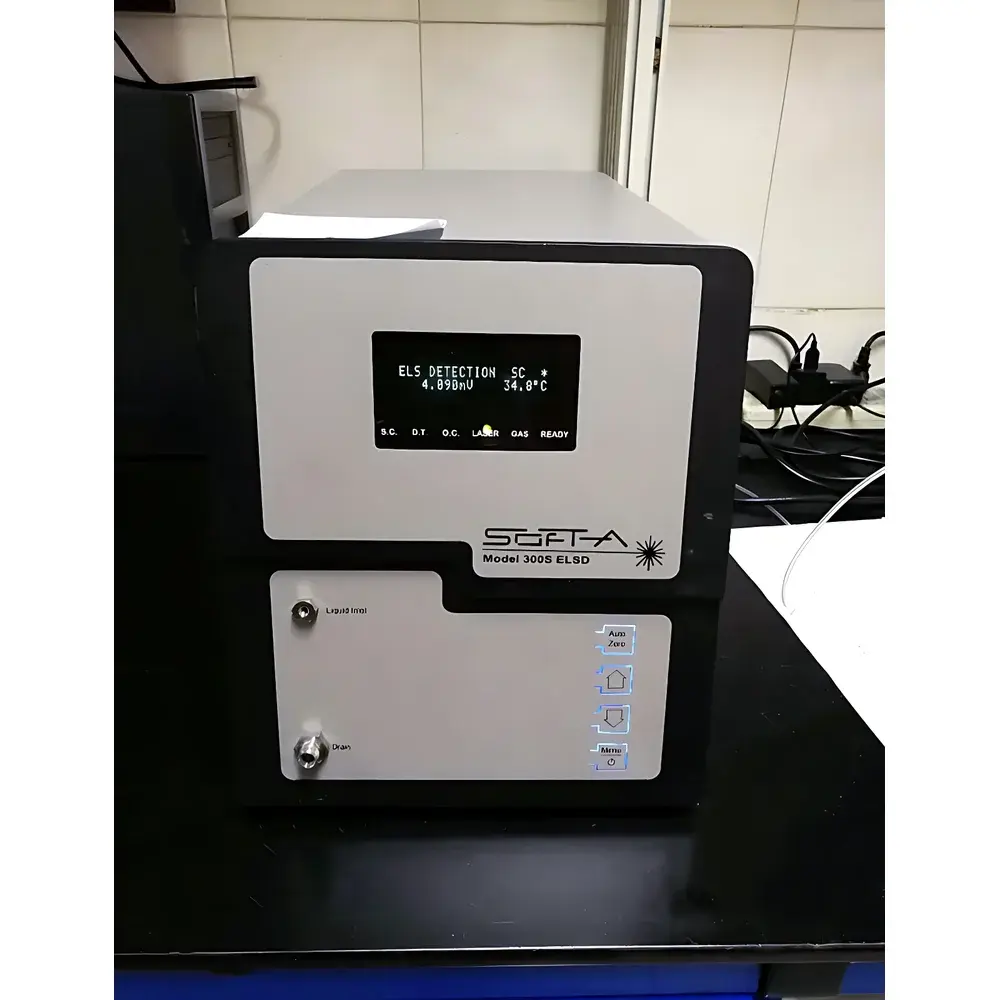
SofTA M300S Evaporative Light Scattering Detector (ELSD)
| Brand | SofTA |
|---|---|
| Origin | Imported |
| Manufacturer Type | Authorized Distributor |
| Model | M300S |
| Detection Principle | Evaporative Light Scattering |
| Compatible Systems | HPLC (Analytical & Preparative) |
| Wavelength Range | 195 nm (UV-Vis Deuterium Lamp for Optional UV Monitoring) |
| Detection Mode | Dual-Beam |
| Light Source | Deuterium Lamp |
| Nebulizer Material | PTFE (Teflon®) |
| Drift Tube Temperature Range | Ambient to 120 °C |
| Nebulization Zone Temperature Range | 10–70 °C |
| Laser Source | 650 nm Near-Infrared Diode (<5 mW, FCC Class I Eye-Safe) |
| Minimum Detectable Mass | 100 pg (Glucopyranoside, Micro-HPLC, 2 µL direct injection) |
| Peak Width (10% height) | 3 s |
| Dynamic Range (Normal/Low Gain) | 3 decades |
| Extended Dynamic Range | 4–4.5 decades |
| Mobile Phase Flow Rate | Up to 5 mL/min |
| Gas Requirement | Nitrogen or inert gas, 50 psi |
| Gas Consumption | ≤2.5 L/min |
| Liquid Path Materials | PTFE, Stainless Steel, Alumina, Borosilicate Glass |
| Interface | RS-232 |
| Power | 120/240 V, 50/60 Hz, 600 W |
| Dimensions (W×D×H) | 25 × 45 × 29 cm |
| Weight | 15 kg |
Overview
The SofTA M300S Evaporative Light Scattering Detector (ELSD) is a high-stability, thermally controlled detection system engineered for universal, non-destructive quantification of non-volatile and semi-volatile analytes in liquid chromatography. Unlike UV-absorbing detectors, the M300S operates on the principle of nebulization, solvent evaporation, and light scattering—making it particularly suitable for compounds lacking chromophores, such as phospholipids (e.g., soy lecithin), carbohydrates, lipids, surfactants, and polymers. Its dual-beam optical architecture—comprising a deuterium lamp for optional UV monitoring at 195 nm and a dedicated 650 nm near-infrared laser for primary ELSD signal generation—ensures robust baseline stability and minimizes drift during gradient elution. The detector integrates SofTA’s proprietary thermal split technology to precisely regulate aerosol formation in the nebulization zone (10–70 °C), enabling consistent response across diverse mobile phase compositions—including aqueous, organic, and mixed solvent systems—without manual re-optimization.
Key Features
- Thermally regulated nebulization zone (10–70 °C) and drift tube (ambient to 120 °C) for reproducible aerosol generation under isocratic and gradient conditions.
- PTFE-coated nebulizer nozzle offering exceptional resistance to clogging, corrosion, and wear—critical for long-term operation with complex biological matrices like soy lecithin extracts.
- Dual-light-source design: Deuterium lamp (195 nm) supports complementary UV assessment; 650 nm Class I eye-safe laser provides high-sensitivity, low-noise scattering detection.
- Integrated gas pressure regulation and automatic inlet valve with timed shut-off—eliminates manual pressure adjustment and prevents inadvertent gas depletion.
- Vacuum fluorescent display (VFD) with intuitive 4-button interface for real-time monitoring of temperature, pressure, gain, filter constant, and self-diagnostic status.
- Onboard method storage for up to 10 user-defined detection protocols, including temperature ramps, gain settings, and filtering parameters—enabling rapid method recall compliant with GLP documentation workflows.
- Full-sealed, large-area silicon photodiode detector with built-in high-gain amplifier ensures stable signal acquisition and wide linear dynamic range (up to 4.5 decades with extended mode).
Sample Compatibility & Compliance
The M300S delivers reliable, quantitative response for non-UV-active compounds across pharmaceutical, nutraceutical, and food quality control applications—including soy lecithin analysis per Chinese Pharmacopoeia monographs (e.g., ChP 2020, Section 0701). Its inert fluidic path—constructed from PTFE, 316 stainless steel, alumina, and borosilicate glass—prevents adsorption or degradation of polar amphiphiles and phospholipid species. The system meets fundamental requirements for regulated environments: drift tube and nebulizer temperature control supports method reproducibility per ICH Q2(R2); RS-232 interface enables audit-trail-capable data logging when paired with compliant chromatography data systems (CDS); and firmware-level error logging satisfies basic traceability expectations under FDA 21 CFR Part 11 Annex 11 and ISO/IEC 17025 frameworks.
Software & Data Management
While the M300S operates as a standalone analog/digital detector, its RS-232 serial interface allows seamless integration with third-party HPLC software platforms (e.g., Chromeleon, Empower, OpenLab CDS) for synchronized acquisition, peak integration, and calibration curve generation. Signal output options include fixed 10 mV or 5 V analog, plus scalable 0–5 V output—supporting both legacy integrators and modern digitizers. Internal memory retains instrument configuration, method parameters, and operational logs, facilitating equipment qualification (IQ/OQ) and routine preventive maintenance tracking. No proprietary software is required; all setup and diagnostics are accessible via front-panel controls and real-time VFD feedback.
Applications
The M300S is routinely deployed in QC laboratories for the quantification of soy lecithin components—including phosphatidylcholine (PC), phosphatidylethanolamine (PE), and phosphatidylinositol (PI)—following reversed-phase or HILIC-HPLC separation. It is equally effective for carbohydrate profiling (e.g., oligosaccharides in infant formula), polymer molecular weight distribution (GPC/SEC), lipidomics workflows, and residual solvent analysis in APIs. Its compatibility with flow rates up to 5 mL/min supports both analytical-scale and semi-preparative HPLC configurations, while low-temperature operation (<25 °C drift tube) preserves thermally labile phospholipid headgroups during detection.
FAQ
Is the M300S compatible with UHPLC systems?
Yes—the detector accepts flow rates up to 5 mL/min and exhibits <3 s peak width under micro-HPLC conditions (2 µL injection), making it suitable for high-efficiency separations when paired with appropriate post-column mixing and dwell volume management.
Does the M300S require column heating or post-column derivatization for phospholipid detection?
No—ELSD detection is inherently label-free and does not rely on chromophore presence or chemical modification; phospholipids are detected directly following HPLC separation and nebulization.
Can the M300S be validated for GMP-compliant environments?
Yes—its stable thermal control, onboard method storage, RS-232 audit trail support, and mechanical design aligned with ICH and USP general chapters (e.g., , ) enable full qualification per laboratory SOPs and regulatory inspection readiness.
What gases are acceptable for nebulization?
Nitrogen is recommended for optimal sensitivity and baseline stability; argon or other inert gases may be used if nitrogen purity or supply is constrained—provided inlet pressure remains at 50 psi and flow is regulated to ≤2.5 L/min.
How often does the PTFE nebulizer require cleaning or replacement?
Under normal use with filtered mobile phases and sample extracts (e.g., soy lecithin in chloroform/methanol), the PTFE nozzle typically requires no maintenance beyond routine system flushing; annual visual inspection is advised as part of PM scheduling.
Related Products






