
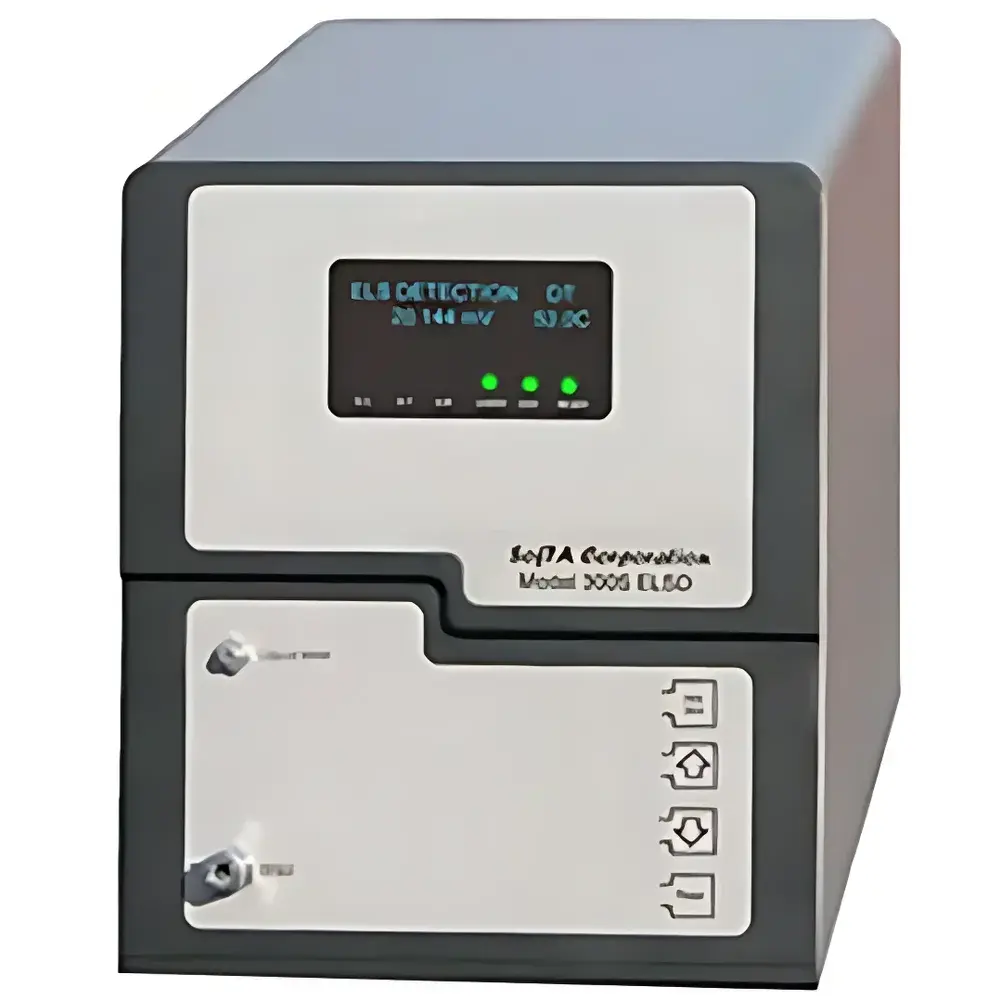
SofTA M300s Pharmaceutical-Grade Evaporative Light Scattering Detector
| Brand | SofTA |
|---|---|
| Model | M300s |
| Detector Type | Evaporative Light Scattering Detector (ELSD) |
| Wavelength Range | 195 nm (Deuterium Lamp) |
| Detection Principle | Dual-Beam Light Scattering |
| Light Source | Deuterium Lamp |
| Drift Tube Temperature Range | Ambient to 120 °C |
| Nebulizer Zone Temperature Range | 10–70 °C |
| Nebulizer Material | PTFE (Teflon®) |
| Minimum Detectable Mass | 100 pg (Glucopyranoside, Micro-HPLC) |
| Peak Width (10% height) | 3 s (2 µL direct injection) |
| Dynamic Range | 3 orders of magnitude (normal/low gain) |
| Mobile Phase Flow Rate | Up to 5 mL/min |
| Gas Requirement | N₂ or inert gas at 50 psi |
| Gas Consumption | ≤2.5 L/min |
| Interface | RS-232 |
| Power | 120/240 V, 50/60 Hz, 600 W |
| Dimensions (W×D×H) | 25 × 45 × 29 cm |
| Weight | 15 kg |
Overview
The SofTA M300s is a pharmaceutical-grade evaporative light scattering detector (ELSD) engineered for robust, reproducible detection of non-chromophoric and semi-volatile analytes in liquid chromatography workflows. Unlike UV-Vis detectors, the M300s operates on the principle of nebulization, solvent evaporation, and light scattering measurement—making it universally responsive to virtually any analyte that can be eluted and dried without thermal degradation. Its dual-beam optical architecture, coupled with a deuterium lamp (195 nm output) and near-infrared laser (650 nm, <5 mW, FCC Class I eye-safe), ensures stable baseline performance and high signal-to-noise ratio across diverse mobile phase compositions—including aqueous, organic, and gradient elution systems. Designed specifically to meet pharmacopoeial compliance requirements—including Chinese Pharmacopoeia (ChP) monographs referencing HPLC-ELSD methods—the M300s delivers method-ready configurations out of the box, minimizing validation overhead in QC/QA laboratories operating under GLP or GMP frameworks.
Key Features
- Patented SofTA Thermal Split Technology enables precise control over droplet evaporation kinetics, optimizing sensitivity and reproducibility across wide-ranging analyte volatilities.
- Cooling-capable ELSD operation supports both organic and inorganic mobile phases at sub-ambient nebulizer zone temperatures (10–70 °C), reducing thermal decomposition of labile compounds.
- PTFE-coated nebulizer nozzle resists clogging, corrosion, and wear—critical for long-term stability when analyzing complex biological matrices or salt-containing buffers.
- Adjustable drift tube temperature (ambient to 120 °C) allows fine-tuning of particle drying efficiency, enhancing response linearity for low-molecular-weight solutes and oligomers.
- Vacuum fluorescent display (VFD) provides high-contrast, ambient-light-readable instrumentation status—including real-time temperature, pressure, filter constant, and self-diagnostic feedback.
- Onboard memory stores up to 10 user-defined detection methods, supporting rapid method recall and instrument reconfiguration without PC dependency.
- Integrated gas management system includes auto-delay shutoff valve, internal pressure regulation, and overpressure protection—eliminating manual gas flow adjustment and preventing accidental cylinder depletion.
Sample Compatibility & Compliance
The M300s is validated for use with reversed-phase, HILIC, and normal-phase HPLC systems delivering flow rates up to 5 mL/min. It accommodates standard and microbore columns, including those employed in ChP-referenced assays for carbohydrates, lipids, saponins, glycosides, and excipients lacking UV chromophores. All wetted surfaces—nebulizer, drift tube, optical chamber, and flow path—are constructed from chemically inert materials: PTFE, 316 stainless steel, anodized aluminum, and borosilicate glass (lens assembly). The detector complies with IEC 61010-1 safety standards and meets electromagnetic compatibility (EMC) requirements per EN 61326-1. Its firmware architecture supports audit-trail-enabled operation when integrated into 21 CFR Part 11–compliant data systems via RS-232 interface.
Software & Data Management
While the M300s operates autonomously via front-panel controls, its RS-232 serial port enables seamless integration with third-party chromatography data systems (CDS), including Empower, Chromeleon, and OpenLab. Instrument parameters—including gain, filter constant, drift tube setpoint, and nebulizer temperature—are fully scriptable and remotely configurable. Raw analog output (0–5 V or fixed 10 mV/5 V) is compatible with analog-input modules of most data acquisition hardware. Internal firmware logs operational events (e.g., power cycles, temperature deviations, error codes) with timestamps—supporting traceability during regulatory audits. No proprietary software installation is required for basic operation; advanced configuration and method archiving are supported through optional SofTA Control Utility (Windows-based, TLS-secured).
Applications
- Quantification of non-UV-absorbing active pharmaceutical ingredients (APIs) and impurities per ChP, USP, and EP monographs.
- Stability-indicating assays for degradation products in forced degradation studies.
- Analysis of polysaccharides, phospholipids, and surfactants in biopharmaceutical formulation development.
- Residual solvent and extractable/leachable screening in packaging compatibility studies.
- Method transfer between R&D, QC, and contract testing laboratories due to inherent inter-unit reproducibility.
- Support of QbD (Quality by Design) initiatives through consistent, physics-based response independent of extinction coefficient.
FAQ
Does the M300s require column heating or post-column derivatization for carbohydrate analysis?
No. The M300s detects carbohydrates directly via mass-dependent light scattering after nebulization and solvent removal—eliminating the need for derivatization or specialized columns.
Can the M300s be used with acetonitrile/water gradients containing 0.1% TFA?
Yes. Its PTFE nebulizer and corrosion-resistant fluid path tolerate low-concentration acidic modifiers; however, drift tube temperature should be optimized to prevent acid condensation.
Is the 100 pg sensitivity specification achievable under standard HPLC conditions?
The 100 pg limit applies to micro-HPLC (2 µL injection, narrow-bore column); under conventional 4.6 mm ID column conditions (10–20 µL injection), typical LOD is 1–5 ng depending on analyte volatility and mobile phase composition.
How does the M300s handle high-salt mobile phases such as ammonium acetate buffers?
Salt residues are removed via thermal splitting and controlled drift tube heating; routine maintenance includes periodic cleaning of the nebulizer capillary and drift tube exit aperture using warm water or dilute acetic acid.
Does the instrument support remote monitoring in unattended overnight runs?
Yes. RS-232 communication enables status polling and alarm triggering; combined with its auto-shutdown gas valve and thermal safeguards, the M300s is certified for unattended operation in ISO 17025-accredited labs.





