
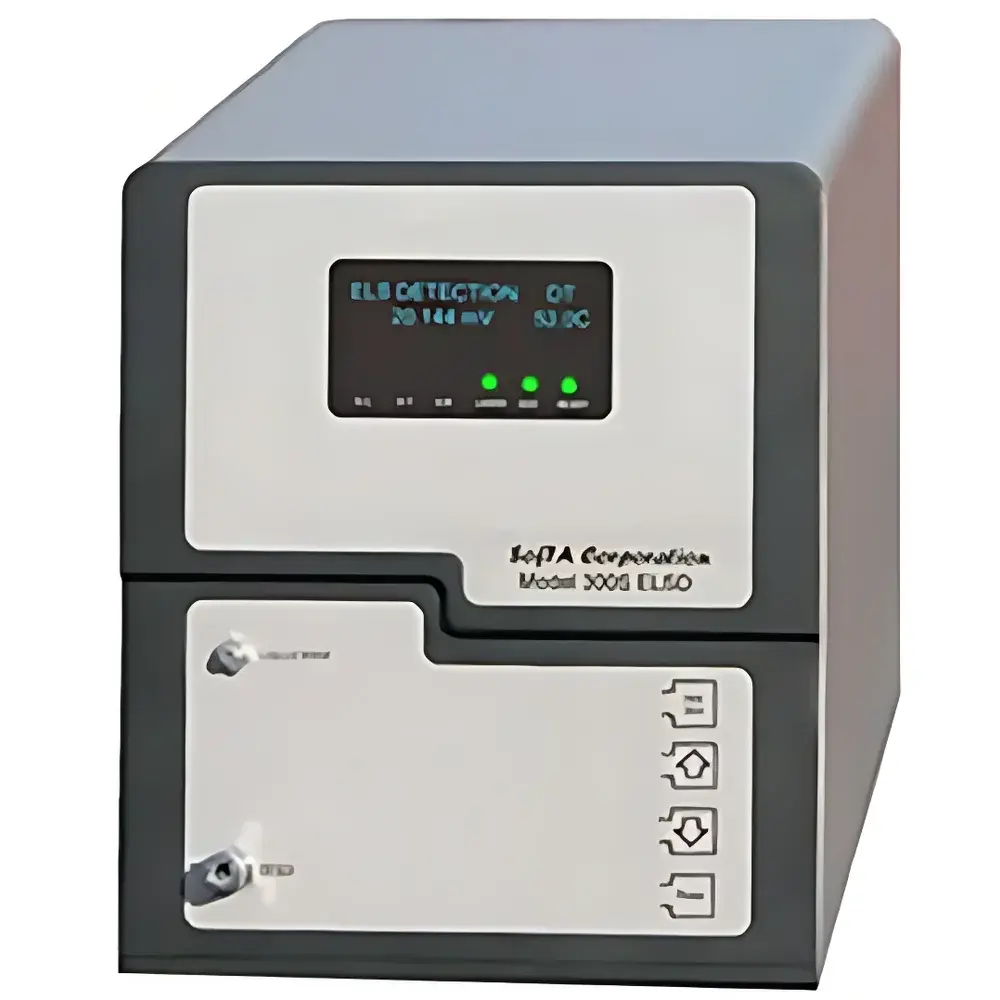
SofTA Model 300s Evaporative Light Scattering Detector
| Brand | SofTA |
|---|---|
| Origin | Imported |
| Manufacturer Type | Authorized Distributor |
| Model | Model 300s |
| Detection Principle | Evaporative Light Scattering Detection (ELSD) |
| Wavelength Range | 195–600 nm |
| Optical Configuration | Dual-Beam |
| Light Source | Deuterium Lamp |
| Nebulizer Material | PTFE (Teflon®) |
| Drift Tube Temperature Range | Ambient to 120 °C |
| Nebulization Zone Temperature Range | 10–70 °C |
| Laser Source | 650 nm Near-Infrared Diode (<5 mW, FCC Class I Eye-Safe) |
| Detector | Sealed Large-Area Silicon Photodiode with Integrated High-Gain Amplifier |
| Minimum Detectable Mass | 100 pg Glucopyranoside (Micro-HPLC, 2 µL direct injection, peak width at 10% height: 3 s) |
| Dynamic Range | 3 decades (standard gain), up to 4.5 decades with extended range mode |
| Mobile Phase Flow Rate Compatibility | Up to 5 mL/min |
| Gas Supply | N₂ or other inert gas, 50 psi inlet pressure |
| Gas Consumption | ≤2.5 L/min |
| Liquid Path Materials | PTFE, Stainless Steel, Alumina, Borosilicate Glass (optical lens) |
| User Interface | Vacuum Fluorescent Display (VFD), 4 multifunction buttons |
| Data Output | Fixed 10 mV / 5 V analog |
| Power | 120/240 V AC, 50/60 Hz, 600 W |
| Dimensions (W×D×H) | 25 × 45 × 29 cm |
| Weight | 15 kg |
Overview
The SofTA Model 300s Evaporative Light Scattering Detector (ELSD) is a precision-engineered, thermally controlled detection system designed for universal, non-destructive quantification of non-chromophoric and semi-volatile analytes in liquid chromatography workflows. Operating on the fundamental principle of nebulization, solvent evaporation, and light scattering measurement, the Model 300s converts eluting solutes into fine dry particles within a precisely regulated drift tube, where they scatter light from a stable near-infrared laser source. Unlike UV-Vis detectors, ELSD response is largely independent of molecular structure—enabling consistent detection of carbohydrates, lipids, surfactants, polymers, and natural product aglycones without chromophores. Its dual-beam optical architecture, coupled with a deuterium lamp for broad-spectrum baseline monitoring (195–600 nm), ensures high baseline stability and minimizes drift during gradient elution. The instrument’s integrated thermal management—including independently adjustable nebulization zone (10–70 °C) and drift tube (ambient–120 °C)—enables robust performance across diverse mobile phase compositions, including high-boiling solvents (e.g., DMSO, glycerol) and aqueous-inorganic buffers.
Key Features
- Thermal分流 (Thermal Split) Technology: SofTA’s proprietary heat-controlled nebulization zone enables precise particle size modulation—optimizing sensitivity and reproducibility across gradient and isocratic methods without mechanical flow splitting.
- Cryogenic-Ready Operation: Refrigerated nebulization capability allows stable ELSD operation with volatile organic solvents (e.g., acetonitrile, methanol) and non-volatile aqueous buffers alike—eliminating condensation artifacts and enhancing signal-to-noise ratio.
- Chemically Inert Fluidics Pathway: Entire liquid path constructed from PTFE, 316 stainless steel, alumina, and borosilicate glass ensures compatibility with aggressive solvents, acidic/basic mobile phases, and corrosive additives (e.g., TFA, ammonium acetate).
- Intelligent Gas Management System: Integrated pressure-regulated inlet valve with automatic timed shut-off prevents inadvertent gas depletion; built-in overpressure protection safeguards internal components and meets laboratory safety protocols.
- High-Fidelity Optical Detection: Sealed large-area silicon photodiode with embedded low-noise amplifier delivers stable signal output (10 mV or 5 V fixed; 0–5 V scalable) and supports dynamic range extension up to 4.5 decades via gain optimization.
- Intuitive Human-Machine Interface: Vacuum fluorescent display (VFD) provides real-time visualization of temperature, pressure, filter constant, self-test status, and alarm conditions; four tactile multifunction buttons enable rapid method recall and parameter adjustment.
Sample Compatibility & Compliance
The Model 300s demonstrates broad compatibility with reversed-phase, HILIC, normal-phase, and size-exclusion chromatography systems, particularly when paired with microbore or analytical-scale HPLC configurations (flow rates up to 5 mL/min). Its universal detection mechanism aligns with pharmacopeial requirements outlined in USP , EP 2.2.29, and ChP (Chinese Pharmacopoeia) monographs for ELSD-based assay validation. The instrument supports GLP/GMP-aligned workflows through configurable audit trails (via optional software integration), RS-232 data logging, and deterministic signal output—facilitating compliance with FDA 21 CFR Part 11 when deployed with validated third-party acquisition platforms. All optical and electronic subsystems conform to IEC 61010-1 safety standards; the 650 nm laser complies with FCC Class I eye-safety regulations.
Software & Data Management
While the Model 300s operates as a standalone detector with fully autonomous control, it is engineered for seamless integration into chromatographic data systems via its RS-232 serial port. Analog outputs (10 mV, 5 V, or 0–5 V) are compatible with all major HPLC data acquisition hardware—including Agilent ChemStation, Waters Empower, and Thermo Chromeleon—enabling synchronized signal capture and post-run calibration. Ten user-defined methods can be stored internally, each retaining nebulizer temperature, drift tube setpoint, gain level, filter constant, and zero-offset parameters. Firmware-level self-diagnostics continuously monitor lamp intensity, detector voltage, gas pressure, and thermal sensor integrity—reporting anomalies via audible alerts and VFD status codes. Optional PC-based configuration utilities support remote firmware updates and advanced method export/import.
Applications
The Model 300s is routinely deployed in pharmaceutical QC laboratories for assay of excipients (e.g., lactose, mannitol), glycosylated APIs, and lipid-based drug products where UV transparency precludes conventional detection. It supports natural product isolation workflows—including saponin, flavonoid glycoside, and polysaccharide profiling—by delivering linear response across wide concentration ranges without derivatization. In food and beverage analysis, it quantifies sucrose, fructose, and starch hydrolysates in complex matrices; in polymer characterization, it enables molar mass distribution assessment via SEC-ELSD coupling. Its tolerance for high-salt mobile phases also makes it suitable for oligonucleotide purification monitoring and carbohydrate mapping in biomanufacturing process development.
FAQ
Does the Model 300s require column heating or post-column derivatization for carbohydrate detection?
No. ELSD detection is inherently label-free and does not rely on chromophore presence or chemical modification.
Can the Model 300s be used with gradient elution containing >40% water?
Yes—its thermally stabilized drift tube and adaptive nebulization zone maintain consistent particle formation and scattering efficiency across steep aqueous–organic gradients.
Is nitrogen the only acceptable carrier gas?
No. While nitrogen is recommended for optimal baseline stability, argon or other inert gases meeting 50 psi inlet pressure and ≤2.5 L/min flow specifications are functionally equivalent.
How is detector response calibrated for quantitative analysis?
Calibration is performed using external standard curves of representative analytes (e.g., glucose, sodium taurocholate); response is logarithmic and requires multi-point curve fitting per ICH Q2(R2) guidelines.
What maintenance intervals are recommended for routine operation?
Nebulizer cleaning every 200 injections; drift tube purge weekly; optical lens inspection quarterly; annual verification of temperature sensor accuracy and laser output stability per ISO/IEC 17025 procedures.
Related Products




