
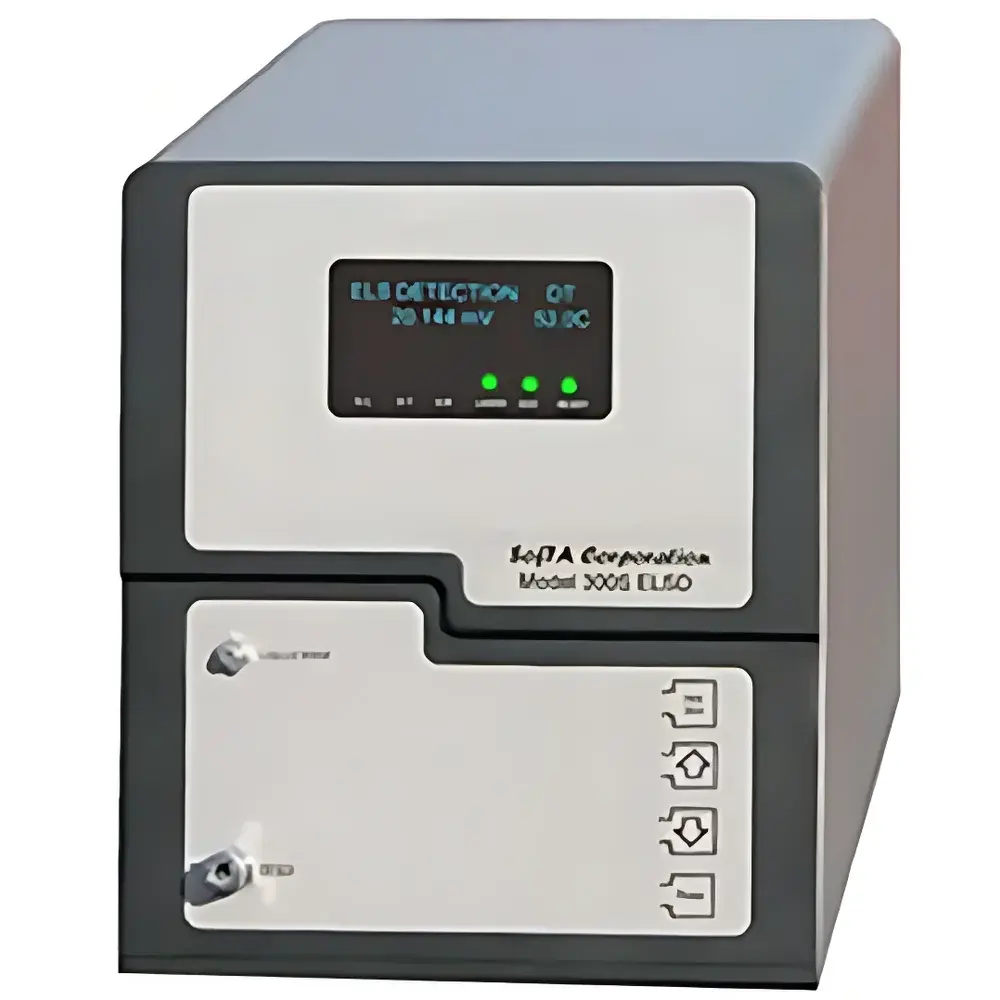
SofTA Model 300s Evaporative Light Scattering Detector
| Brand | SofTA |
|---|---|
| Origin | Imported |
| Manufacturer Type | Authorized Distributor |
| Instrument Type | Evaporative Light Scattering Detector (ELSD) |
| Compatible System | HPLC (Analytical & Preparative) |
| Wavelength Range | 195–600 nm |
| Detection Mode | Dual-Beam |
| Light Source | Deuterium Lamp |
| Nebulizer Material | PTFE |
| Drift Tube Temperature Range | Ambient to 120 °C |
| Nebulization Zone Temperature Range | 10–70 °C |
| Laser Source | 650 nm Near-Infrared Diode (<5 mW, FCC Class I Eye-Safe) |
| Detector Element | Sealed Large-Area Silicon Photodiode with Integrated High-Gain Amplifier |
| Minimum Detectable Mass | 100 pg Glucopyranoside (Micro-HPLC, 2 µL Direct Injection, 3 s Peak Width at 10% Height) |
| Dynamic Range | 3 orders of magnitude (Normal/Low Gain), Extended to 4–4.5 orders with gain optimization |
| Mobile Phase Flow Rate | Up to 5 mL/min |
| Gas Supply | Nitrogen or inert gas, 50 psi inlet pressure |
| Gas Consumption | ≤2.5 L/min |
| Fluidic Path Materials | PTFE, Stainless Steel, Alumina, Optical Glass |
| User Interface | Vacuum Fluorescent Display (VFD) with 4 Multifunction Keys |
| Onboard Method Storage | 10 Methods |
| Signal Output | Fixed 10 mV or 5 V |
| Digital Interface | RS-232 (Rear Panel) |
| Power | 120/240 V AC, 50/60 Hz, 600 W |
| Dimensions | 25 W × 45 D × 29 H cm |
| Weight | 15 kg |
Overview
The SofTA Model 300s Evaporative Light Scattering Detector (ELSD) is a precision-engineered, thermally controlled detection system designed for universal, non-destructive quantification of non-volatile and semi-volatile analytes in liquid chromatography workflows. Operating on the fundamental principle of nebulization, solvent evaporation, and light scattering measurement, the Model 300s converts eluting solutes into fine particles via a PTFE-coated nebulizer, removes volatile mobile phase components in a precisely regulated drift tube, and detects the resulting aerosol cloud using a near-infrared (650 nm) laser and a sealed high-sensitivity silicon photodiode. Its dual-beam optical architecture—comprising a deuterium lamp for broad UV-Vis spectral monitoring (195–600 nm) and a dedicated low-power NIR laser for primary scattering detection—ensures robust baseline stability and minimizes interference from solvent gradients or column bleed. Engineered for integration with both analytical and preparative HPLC systems, the Model 300s achieves rapid thermal equilibration and supports gradient-compatible operation across diverse mobile phase compositions—including aqueous, organic, and mixed solvent systems—without signal suppression or baseline drift.
Key Features
- Thermal分流 (Thermal Split) Technology: SofTA’s proprietary temperature-controlled nebulization zone (10–70 °C) enables precise aerosol splitting, optimizing sensitivity and reproducibility for both high-boiling-point compounds and shallow-gradient separations.
- Cryogenic-Capable Operation: Unique refrigerated ELSD design permits stable detection under sub-ambient conditions—critical for preserving thermally labile analytes and improving signal-to-noise ratios with volatile or corrosive mobile phases (e.g., TFA, HFIP).
- Chemically Resistant Fluidics: Entire liquid path constructed from PTFE, 316 stainless steel, alumina, and optical-grade glass ensures long-term compatibility with aggressive solvents (acetonitrile, THF, chlorinated hydrocarbons) and acidic/basic buffers.
- Intelligent Gas Management: Integrated pressure-regulated inlet valve, automatic delayed shut-off, and overpressure protection eliminate manual gas-flow tuning and prevent inadvertent cylinder depletion—enhancing operational safety and compliance with laboratory gas-handling protocols.
- Onboard Intelligence: Vacuum fluorescent display (VFD) with real-time diagnostics, self-test reporting, audible status alerts, and storage for up to 10 user-defined methods—including pre-configured parameters aligned with Chinese Pharmacopoeia HPLC-ELSD validation requirements.
Sample Compatibility & Compliance
The Model 300s delivers consistent response across compound classes lacking strong chromophores or electrochemical activity—including carbohydrates, lipids, surfactants, polymers, natural products, and synthetic small molecules. Its universal detection mechanism avoids the wavelength-dependent limitations of UV absorbance and eliminates ionization bias inherent in mass spectrometry. The detector meets essential regulatory expectations for routine QC/QA environments: its analog and digital signal outputs support audit-trail-capable data acquisition when paired with validated chromatography data systems (CDS); firmware supports configurable filter constants and gain settings traceable to instrument logs; and hardware-level gas and temperature controls align with GLP/GMP operational controls (e.g., 21 CFR Part 11-compliant CDS integration via RS-232). While not certified to a specific ISO standard, its design adheres to general principles outlined in ISO/IEC 17025 for detector performance verification—including linearity assessment, LOD/LOQ determination per ICH Q2(R2), and system suitability testing per USP and EP 2.2.46.
Software & Data Management
The Model 300s operates as a standalone detector with full local control—no driver installation or proprietary software required. All operational parameters (drift tube temperature, nebulizer zone temperature, gain, filter constant, zero calibration) are adjustable via front-panel interface and retained in non-volatile memory. Analog output (0–5 V or fixed 10 mV/5 V) provides seamless integration with third-party CDS platforms (e.g., Waters Empower, Agilent OpenLab, Thermo Chromeleon). RS-232 serial communication enables remote status interrogation, method recall, and error logging—supporting automated run sequences and electronic record retention when deployed within validated environments. Firmware includes built-in self-diagnostics that report sensor health, gas pressure status, thermal stability, and optical alignment integrity—facilitating preventive maintenance scheduling and reducing unplanned downtime.
Applications
- Pharmaceutical Quality Control: Quantification of excipients (lactose, mannitol), APIs without UV chromophores (e.g., certain peptides, glycosylated compounds), and degradation products per ChP monographs requiring HPLC-ELSD.
- Natural Product Analysis: Detection of triterpenoid saponins, flavonoid glycosides, and polysaccharide fractions in herbal extracts where UV response is weak or variable.
- Lipidomics & Metabolomics: Robust detection of phospholipids, glycerolipids, and sterol esters in complex biological matrices without derivatization.
- Polymer Characterization: GPC/SEC analysis of polyethylene glycols, poloxamers, and other non-UV-absorbing macromolecules using refractive index-independent detection.
- Process Monitoring: Real-time detection in preparative HPLC purification of synthetic intermediates, especially under high-flow (≤5 mL/min) or high-salt mobile phase conditions.
FAQ
Does the Model 300s require external gas flow controllers or regulators?
No—the detector incorporates an integrated pressure-regulated inlet valve and automatic overpressure relief, eliminating the need for external regulators or manual flow adjustment.
Can it be used with aqueous mobile phases containing >0.1% TFA?
Yes—PTFE nebulizer and corrosion-resistant fluidic materials ensure reliable operation with acidic modifiers, including trifluoroacetic acid and formic acid, at concentrations commonly used in reversed-phase LC.
Is the 650 nm laser compliant with international laser safety standards?
Yes—the NIR diode emits <5 mW and is classified as FCC Class I, posing no ocular hazard under normal operating conditions.
How is baseline stability maintained during gradient elution?
Through dual-beam compensation, active temperature stabilization of both nebulization and drift zones, and programmable filter constants that suppress solvent vapor noise without sacrificing peak resolution.
What validation documentation is provided with the instrument?
SofTA supplies a Factory Acceptance Test (FAT) report, IQ/OQ-ready protocol templates, and a comprehensive technical manual—including specifications, maintenance schedules, and troubleshooting guides aligned with ISO/IEC 17025 and FDA guidance for analytical instrument qualification.
Related Products






