
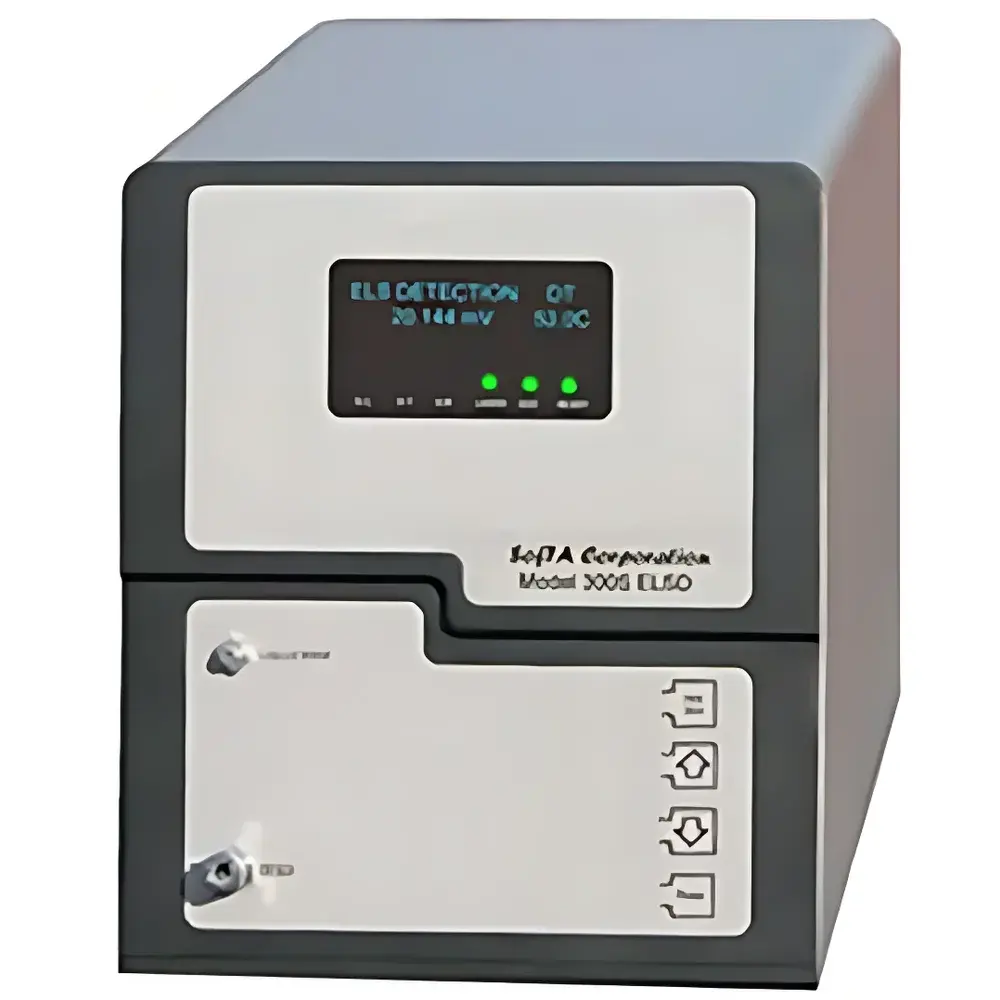
SofTA Model 300s Evaporative Light Scattering Detector
| Brand | SofTA |
|---|---|
| Origin | Imported |
| Manufacturer Type | Authorized Distributor |
| Model | 300s |
| Detection Principle | Evaporative Light Scattering (ELSD) |
| Wavelength | 650 nm (Near-Infrared Laser) |
| Beam Configuration | Dual-Beam |
| Light Source | 650 nm NIR Laser (<5 mW, FCC Eye-Safe Compliant) |
| Nebulizer | PTFE-Coated Stainless Steel Capillary |
| Drift Tube Temperature Range | Ambient to 120 °C |
| Nebulization Zone Temperature Range | 10–70 °C |
| Sensitivity | 100 pg Glucopyranoside (Micro-HPLC, 2 µL direct injection, peak width at 10% height = 3 s) |
| Dynamic Range | 3 decades (normal/low gain), extendable to 4–4.5 decades with signal processing |
| Flow Rate Compatibility | Up to 5 mL/min (HPLC & preparative LC) |
| Gas Requirement | N₂ or other inert gas, 50 psi inlet pressure |
| Gas Consumption | ≤2.5 L/min |
| Integrated Pressure Regulation | Yes, with automatic shutoff delay and overpressure protection |
| Fluidic Path Materials | PTFE, 316 stainless steel, alumina, borosilicate glass (optical lens) |
| User Interface | Vacuum Fluorescent Display (VFD), 4 multifunction buttons |
| Onboard Method Storage | 10 user-defined methods |
| Signal Output | Fixed 10 mV or 5 V |
| Digital Interface | RS-232 (rear panel) |
| Power | 120/240 V AC, 50/60 Hz, 600 W |
| Dimensions (W×D×H) | 25 × 45 × 29 cm |
| Weight | 15 kg |
Overview
The SofTA Model 300s Evaporative Light Scattering Detector (ELSD) is a precision-engineered, thermally regulated detection system designed for universal, non-destructive quantification of non-volatile and semi-volatile analytes in liquid chromatography workflows. Unlike UV-Vis or fluorescence detectors, the 300s operates on the principle of nebulization, solvent evaporation, and light scattering—making it inherently mass-sensitive and independent of chromophore presence. Its dual-beam optical architecture, coupled with a temperature-stabilized nebulization zone and drift tube, ensures high reproducibility across gradient elution, high-boiling-point solvents, and aqueous–organic mobile phases. The integrated 650 nm near-infrared laser source (<5 mW) complies with FCC Class I eye-safety standards, while the fully sealed, high-gain silicon photodiode detector delivers low-noise signal acquisition. Engineered for compatibility with analytical and preparative HPLC systems—including those referenced in the Chinese Pharmacopoeia—the Model 300s supports method transfer, regulatory-compliant validation, and routine QC without re-optimization.
Key Features
- Thermal分流 (Thermal Split) Technology: SofTA’s proprietary heat-controlled nebulization zone enables precise aerosol splitting—critical for maintaining consistent response across volatile and non-volatile solvent gradients.
- Cryogenic-Ready Operation: Capable of sub-ambient nebulization (down to 10 °C), enabling stable detection with high-water-content or thermally labile mobile phases (e.g., ammonium acetate buffers, TFA-containing systems).
- Chemically Inert Fluidics: PTFE-coated nebulizer capillary, 316 stainless steel lines, alumina components, and borosilicate optical windows ensure long-term resistance to corrosion, clogging, and carryover—even with aggressive solvents or salt-containing eluents.
- Intelligent Gas Management: Built-in pressure regulator, automatic delayed shutoff valve, and overpressure protection eliminate manual gas flow tuning and prevent inadvertent cylinder depletion.
- Onboard Intelligence: Vacuum fluorescent display (VFD) with real-time diagnostics, self-test reporting, and intuitive 4-button navigation. Stores up to 10 validated detection methods with independent temperature, gain, and filter settings.
- Regulatory-Ready Architecture: Designed to support audit trails, electronic signatures, and data integrity requirements under FDA 21 CFR Part 11 and GLP/GMP environments when paired with compliant chromatography data systems (CDS).
Sample Compatibility & Compliance
The Model 300s detects any non-volatile or low-volatility compound that forms stable particles upon solvent removal—including carbohydrates, lipids, surfactants, polymers, natural products, and synthetic organic molecules lacking UV chromophores. It is routinely applied in pharmaceutical stability-indicating assays (per ICH Q5C), excipient quantification (USP ), and herbal extract profiling (Chinese Pharmacopoeia Vol. IV). All wetted materials comply with USP Class VI biocompatibility standards. The detector meets CE marking requirements for electromagnetic compatibility (EMC Directive 2014/30/EU) and low-voltage safety (LVD Directive 2014/35/EU). Its optical design conforms to ISO 13847:2013 for light-scattering instrumentation performance verification.
Software & Data Management
The 300s communicates via standard RS-232 serial protocol, enabling seamless integration with major CDS platforms (e.g., Waters Empower, Thermo Chromeleon, Agilent OpenLab). Analog outputs (0–5 V or fixed 10 mV/5 V) are compatible with legacy chart recorders and PLC-based process control systems. Firmware supports time-stamped event logging—including temperature ramping, gas valve actuation, and calibration status—for traceable method execution. When deployed in validated environments, raw signal files (ASCII .txt) and instrument metadata (including firmware version, lamp hours, and thermal history) are retained as part of the audit trail. Optional firmware upgrades provide enhanced baseline stabilization algorithms and improved low-concentration linearity correction per ASTM E2656-22.
Applications
- Pharmaceutical QC: Quantitation of APIs and impurities in formulations containing non-UV-absorbing excipients (e.g., polysorbates, cyclodextrins, PEG derivatives).
- Natural Product Analysis: Detection of saponins, flavonoid glycosides, and terpene lactones in botanical extracts where UV response is weak or masked.
- Lipidomics & Glycomics: Robust response to phospholipids, triglycerides, and oligosaccharides without derivatization.
- Preparative HPLC Fraction Monitoring: Real-time ELSD-triggered fraction collection using analog threshold signals.
- Method Development Support: Rapid optimization of nebulizer and drift tube temperatures for new mobile phase systems—especially critical for HILIC, SEC, and SFC applications.
FAQ
Does the Model 300s require column heating or post-column derivatization?
No. As a universal, label-free detector, it requires no post-column chemistry or thermal modification of the effluent stream.
Can it be used with corrosive mobile phases such as trifluoroacetic acid (TFA) or hydrochloric acid?
Yes—its PTFE-lined nebulizer and alumina drift tube components resist degradation from acidic and basic eluents within pH 1–12.
Is the 300s compatible with UHPLC systems operating above 1000 bar?
It interfaces directly with any HPLC-compatible flow path; however, backpressure management must be handled upstream via restrictor tubing or dedicated low-dead-volume mixing tees.
How is sensitivity verified during routine qualification?
Per USP , users perform system suitability testing using glucopyranoside reference standards at defined concentrations (e.g., 0.1–10 µg on-column), measuring signal-to-noise ratio, peak symmetry, and retention time repeatability.
Does the instrument support remote monitoring or network connectivity?
Native Ethernet or Wi-Fi is not included; however, RS-232-to-Ethernet converters (e.g., Digi One SP) enable secure IP-based access within validated IT infrastructures.
Related Products




