
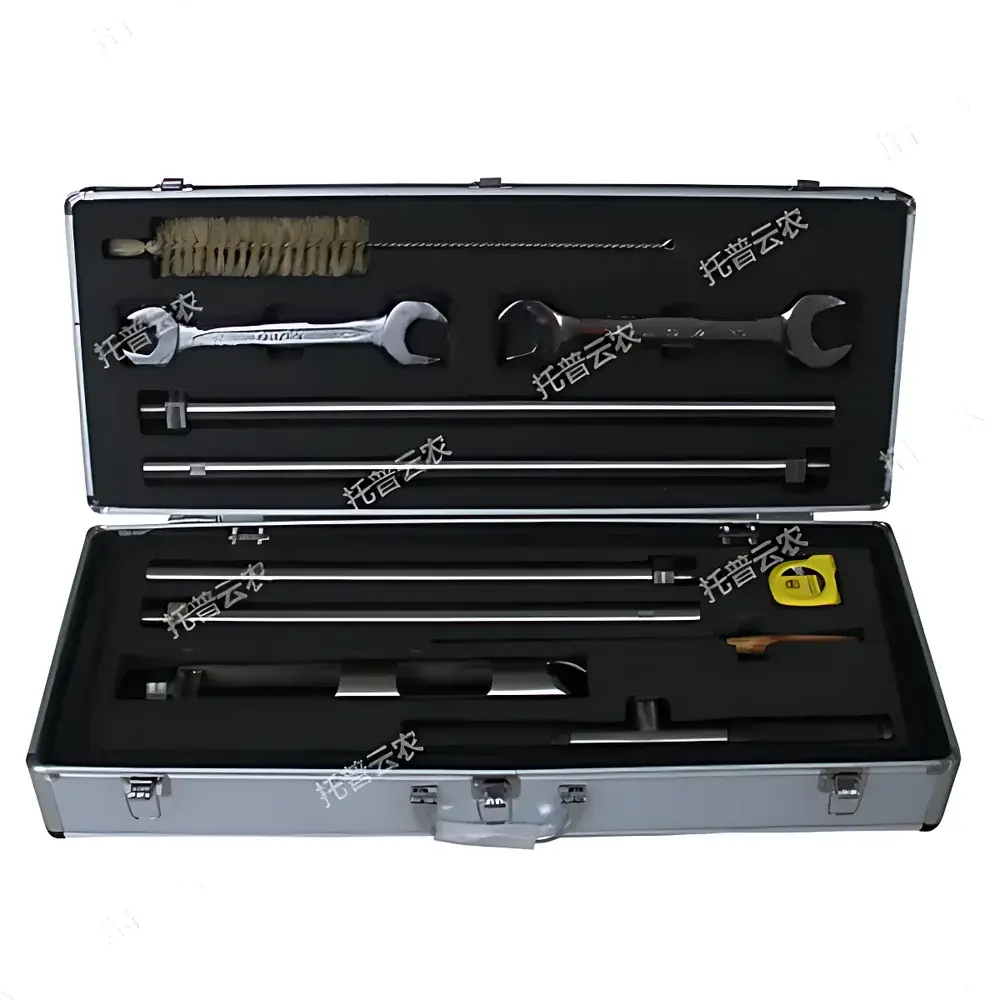
Soil Sampling Auger TPLQ-2 by Top Cloud-agri
| Brand | Top Cloud-agri |
|---|---|
| Origin | Zhejiang, China |
| Manufacturer Type | Direct Manufacturer |
| Country of Origin | China |
| Model | TPLQ-2 |
| Instrument Type | Soil Moisture/Suction Probe Support Tool |
| Depth Options | 1 m / 1.5 m / 2 m |
| Material | AISI 304 Stainless Steel |
| Sample Length per Insertion | 15–20 cm |
| Depth Scale | Graduated at 100 mm intervals |
| Connection Type | Threaded (M12 × 1.75 mm standard interface) |
| Accessories Included | Aluminum Carrying Case, Brush, Two Wrenches, 3-m Tape Measure, Soil Scraper, Ergonomic Handle, Cutting Head, Four Extension Rods |
Overview
The TPLQ-2 Soil Sampling Auger is a field-deployable, manually operated helical soil coring tool engineered for precise, low-disturbance collection of stratified soil samples across variable terrain and moisture conditions. Designed in accordance with ASTM D1586 (Standard Test Method for Penetration Resistance and Classification of Soils) and ISO 22029:2021 (Soil quality — Sampling — Guidance on sampling strategies), the auger operates on the principle of rotational torque transfer through a continuous Archimedean screw geometry. This geometry ensures consistent core retention during extraction, minimizing sample sloughing and preserving vertical layer integrity—critical for profile-based analysis including moisture gradient mapping, nutrient horizon assessment, and contaminant depth profiling. Unlike push-type samplers or percussion-driven probes, the TPLQ-2 delivers controlled, incremental penetration without requiring external power sources or hydraulic assistance, making it suitable for remote, off-grid, or ecologically sensitive sites where minimal site footprint is mandated.
Key Features
- Construction from AISI 304 stainless steel ensures chemical inertness and corrosion resistance, eliminating metallic leaching that could compromise elemental analysis (e.g., Fe, Cr, Ni quantification via ICP-MS or XRF).
- Helical cutting edge geometry optimized for soil shear strength ranges typical of loam, silt, clay, and sandy loam textures (0.5–25 kPa cohesion; 20–45° internal friction angle), enabling stable advancement without blade deflection.
- Modular threaded assembly (M12 × 1.75 mm pitch) allows rapid configuration of 1 m, 1.5 m, or 2 m total working lengths using four standardized extension rods—each marked with permanent laser-etched depth graduations at 100 mm intervals for traceable, repeatable stratigraphic sampling.
- Integrated handle ergonomics reduce operator fatigue during repeated insertion cycles; average torque requirement remains below 12 N·m at full 2 m depth in medium-density soils (bulk density ≤ 1.4 g/cm³).
- Calibrated 15–20 cm core length per full rotation cycle supports standardized volumetric subsampling aligned with ISO 11464:2021 (Soil quality — Pretreatment of samples) and USP (Sampling Plans for Pharmaceutical Raw Materials).
- Secondary utility as a rigid mounting rod for calibrated soil moisture sensors (e.g., EC-5, 5TE, or GS3 probes), enabling co-located in situ water content measurement at discrete depths without repositioning.
Sample Compatibility & Compliance
The TPLQ-2 is validated for use with mineral soils ranging from coarse sand (D₅₀ ≥ 0.5 mm) to heavy clay (plasticity index > 25). It is not recommended for gravel-rich (>15% particles > 2 mm) or highly compacted subsoil layers (CPT tip resistance > 3 MPa). All components comply with RoHS Directive 2011/65/EU and meet EN 12549:2017 requirements for field sampling tools used in environmental monitoring programs. The stainless-steel construction satisfies GLP-compliant material traceability standards (OECD Series on Principles of Good Laboratory Practice), ensuring no analyte adsorption or catalytic surface interference during subsequent laboratory analysis (e.g., TOC, NO₃⁻, or PAH extraction).
Software & Data Management
While the TPLQ-2 is a manual, non-electronic instrument, its design integrates seamlessly into digital field workflows. Depth-specific sample identifiers generated during operation can be logged directly into LIMS-compatible platforms (e.g., LabWare LIMS, Thermo Fisher SampleManager) via barcode-labeled sample containers. When used with compatible moisture sensors, raw sensor output (e.g., dielectric permittivity, EC, temperature) may be captured via SDI-12 or analog 0–2.5 V interfaces and synchronized with spatial metadata (GPS coordinates, timestamp, depth code) using open-source tools such as QGIS + Field Papers or commercial solutions like ESRI ArcGIS Field Maps. Audit trails for sampling location, depth, and operator ID are fully supportable under FDA 21 CFR Part 11 when paired with validated electronic data capture systems.
Applications
- Long-term ecological research (LTER) soil profile monitoring across climate transects.
- Agricultural precision farming—spatially resolved sampling for variable-rate fertilization planning.
- Environmental site assessments (ESAs) per ASTM E1527-21, supporting Phase I and II investigations.
- Regulatory compliance sampling for landfill cover verification (EPA SW-846 Method 5035A).
- Validation of in situ geophysical surveys (e.g., ERT or GPR) through ground-truthing of layer boundaries and moisture anomalies.
- Academic pedagogy in soil science laboratories, supporting hands-on instruction in horizon identification, bulk density determination, and texture-by-feel protocols.
FAQ
Is the TPLQ-2 suitable for frozen or rocky soils?
No. The auger is designed for unfrozen, non-cemented, and particle-size-homogeneous soils. Ice lenses or embedded stones >5 mm diameter risk thread stripping or blade deformation.
Can the extension rods be interchanged with other Top Cloud-agri models?
Only with TPLQ-series augers sharing identical M12 × 1.75 mm thread specification and shoulder alignment tolerances (±0.1 mm). Cross-compatibility with TPYQ or TPSQ series is not guaranteed.
Does the aluminum carrying case meet IATA carry-on size requirements?
Yes—the case dimensions (58 × 12 × 12 cm) conform to standard airline cabin baggage limits; TSA-approved locks are recommended for international deployments.
How is calibration traceability maintained for depth measurements?
Each graduated rod undergoes factory verification against NIST-traceable linear standards (certified uncertainty ±0.3 mm per 100 mm segment); calibration certificates are supplied with every unit batch.
What maintenance is required between sampling campaigns?
Rinse all components with deionized water after use; air-dry completely before storage. Apply food-grade mineral oil to threads biannually to prevent galling. No lubrication is required on the helix surface.







