
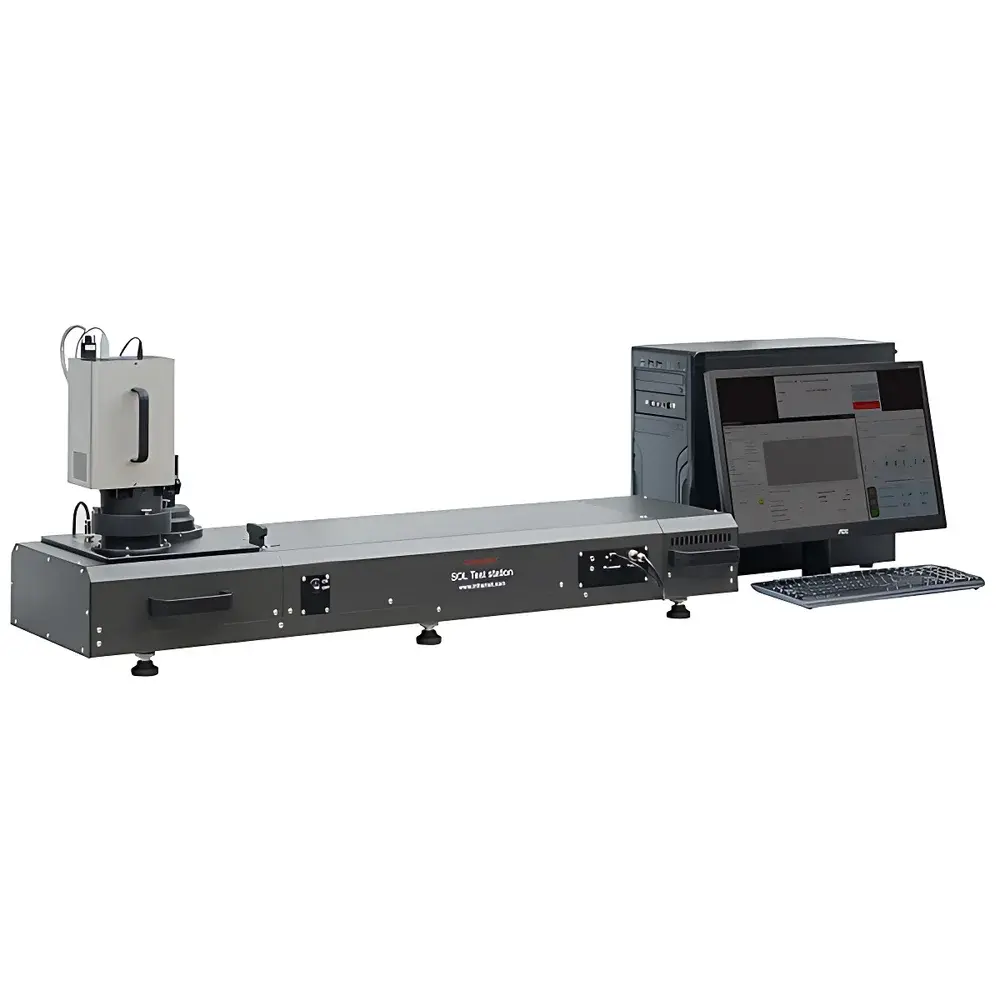
SOL VIS-SWIR Imaging Detector Test System by Inframet
| Brand | Inframet |
|---|---|
| Origin | Poland |
| Model | SOL |
| Spectral Range | 400–2500 nm |
| Number of Discrete Bandpass Channels | 16 |
| Adjustable Irradiance | Continuous |
| Filter Type | Precision Narrowband Interference Filters |
| Operating Temperature | +5 °C to +35 °C |
| Storage Temperature | −5 °C to +55 °C |
| Dimensions (W×D×H) | 119 × 40 × 24 cm |
| Weight | 29.2 kg |
| Measurement Capabilities | NEI, Responsivity, Linearity, Dynamic Range, D*, Quantum Efficiency, Spatial Noise, Relative Spectral Responsivity |
Overview
The SOL VIS-SWIR Imaging Detector Test System is a precision-engineered calibration and characterization platform designed for quantitative evaluation of focal plane arrays (FPAs) and camera cores sensitive across the visible to short-wave infrared spectrum (400–2500 nm). Developed by Inframet—a Polish manufacturer specializing in radiometric and photometric test instrumentation—the SOL system implements a monochromatic, step-tunable illumination architecture based on high-stability broadband source coupling with a motorized filter wheel housing sixteen certified narrowband interference filters. Each spectral channel delivers spectrally defined irradiance with traceable bandwidths (FWHM typically <10 nm), enabling rigorous determination of detector-specific radiometric and photometric transfer functions under controlled, repeatable conditions. Unlike broadband or LED-based simulators, the SOL’s filter-driven spectral stepping ensures unambiguous attribution of response variation to wavelength-dependent quantum efficiency—critical for validation of InGaAs, silicon, and black silicon detectors used in scientific imaging, remote sensing, industrial inspection, and defense-grade EO/IR systems.
Key Features
- Traceable spectral irradiance generation across 16 discrete bands from 400 nm to 2500 nm, each defined by NIST-traceable narrowband interference filters
- Continuous, calibrated irradiance adjustment over six decades (typically 10⁻⁶–10⁰ W/m²/nm), enabling dynamic range and linearity mapping
- Integrated spatial uniformity optics delivering >98% flatness over Ø25 mm field—validated per ISO 15739 and ASTM E1553
- Thermally stabilized optical bench with active ambient temperature monitoring (+5 °C to +35 °C operational envelope)
- Modular design supporting optional accessories: collimated output adapter, fiber-coupled input port, and external shutter synchronization interface
- Compliance-ready architecture: supports audit trails, user access levels, and parameter logging aligned with GLP and ISO/IEC 17025 laboratory requirements
Sample Compatibility & Compliance
The SOL system accommodates standard-format imaging detectors—including bare FPAs, hybridized camera cores, and OEM modules—with mechanical mounting via adjustable kinematic stage (M4/M6 threaded holes) and electrical interfacing through configurable BNC/SMA breakout panels. It supports both front-illuminated and back-illuminated architectures and is compatible with vacuum-chamber integration for cryogenic detector testing (with optional thermal isolation kit). All radiometric outputs are calibrated against Inframet’s primary standard tungsten-halogen source, itself validated annually against PTB (Physikalisch-Technische Bundesanstalt) reference data. The system conforms to key international standards including ISO 15739 (electronic still-picture imaging — noise measurements), ISO 17850 (spectral responsivity of IR detectors), and ASTM E2722 (standard practice for characterizing SWIR cameras). Full calibration certificates—including uncertainty budgets per GUM (JCGM 100:2008)—are provided with each unit.
Software & Data Management
Inframet’s proprietary SOL Control Suite (v4.x, Windows 10/11 64-bit) provides full instrument orchestration, automated measurement sequencing, and standardized reporting. The software enables scripted acquisition of full spectral response curves, pixel-level noise maps (temporal and spatial), and D* derivation using manufacturer-supplied pixel pitch and active area metadata. All raw frame data are stored in IEEE-compliant 32-bit floating-point TIFF format with embedded EXIF tags specifying spectral band ID, irradiance value, exposure time, and environmental sensor readings. Audit logs record operator ID, timestamp, parameter changes, and calibration status—fully compliant with FDA 21 CFR Part 11 requirements when configured with digital signature and role-based authentication. Export options include CSV (for MATLAB/Python post-processing), PDF test reports (ISO 17025 template), and XML metadata packages compatible with LIMS integration.
Applications
- Quantitative validation of relative spectral responsivity (RSR) for InGaAs, Si, and black-Si SWIR imagers per MIL-STD-3009 and ECSS-E-ST-50-12C
- Determination of noise-equivalent irradiance (NEI), detectivity (D*), and quantum efficiency (QE) across extended SWIR bands
- Linearity assessment and dynamic range verification under variable scene luminance conditions
- Pre-shipment acceptance testing for OEM detector suppliers serving aerospace, medical endoscopy, and hyperspectral OEM markets
- Reference-grade inter-laboratory comparison studies coordinated under EURAMET TC-IR initiatives
- Support for ISO/IEC 17025 accreditation of metrology labs performing EO/IR sensor calibration
FAQ
What spectral resolution does the SOL system achieve?
The system delivers discrete spectral bands defined by narrowband interference filters; typical FWHM is 5–12 nm depending on center wavelength—sufficient for RSR mapping without requiring monochromator-grade resolution.
Can the SOL be used for MTF or modulation transfer function testing?
No—the SOL is optimized for radiometric and spectral responsivity characterization, not spatial frequency analysis. For MTF, Inframet recommends pairing the SOL with its optional USAF 1951 target module and dedicated image quality analysis software.
Is factory recalibration required annually?
Yes. Inframet recommends annual recalibration at an Inframet-accredited service center to maintain traceability to national standards and ensure continued compliance with ISO/IEC 17025 Clause 6.5.
Does the system support custom filter sets outside the standard 16-band configuration?
Yes—custom filter wheels with up to 24 positions can be ordered ex-factory, subject to optical transmission and thermal stability validation.
How is uniformity verified across the illuminated field?
Uniformity is measured using a NIST-traceable CCD-based radiometer scan (per ISO 15739 Annex D); results are supplied in the initial calibration certificate and repeated during each recalibration cycle.




