
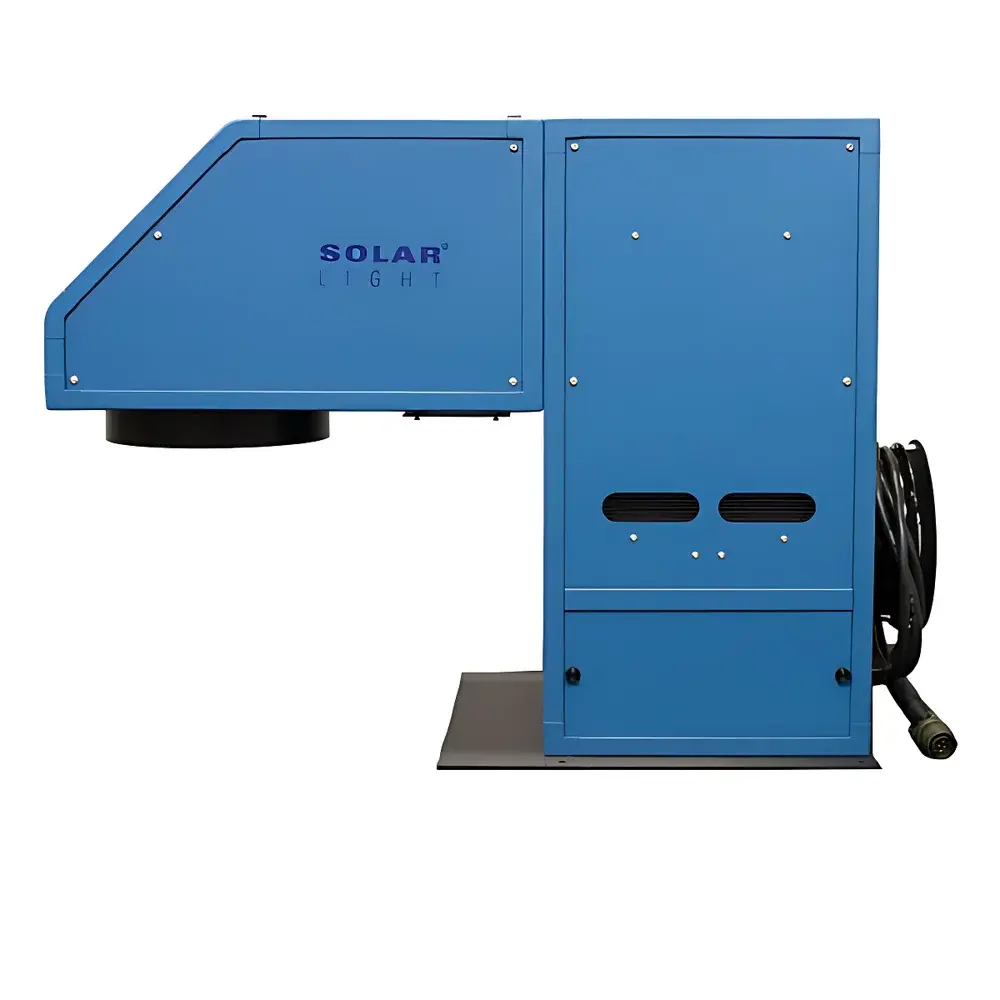
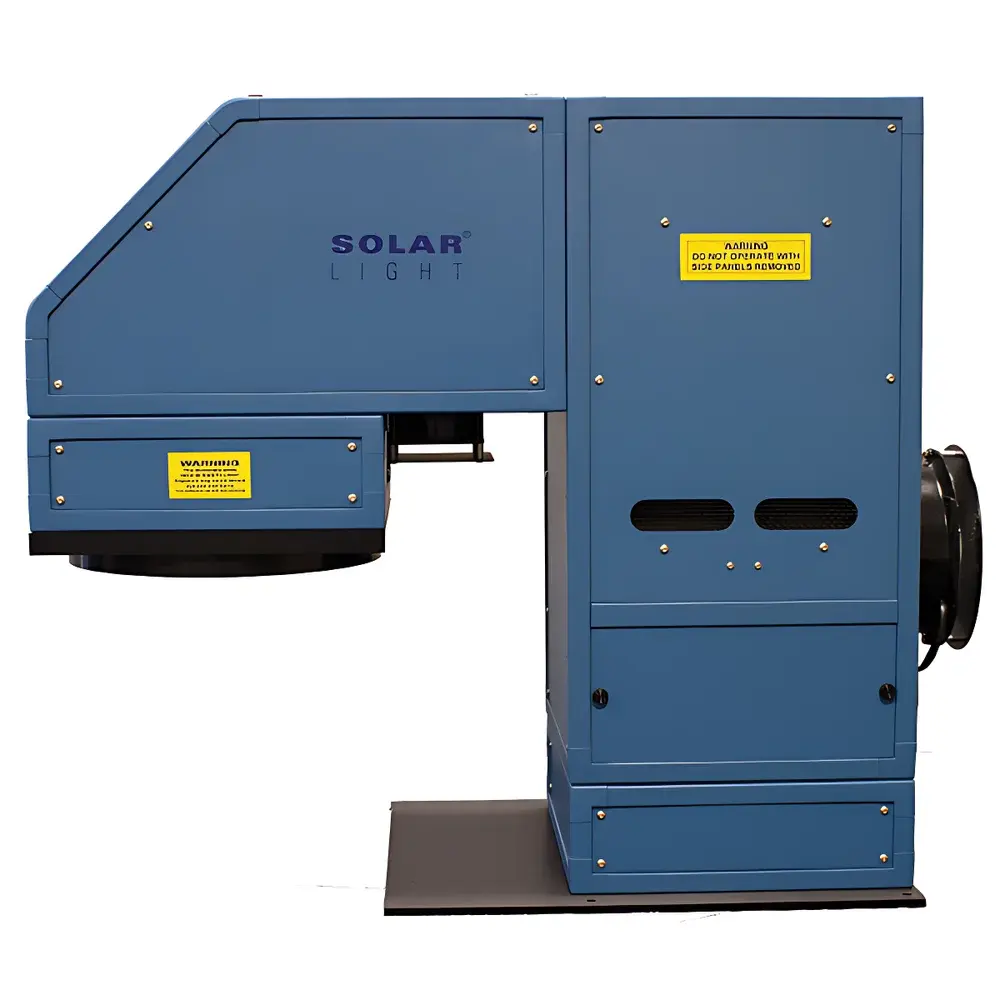
Solar Light LS1000 1000W UV Solar Simulator
| Brand | Solar Light |
|---|---|
| Origin | USA |
| Model | LS1000 1000W UV |
| Spectral Range | 290–400 nm |
| Output Configurations | Circular or Square Beam (2", 4", 6" / 5 cm, 10 cm, 15 cm) |
| Uniformity | ≥98% over usable area |
| Collimated Working Distance | 35.5 cm |
| Compliance | ASTM G154, ASTM G155, IEC 61215, ISO 4892-3, CE |
| Light Source | 1000W Xenon Arc Lamp |
| Power Supply | High-Efficiency Switching PSU with Adjustable Lamp Power |
| Optional Filters | UVA-only, UVB-only, Visible-only, Neutral Density Attenuation Screens |
| Beam Orientation | Vertical Downward, Vertical Upward, or Horizontal |
| Long-Term Stability | <±1% drift per 100 hours |
Overview
The Solar Light LS1000 1000W UV Solar Simulator is a research-grade, single-output solar simulation system engineered for high-fidelity ultraviolet irradiance delivery in controlled laboratory environments. Unlike broadband solar simulators intended for photovoltaic testing, the LS1000 is purpose-built to replicate the biologically and photochemically active UV spectrum (290–400 nm), with spectral selectivity enabling isolated UVA (315–400 nm) or UVB (290–320 nm) exposure protocols. Its core optical architecture employs a stabilized 1000W xenon arc lamp coupled with precision collimating optics and calibrated interference filters, delivering spatially uniform, collimated UV radiation over defined test areas. The system achieves ≥98% irradiance uniformity across its usable beam area—verified per ASTM E927-19—and maintains long-term radiometric stability (<±1% intensity drift over 100 hours), making it suitable for accelerated aging studies, photostability validation, and dose-controlled photobiological assays where reproducibility and traceability are critical.
Key Features
- High-intensity UV output (up to several suns equivalent in UV-B region) without significant infrared thermal load—enabling thermal-sensitive sample testing
- Configurable beam geometry: circular or square output apertures (2″, 4″, or 6″ / 5 cm, 10 cm, 15 cm)
- Collimated output with validated 35.5 cm working distance, minimizing angular divergence for consistent irradiance across planar samples
- Motorized, remotely actuated shutter with TTL/RS-232 interface for precise exposure timing and integration into automated test sequences
- Adjustable lamp power via high-efficiency switching power supply—supports fine-tuned irradiance control without spectral shift
- Modular filter tray accommodating interchangeable bandpass filters (UVA-only, UVB-only, visible-only, ND attenuation screens) for spectral customization
- Three standard beam orientations: vertical downward, vertical upward, or horizontal—facilitating integration into environmental chambers, gloveboxes, or custom optical benches
- CE-marked design compliant with EN 61000-6-3 (EMC) and EN 61000-6-2 (immunity), meeting essential safety and electromagnetic compatibility requirements for EU laboratories
Sample Compatibility & Compliance
The LS1000 is routinely deployed in applications requiring strict adherence to international material and biological testing standards. Its spectral output and uniformity profile have been independently verified against ASTM G154 (UV fluorescent lamp exposure), ASTM G155 (xenon arc exposure), IEC 61215 (photovoltaic module qualification), and ISO 4892-3 (plastics—exposure to UV radiation). For regulated pharmaceutical and cosmetic stability testing, the system supports GLP-compliant documentation workflows when paired with calibrated reference detectors and NIST-traceable radiometers. Beam uniformity is certified over the central 90% of the output aperture using a scanning thermopile array, and spectral irradiance data (W/m²/nm) is supplied with each unit as a factory-measured reference curve. The absence of convection-driven thermal gradients enables direct irradiation of thin films, polymer coatings, topical formulations, and monolayer cell cultures without convective cooling artifacts.
Software & Data Management
While the LS1000 operates as a stand-alone hardware platform, its RS-232 and TTL interfaces support integration with third-party data acquisition systems and LIMS environments. Users may log shutter actuation timestamps, lamp power settings, and external sensor readings (e.g., UV radiometer output, chamber temperature/humidity) via serial command protocol. Solar Light provides a basic terminal utility for configuration and diagnostics; however, for audit-ready operation under FDA 21 CFR Part 11 or ISO/IEC 17025 frameworks, integration with validated software platforms—such as LabVIEW-based irradiance monitoring suites or ELN systems with electronic signature capability—is recommended. All calibration certificates include uncertainty budgets traceable to NIST SRM 2241 (UV irradiance standard), and recalibration services are available with documented metrological chain-of-custody.
Applications
- Accelerated UV degradation testing of polymers, coatings, adhesives, and packaging materials per ASTM D4329 and ISO 4892
- Photostability assessment of active pharmaceutical ingredients (APIs) and finished dosage forms per ICH Q1B guidelines
- In vitro skin phototoxicity and photoallergy screening (OECD TG 432, 442A)
- Dose-response characterization in dermatological phototherapy research (e.g., narrowband UVB efficacy studies)
- Calibration and verification of UV radiometers, spectroradiometers, and dosimeters
- Development and validation of UV-blocking sunscreens and textile UV protection factors (UPF)
- Environmental simulation for space materials testing (e.g., low-Earth orbit UV exposure modeling)
FAQ
What standards does the LS1000 comply with for UV exposure testing?
The LS1000 meets the spectral match, spatial uniformity, and temporal stability requirements of ASTM G154, ASTM G155, ISO 4892-3, and IEC 61215. Full compliance documentation—including spectral irradiance reports and uniformity maps—is provided with each system.
Can the LS1000 be used for visible-light-only experiments?
Yes. An optional visible-pass filter (400–800 nm) is available, enabling controlled visible-spectrum irradiation while blocking UV and IR components—useful for photosynthesis studies or visible-light photocatalysis.
Is radiometric calibration included with purchase?
Each LS1000 ships with a NIST-traceable spectral irradiance calibration certificate valid for 12 months. Recalibration services are offered annually through Solar Light’s accredited metrology lab.
How is beam uniformity measured and verified?
Uniformity is determined using a motorized scanning thermopile detector traversing the full beam area at 1 mm increments. Results are reported as % deviation from mean irradiance across the central 90% of the beam—guaranteed ≥98% for all standard configurations.
Does the system support automated exposure control?
Yes. The integrated motorized shutter accepts TTL trigger signals and RS-232 commands, allowing synchronization with timers, environmental controllers, or programmable logic controllers (PLCs) in high-throughput testing setups.




