
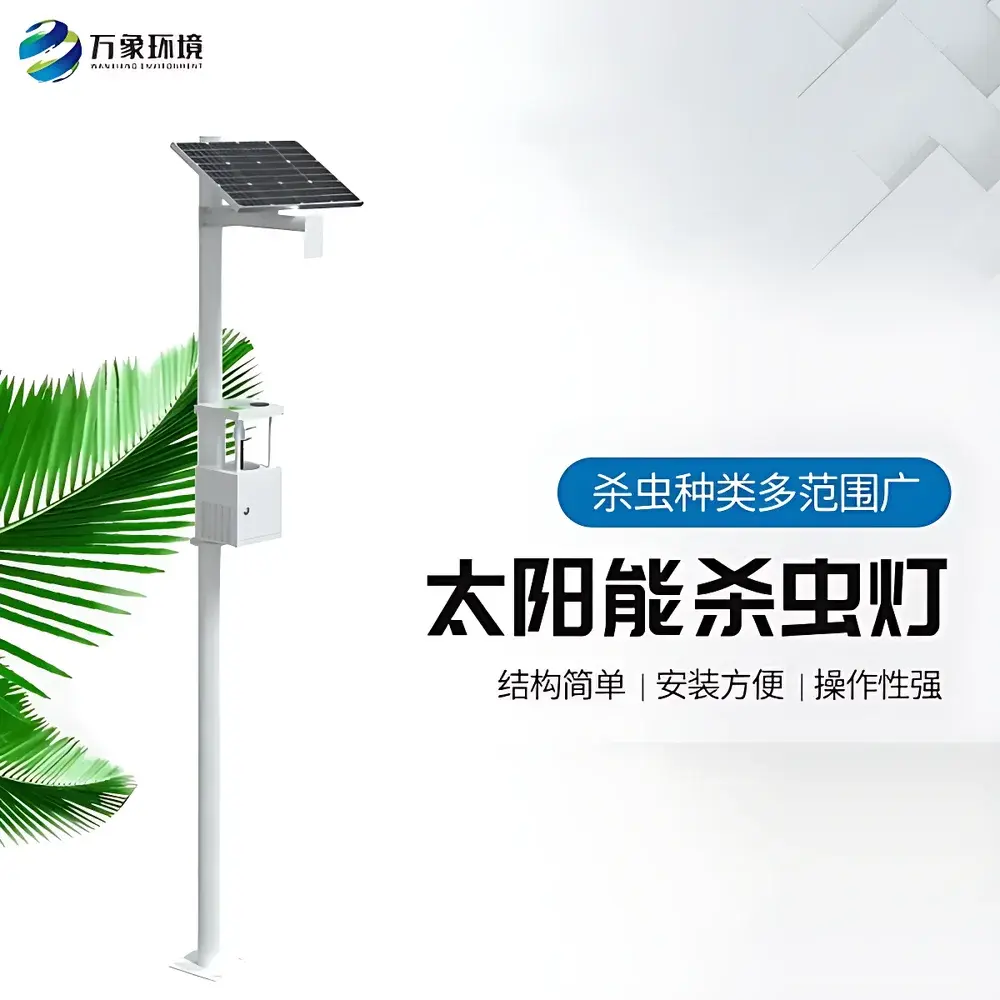
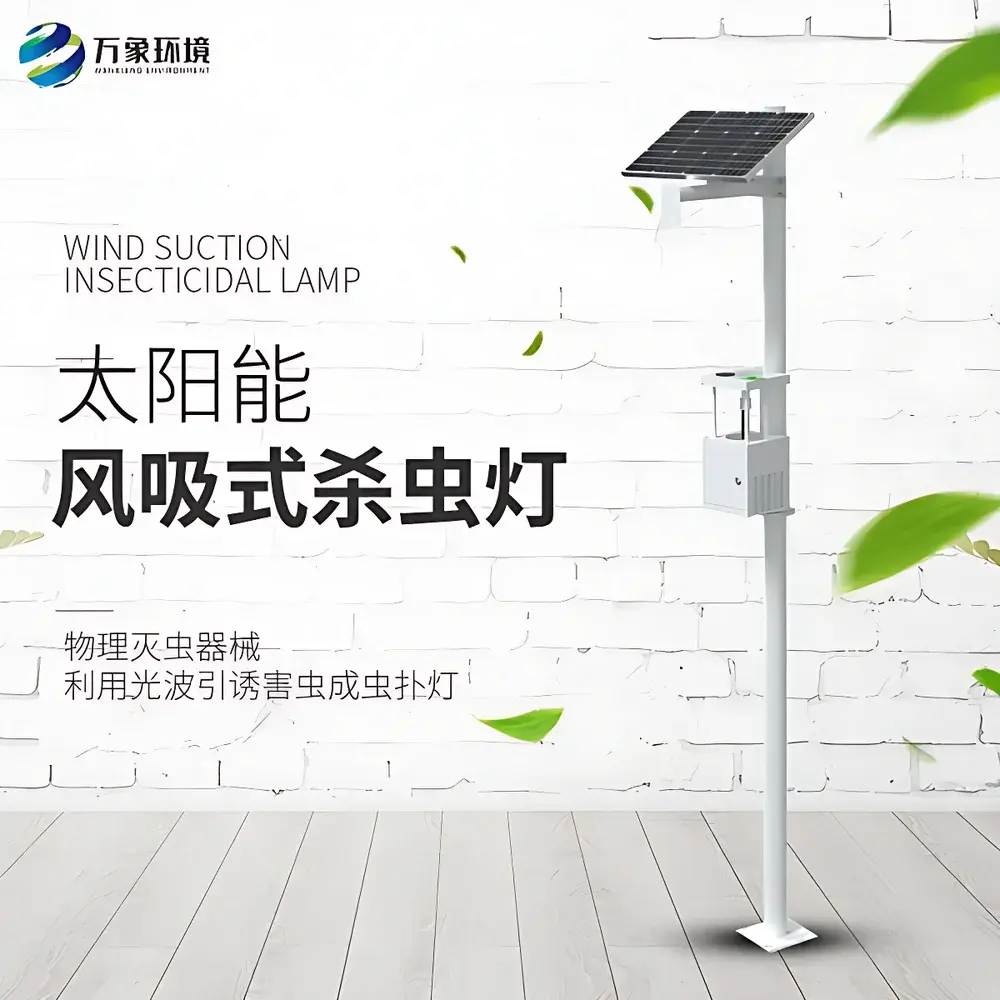
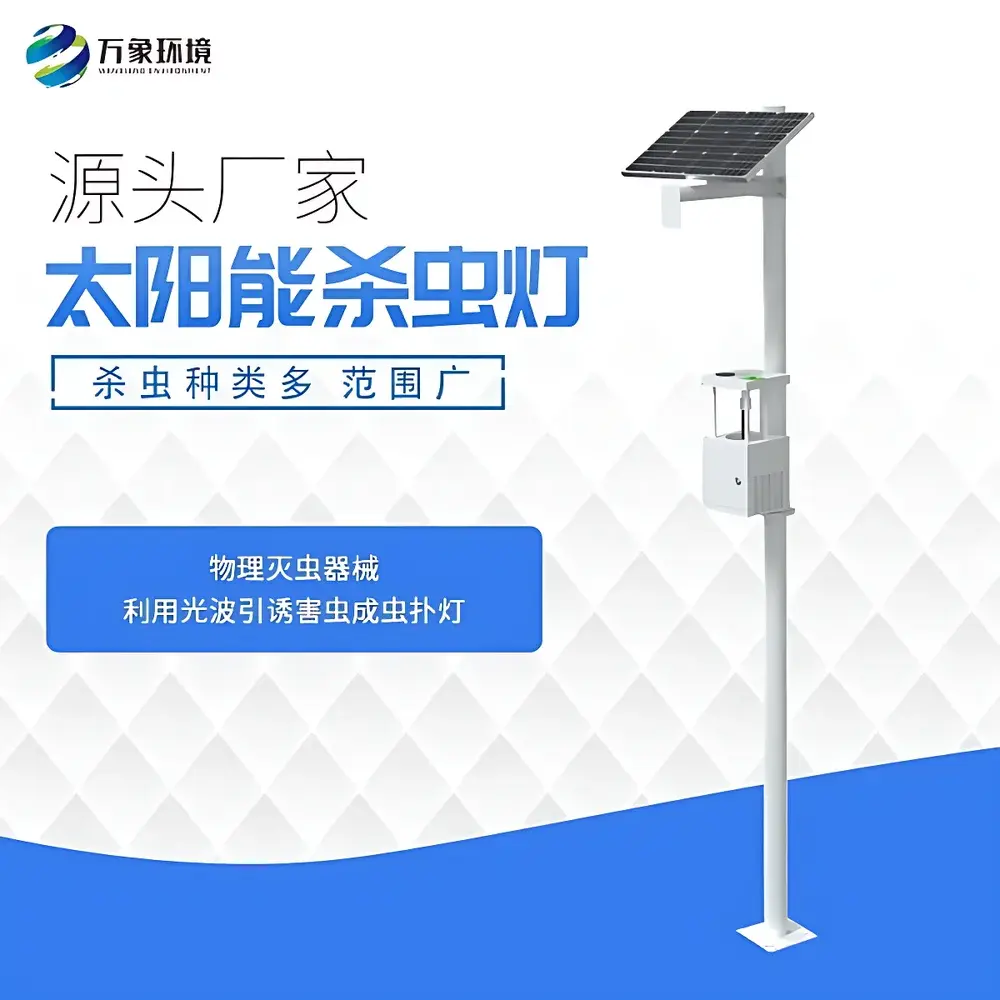
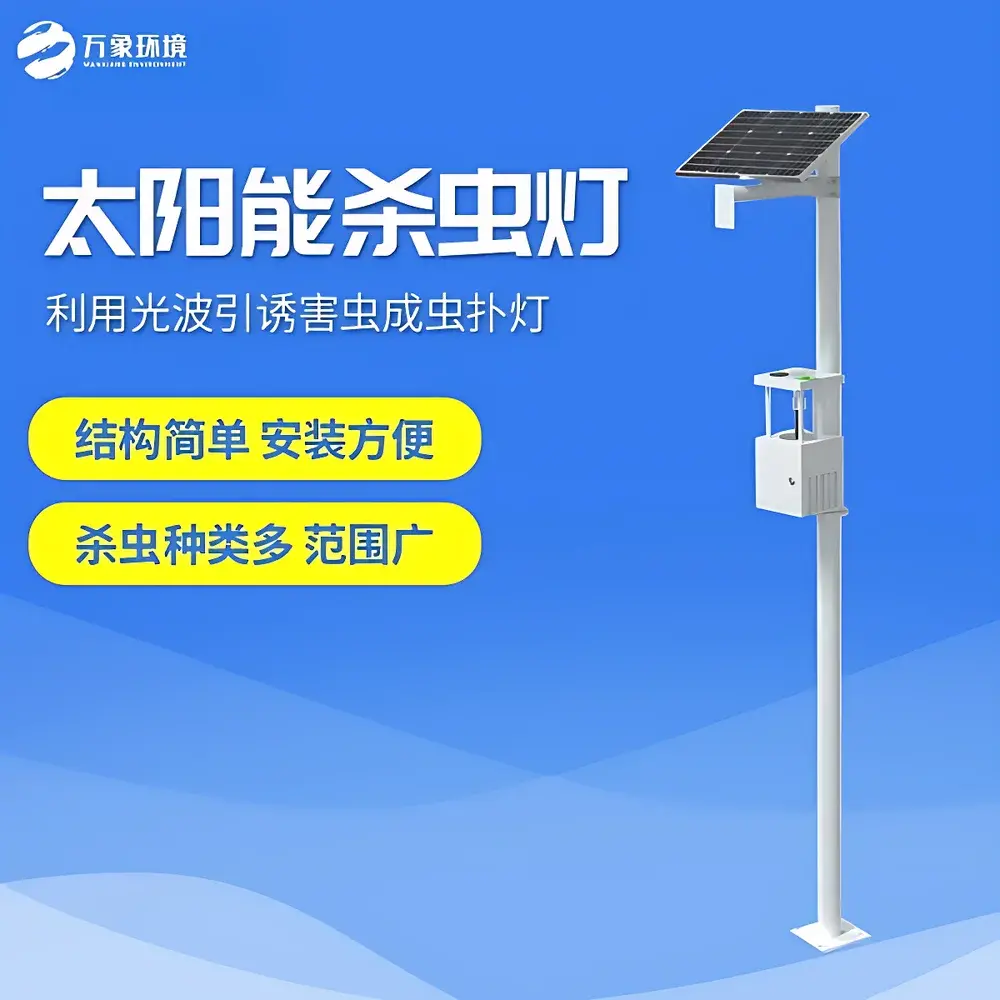
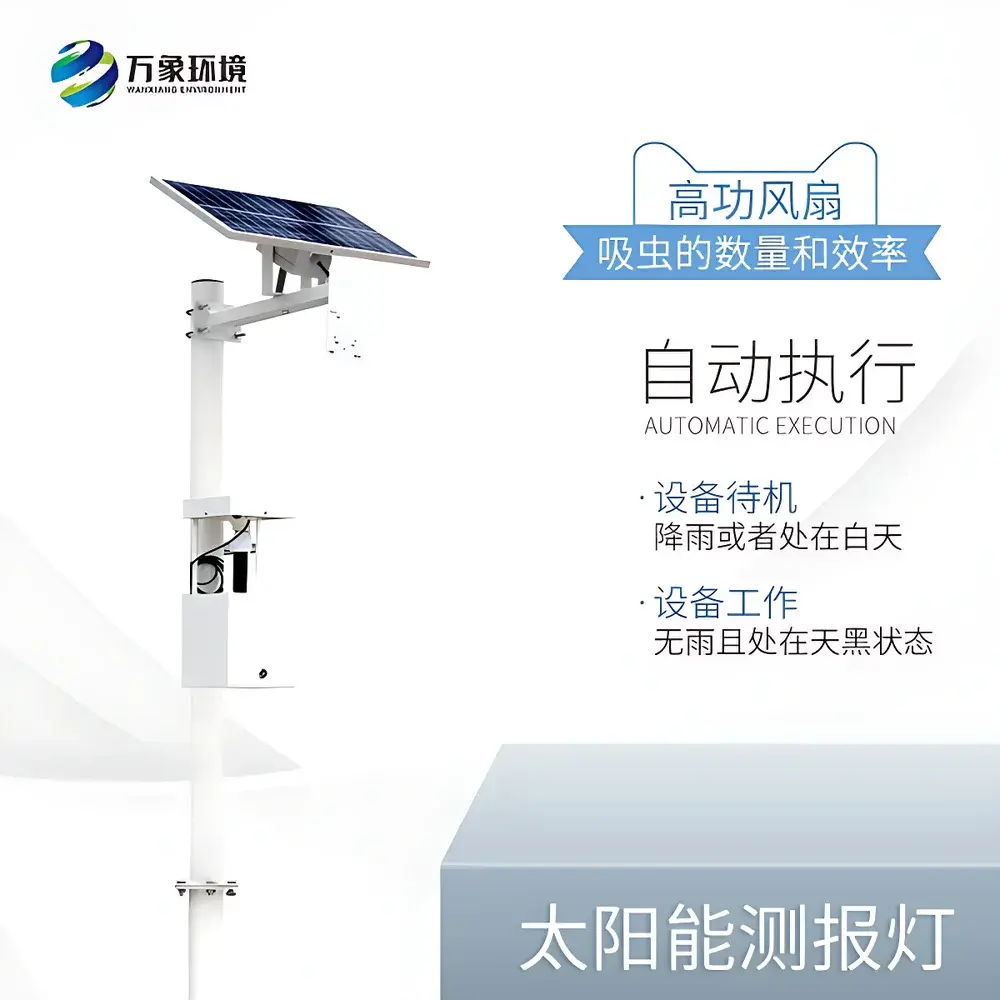
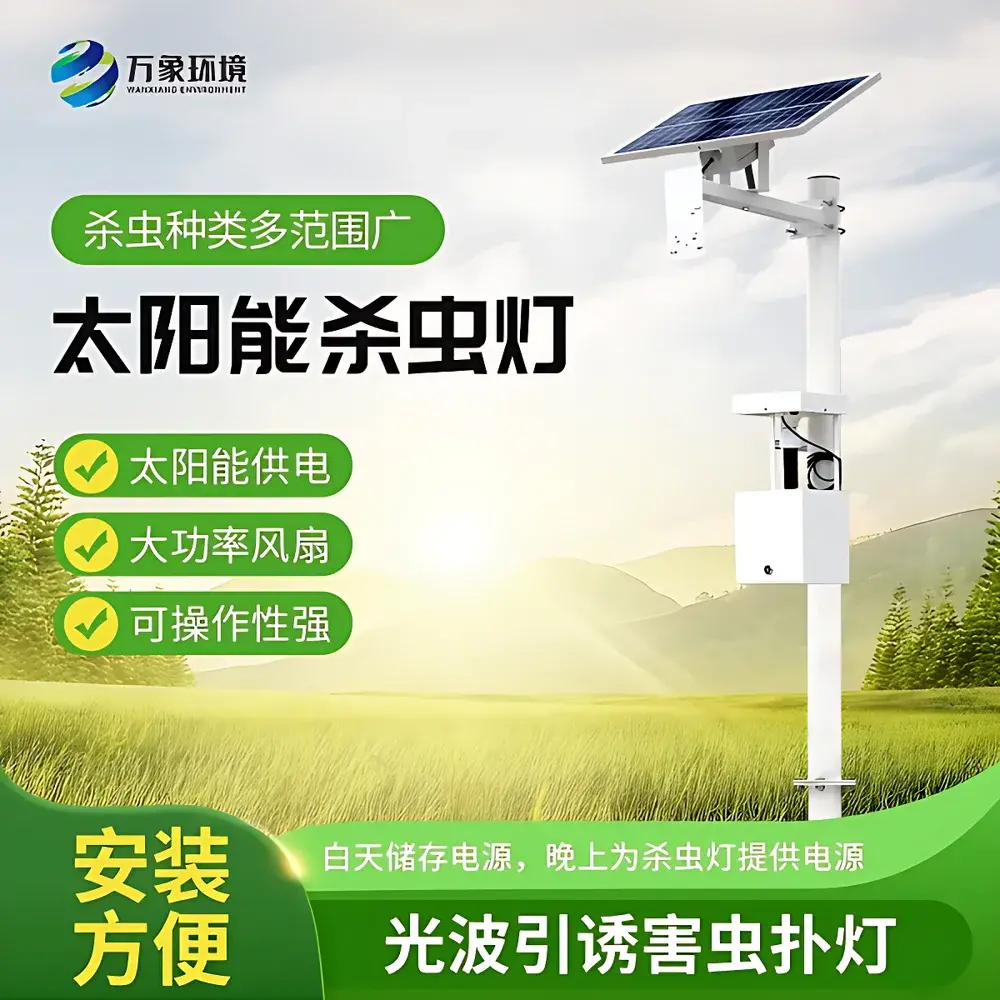
Solar-Powered Wind-Suction Insect Trap WX-SCD1 by Vientiane Environment
| Brand | Vientiane Environment |
|---|---|
| Model | WX-SCD1 |
| Origin | Shandong, China |
| Manufacturer Type | Direct Manufacturer |
| Instrument Category | Pest Control Equipment for Agriculture |
| Power Source | Integrated 30W Polycrystalline Solar Panel + 12V Rechargeable Battery |
| Operating Principle | Multi-spectrum Phototactic Attraction (320–680 nm) + Negative-Pressure Airflow Capture |
| Rated Lamp Power | 15 W |
| Fan Power | 4 W |
| Total System Power Consumption | ≤15 W |
| Solar Panel Dimensions | 505 × 430 mm |
| Support Pole | Φ76 mm × 3 m |
| Operational Autonomy | 2–3 Days Under Continuous Overcast Conditions |
| Service Life | ≥3 Years |
| Compliance | Designed per GB/T 24689.2–2009 (Chinese National Standard for Crop Pest Monitoring Traps) |
| Data Output | Standalone Local Operation (No Remote Transmission) |
Overview
The Solar-Powered Wind-Suction Insect Trap WX-SCD1 is an autonomous, off-grid pest management instrument engineered for long-term deployment in open-field agriculture, orchards, forestry plantations, grain storage facilities, and aquaculture perimeters. Unlike conventional UV-based electrocution traps or sticky-board monitors, this device employs a dual-mode physical control strategy grounded in entomological phototaxis and aerodynamic capture mechanics. It emits a calibrated multi-spectral light band (320–680 nm), spanning near-UV to orange-red wavelengths, to attract nocturnal adult Lepidoptera—including moths from families Noctuidae, Geometridae, and Pyralidae—as well as select Coleoptera and Diptera species known to respond to broad-spectrum visual cues. Once attracted, insects enter a high-velocity laminar airflow zone generated by a 12V DC axial fan, inducing rapid desiccation and mechanical immobilization within the sealed collection chamber. The system operates exclusively on solar energy: a 30W polycrystalline photovoltaic panel charges a maintenance-free deep-cycle battery during daylight hours, enabling full-night operation without grid dependency or fuel consumption.
Key Features
- Intelligent ambient-light and rain-sensing activation logic: automatically enters standby mode under daylight illumination (>1000 lux) or detected precipitation, resuming operation only during dry, dark conditions—minimizing unnecessary power draw and extending component service life.
- Optimized multi-wavelength LED array (320–680 nm) delivering uniform spectral irradiance across target photoreceptor sensitivity bands of key agricultural pests, significantly improving catch rates for small-bodied and low-mobility insects compared to narrow-band 365 nm UV lamps.
- High-efficiency 12V brushless axial fan (4W input) generating sustained negative-pressure airflow (>8 m/s at inlet aperture), ensuring reliable capture of flying insects up to 15 mm in wingspan without clogging or recirculation.
- Modular, tool-free assembly design: integrated lamp housing, fan duct, and detachable cylindrical collection chamber allow rapid field maintenance and specimen retrieval without disassembly tools or calibration recalibration.
- Ruggedized support pole (Φ76 mm × 3 m galvanized steel) with ground-anchor flange enables stable installation across varied terrain types—including sandy soils, paddy bunds, and forest margins—without concrete foundations.
Sample Compatibility & Compliance
The WX-SCD1 is validated for continuous monitoring and suppression of adult-stage Lepidopteran pests in compliance with national and regional integrated pest management (IPM) frameworks. Its operational parameters align with GB/T 24689.2–2009 “Plant Protection Machinery – Insect Traps – Technical Requirements and Test Methods”, particularly regarding spectral output fidelity, structural durability under outdoor exposure (IP65-rated enclosure), and non-chemical intervention classification. While not a diagnostic instrument per se, its standardized catch data supports phenological modeling when deployed in grid-based networks. It is unsuitable for use in enclosed greenhouses or indoor controlled-environment agriculture (CEA) systems due to reliance on natural diel light cycles and ambient airflow dynamics.
Software & Data Management
The WX-SCD1 operates in standalone mode with no embedded microcontroller, wireless interface, or cloud connectivity. All operational logic is implemented via analog photoresistor and hygrosensor circuits coupled with solid-state relays—ensuring electromagnetic compatibility (EMC) in high-humidity rural environments and eliminating firmware vulnerabilities or cybersecurity risks. Catch volume assessment requires manual inspection and enumeration at scheduled intervals (e.g., weekly). For quantitative analysis, users may integrate trap counts into third-party IPM software platforms (e.g., Crop Protection Decision Support Systems) using CSV upload or API ingestion—provided external logging hardware (e.g., digital time-lapse cameras or weight-sensing collection bins) is deployed. No FDA 21 CFR Part 11 or ISO/IEC 17025 traceability features are included, as the device functions strictly as a passive surveillance and suppression tool.
Applications
- Field-scale monitoring of Helicoverpa armigera, Spodoptera litura, and other migratory moth populations in cotton, maize, soybean, and vegetable production systems.
- Perimeter protection of rice paddies against stem borers (Chilo suppressalis) and leaf folders (Cnaphalocrocis medinalis).
- Suppression of stored-grain pests (Ephestia kuehniella, Plodia interpunctella) in silos and warehouse buffer zones.
- Non-toxic vector reduction around aquaculture ponds where chemical insecticides risk fish toxicity or water contamination.
- Baseline ecological surveys supporting biodiversity assessments in agroforestry and conservation buffer strips.
FAQ
Does the WX-SCD1 require external power or battery replacement?
No. It relies entirely on its integrated 30W polycrystalline solar panel and sealed lead-acid battery. Under typical insolation (≥4 kWh/m²/day), the battery sustains full-night operation for ≥3 years without electrolyte servicing or cell replacement.
Can it be used in shaded or high-latitude locations?
Performance degrades below 3.5 kWh/m²/day average daily solar irradiance. In such environments, supplemental panel orientation optimization or auxiliary tilt-mounting is recommended to maintain ≥2-day overcast autonomy.
Is the collection chamber compatible with morphological specimen preservation?
Yes—the dry-capture method preserves exoskeletal integrity sufficiently for taxonomic identification under stereo microscopy; however, DNA degradation begins within 48 hours under ambient humidity, limiting molecular applications unless desiccants are added post-collection.
How frequently should the fan and lamp assembly be cleaned?
Bi-weekly inspection is advised in high-dust environments; cleaning involves compressed air blowout of the fan shroud and isopropyl alcohol wipe of the lens surface—no optical recalibration is required.
Does it comply with EU Plant Health Regulation (EU) 2016/2031?
As a non-chemical, non-GMO physical control device, it falls outside the scope of Annex IV phytosanitary certification requirements but may be deployed as part of an approved IPM plan under Article 15(2) for protected zone management.






