
SolarSIM-D2 Solar Spectral Radiometer by Spectrafy
| Origin | USA |
|---|---|
| Manufacturer Type | Authorized Distributor |
| Origin Category | Imported |
| Model | SolarSIM-D2 |
| Pricing | Upon Request |
Overview
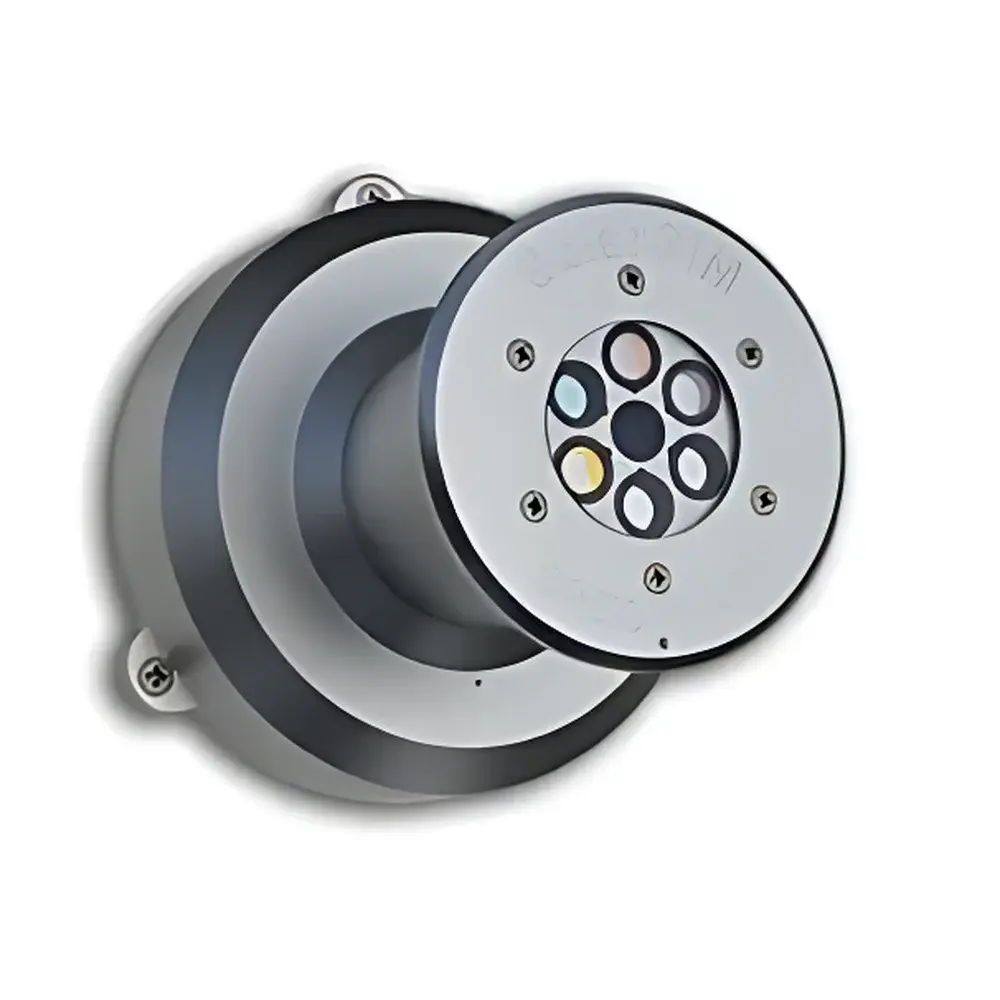
The SolarSIM-D2 is a high-accuracy, field-deployable solar spectral radiometer engineered for quantitative characterization of direct normal irradiance (DNI) across the full solar spectrum—from 280 nm to 4000 nm—with spectral resolution defined by six discrete optical bandpass filters. Developed by Spectrafy (Canada) as the successor to the SolarSIM-G1, it implements a silicon photodiode-based multi-channel detection architecture calibrated traceably to NIST and compliant with IEC 60904-4 for reference solar spectral irradiance measurements. Unlike broadband pyrheliometers, the SolarSIM-D2 delivers spectrally resolved DNI data essential for spectral mismatch correction in PV performance modeling, atmospheric transmittance validation, and site-specific solar resource assessment under variable aerosol, ozone, and water vapor conditions. Its secondary standard classification per ISO 9060:2018 (Class A, Secondary Standard) confirms its suitability for reference-grade monitoring in calibration laboratories, bankable solar project due diligence, and long-term climate observation networks.
Key Features
- Full-spectrum DNI measurement from 280 nm to 4000 nm with six precisely defined optical bandpass channels, enabling reconstruction of continuous spectral irradiance at <1 nm effective resolution
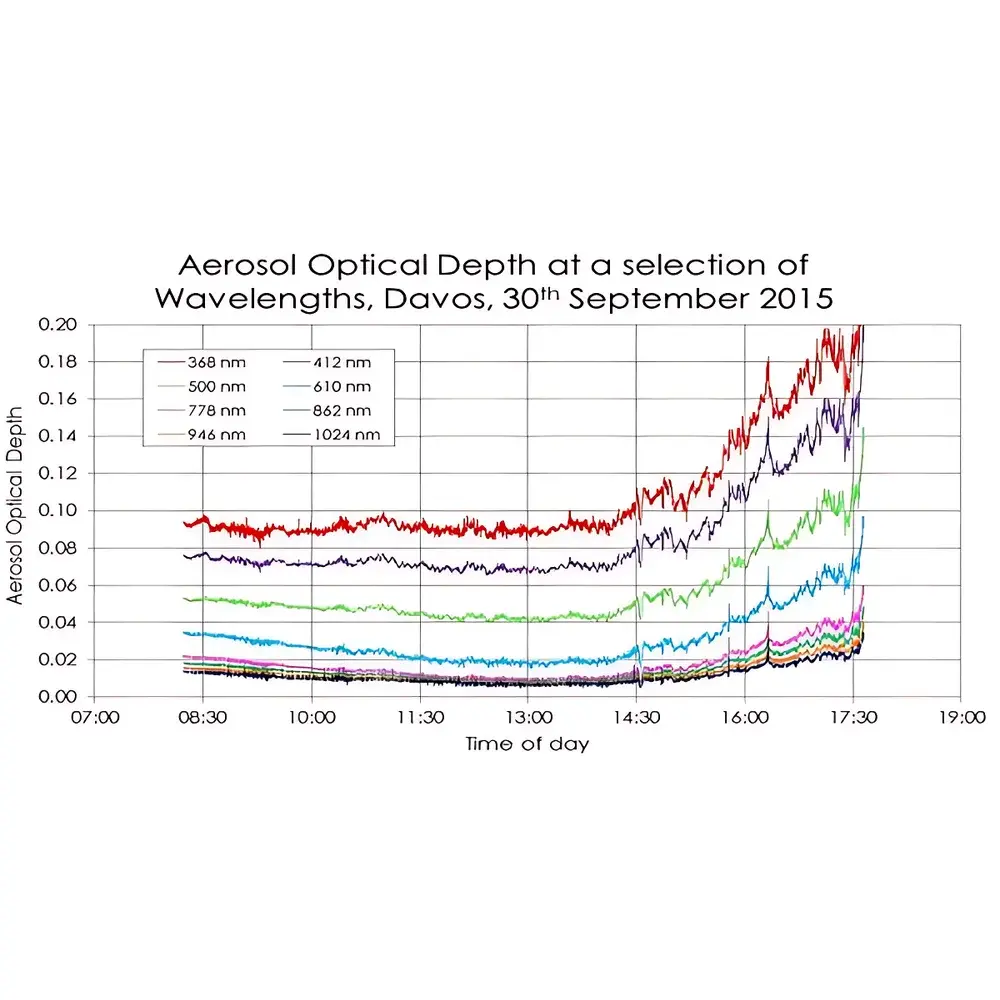
- Integrated environmental sensing: co-located air temperature (±0.2 °C), barometric pressure (±0.1 hPa), column ozone (via Huggins band absorption at 325–340 nm), total column water vapor (via 940 nm absorption), and aerosol optical depth at 500 nm (via spectral extinction modeling)
- Onboard automatic temperature compensation—real-time correction applied to all photodiode channels across –30 °C to +65 °C operating range
- Optical field-of-view options: 5° full-angle for standard DNI or 1° full-angle for high-precision tracking applications; compatible with solar trackers meeting ±0.5° pointing accuracy (per IEC 61724-1)
- Low-power operation: <1 W nominal consumption, 12 VDC input; designed for unattended, year-round deployment using battery or solar-charged systems
- RS-485 two-wire digital interface (Modbus RTU protocol) supporting daisy-chaining up to 32 units; optional USB-to-serial and Ethernet gateway modules available for direct PC or SCADA integration
Sample Compatibility & Compliance
The SolarSIM-D2 is optimized for outdoor, ground-based direct solar beam measurements under clear-sky and partially cloudy conditions. It requires precise solar tracking (e.g., Kipp & Zonen SOLYS 2 or comparable Class A tracker) and is compatible with standard ISO 9060:2018 mounting hardware. All calibrations are performed in accordance with ASTM E892 and IEC 60904-4 Annex B procedures, with annual recalibration recommended to maintain secondary standard traceability. The instrument meets GLP-compliant data integrity requirements when used with timestamped, audit-trail-enabled data loggers. Its spectral uncertainty profile (<5% per channel, <2% integrated DNI) supports compliance with IEC 61724-1 for PV system performance monitoring and with IEA-SHC Task 46 guidelines for spectral irradiance validation.
Software & Data Management
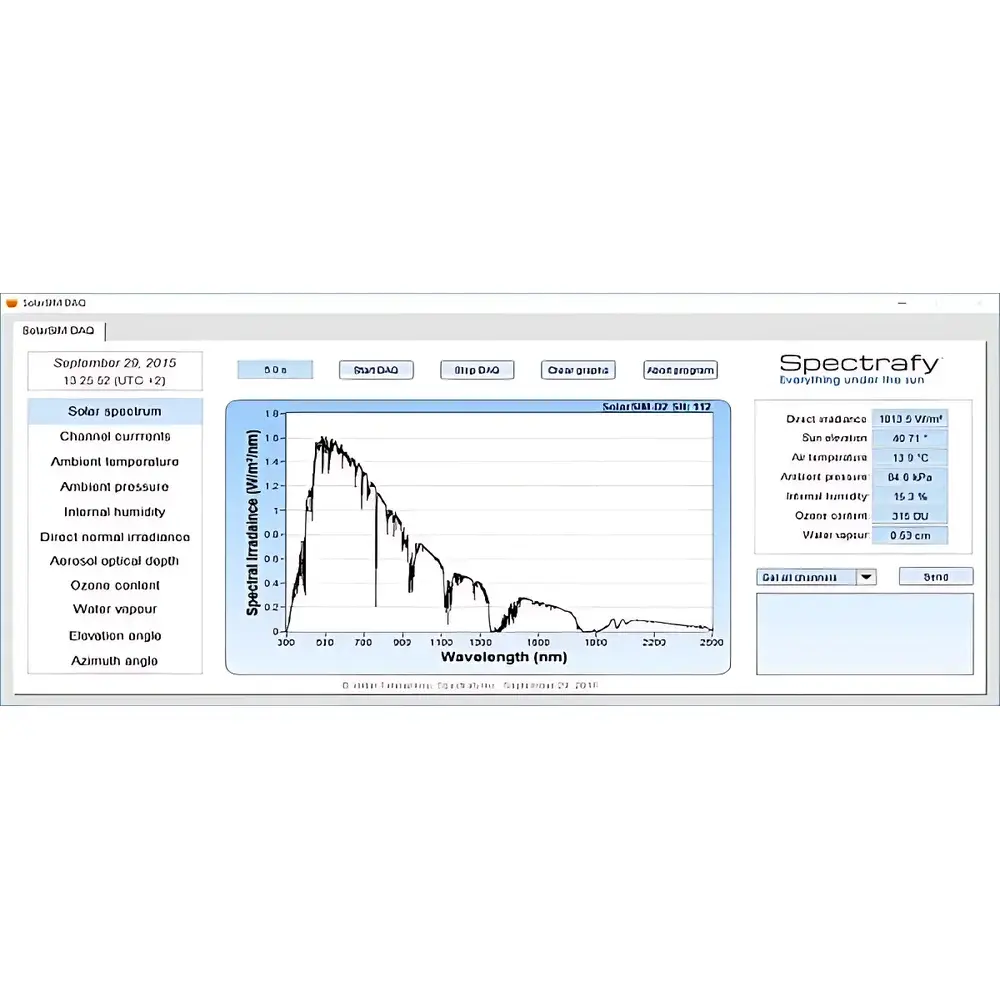
Spectrafy provides the SolarSIM Control Suite—a Windows-based application supporting real-time visualization, automated spectral reconstruction (using built-in Look-Up Tables derived from MODTRAN simulations), and export of calibrated irradiance values in SI units (W·m⁻²·nm⁻¹). Raw sensor outputs, environmental parameters, and diagnostic flags are logged with UTC timestamps and embedded metadata (e.g., tracker azimuth/elevation, ambient humidity). Data files comply with CF-netCDF v1.8 conventions and include embedded provenance tags for ISO/IEC 17025 traceability. Optional API access enables integration into enterprise SCADA platforms or cloud-based analytics engines (e.g., AWS IoT Core, Azure Time Series Insights) with configurable sampling intervals up to 1 Hz. All firmware updates and calibration coefficients are digitally signed and version-controlled to satisfy FDA 21 CFR Part 11 requirements for electronic records.
Applications
- Spectral correction of PV module I-V curves in laboratory and field settings per IEC 60904-7
- Validation of radiative transfer models (e.g., SMARTS, libRadtran) against measured atmospheric absorption features
- Long-term monitoring of aerosol optical depth trends in air quality and climate research programs
- Site adaptation studies for bifacial and multi-junction PV technologies requiring wavelength-resolved irradiance inputs
- Calibration transfer between reference cells and field-deployed reference modules in commercial solar farms
- Supporting Levelized Cost of Energy (LCOE) modeling where spectral effects contribute >1.5% uncertainty in energy yield prediction
FAQ
What is the calibration traceability chain for the SolarSIM-D2?
Traceable to NIST SRM 2254 (spectral irradiance scale) via primary calibration at the National Renewable Energy Laboratory (NREL) or accredited ISO/IEC 17025 laboratories.
Can the SolarSIM-D2 operate without a solar tracker?
No—it measures only the direct solar beam and requires continuous, high-accuracy solar tracking (±0.5° or better) to maintain spectral fidelity and avoid cosine error.
How frequently should recalibration be performed?
Annual recalibration is recommended; drift is specified at <0.5% per year under typical field exposure conditions.
Is spectral ozone and water vapor retrieval included in standard firmware?
Yes—column ozone (cm-ATM) and column water vapor (cm-H₂O) are computed in real time using on-board absorption band ratios; no external spectroscopic analysis is required.
Does the instrument support remote firmware updates and diagnostics?
Yes—over-the-air updates and health monitoring (photodiode responsivity drift, thermal sensor offset, communication latency) are supported via Modbus register polling and diagnostic command set.






