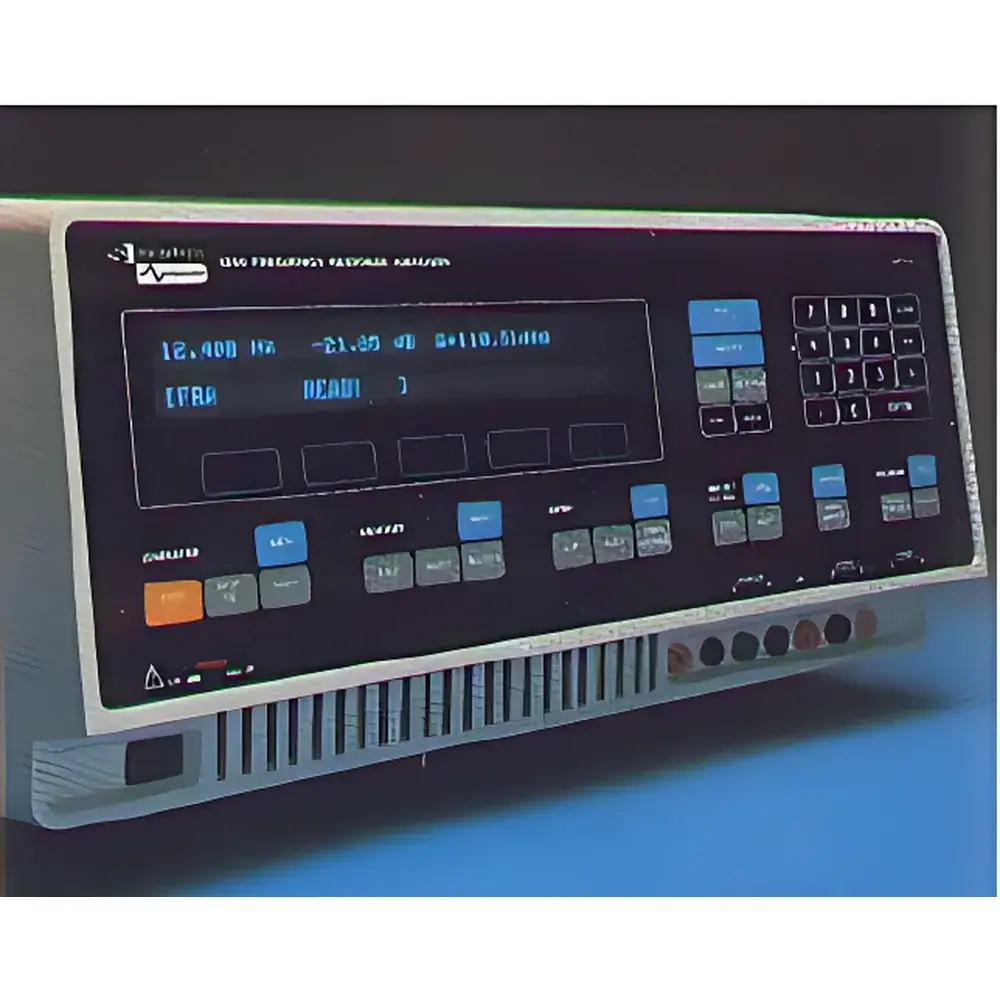
Solartron Analytical 1250 Frequency Response Analyzer
| Brand | Solartron Analytical |
|---|---|
| Origin | United Kingdom |
| Model | 1250 |
| Frequency Range | 10 µHz – 65 kHz |
| Signal Amplitude Range | 10 mV – 10.23 V (AC), up to 300 V (analysis input range) |
| Waveform Options | Sine, Square, Triangle |
| Amplitude Resolution | 1/1023 |
| Compliance | ASTM E2928, IEC 61000-4-30 (power quality), ISO/IEC 17025-accredited calibration support available |
Overview
The Solartron Analytical 1250 Frequency Response Analyzer (FRA) is a precision-engineered instrument designed for high-fidelity measurement of gain, phase, and complex impedance across ultra-low to mid-audio frequency domains (10 µHz to 65 kHz). Operating on the principle of swept-sine excitation and synchronous demodulation, the 1250 FRA delivers exceptional signal-to-noise ratio and phase coherence by employing digital lock-in detection with programmable integration time. This architecture enables accurate characterization of linear and weakly nonlinear systems under controlled perturbation—essential for transfer function analysis, stability margin assessment, and dynamic system identification. Unlike broadband noise-based methods, the 1250’s deterministic sinusoidal stimulus ensures unambiguous separation of fundamental response from harmonic distortion and ambient interference. Its dual-channel architecture supports two-point measurement (stimulus and response), while optional multichannel expansion (e.g., 1254 variant) accommodates multi-input/multi-output (MIMO) system modeling.
Key Features
- Ultra-low frequency capability down to 10 µHz—enabling electrochemical impedance spectroscopy (EIS), corrosion studies, and slow kinetic process analysis
- High-voltage analysis input range up to ±300 V—validated for fuel cell stack monitoring, EV battery module testing, and grid-tied inverter characterization
- Programmable AC excitation amplitude (10 mV–10.23 V) with 10-bit resolution (1/1023 step size) for precise stimulus control
- Synchronous reference option for phase-locked operation with external carriers or master clocks—critical for modulated photocurrent spectroscopy (IMPS) and pulsed electrochemical experiments
- Harmonic rejection via narrow-band digital filtering and adaptive averaging—ensures robust measurements even in electrically noisy industrial environments
- Native support for nonlinearity assessment through harmonic distortion analysis (up to 5th order) and intermodulation response mapping
- Front-panel and PC-based control via Visual Basic ActiveX libraries—compatible with LabVIEW, MATLAB, and custom ATS (Automated Test System) frameworks
Sample Compatibility & Compliance
The 1250 FRA interfaces seamlessly with a broad spectrum of transducers—including voltage/current probes, piezoelectric actuators, electrochemical cells, and optical detectors—via standard BNC and isolated differential inputs. It meets functional safety requirements for Class I equipment per IEC 61010-1 and supports traceable calibration per ISO/IEC 17025 guidelines. In power electronics applications, it aligns with ASTM E2928 for impedance-based stability evaluation of switching regulators and conforms to IEC 61000-4-30 Annex D for harmonic and interharmonic measurement in power quality analysis. For electrochemical research, its low-noise front-end and sub-millivolt resolution satisfy the sensitivity demands of photoelectrochemical impedance spectroscopy (PEIS) and intensity-modulated photocurrent spectroscopy (IMPS), where phase lag quantification directly informs charge-transfer resistance and recombination time constants.
Software & Data Management
Instrument control and data acquisition are managed through Solartron’s ModuLab XM software suite, which provides real-time Bode/Nyquist plotting, automated frequency sweep sequencing, and batch-mode experiment scripting. All raw and processed datasets are stored in HDF5 format with embedded metadata—including timestamp, stimulus parameters, hardware configuration, and user-defined annotations—to ensure full auditability. The software supports 21 CFR Part 11-compliant electronic signatures, role-based access control, and immutable audit trails—making it suitable for GLP and GMP-regulated environments. Export options include CSV, MATLAB .mat, and IMPEDANCE (.z) formats for third-party modeling tools such as COMSOL Multiphysics and Python-based SciPy electrochemical libraries.
Applications
- Power electronics: Loop gain and phase margin validation of DC-DC converters, motor drives, and UPS systems
- Electrochemistry: PEIS and IMPS for dye-sensitized solar cells, solid-state batteries, and corrosion inhibition studies
- Aerospace & defense: Servo loop stability analysis in flight control actuators and satellite reaction wheel assemblies
- Structural dynamics: Modal parameter identification in civil infrastructure (e.g., bridge damping ratio estimation)
- Acoustics & transducer design: Loudspeaker Thiele-Small parameter extraction and microphone sensitivity calibration
- Advanced materials: Microwave reflection monitoring via PMMR (Potential-Modulated Microwave Reflectometry) for semiconductor interface carrier dynamics
FAQ
What is the minimum measurable phase resolution of the 1250 FRA?
Phase resolution is limited by signal-to-noise ratio and integration time—not fixed bit depth—but routinely achieves ±0.1° accuracy at frequencies above 1 Hz with adequate averaging.
Can the 1250 be used for real-time closed-loop control?
No—it is a dedicated open-loop characterization tool; however, its output data can feed into external PID controllers or model-predictive algorithms via analog/digital I/O interfaces.
Is firmware upgrade support available for legacy 1250 units?
Yes—Solartron Analytical provides documented firmware updates and technical bulletins through authorized service centers under extended support agreements.
Does the instrument comply with FDA 21 CFR Part 11 for pharmaceutical manufacturing use?
While the hardware itself is not classified as a regulated device, its software configuration (ModuLab XM v12.5+) supports full Part 11 compliance when deployed within validated laboratory information management systems (LIMS).
How is grounding handled during high-voltage measurements?
The 1250 employs fully floating, optically isolated input channels with reinforced insulation rated to 300 V CAT II, enabling safe differential measurements across grounded or floating DUTs without ground loops.