
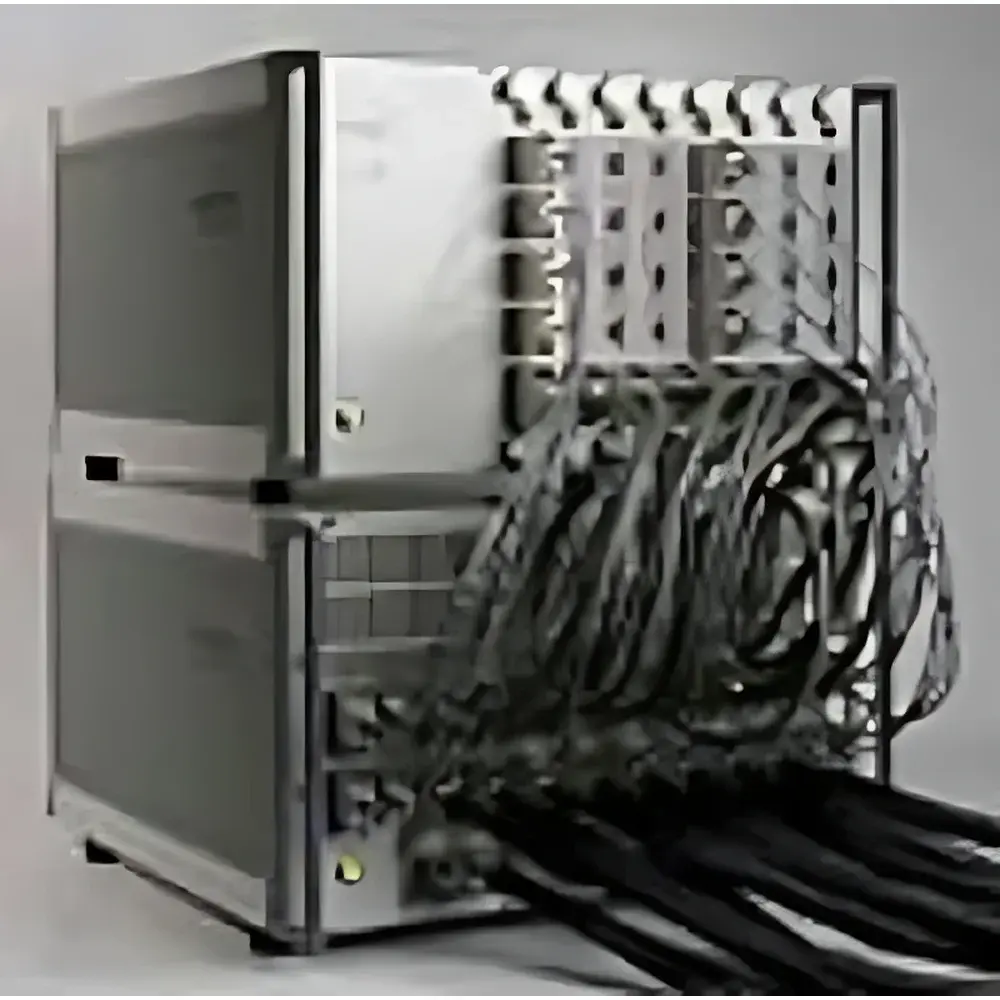
Solartron Analytical 1470E Multi-Channel Potentiostat/Galvanostat with Integrated Electrochemical Impedance Spectroscopy (EIS) System
| Brand | Solartron Analytical |
|---|---|
| Origin | United Kingdom |
| Model Series | 1470E |
| Current Range | ±4 A |
| Current Accuracy | ±0.1% of full scale |
| Potential Accuracy | ±0.1% of full scale |
| Potentiostatic Range | −3 V to +10 V |
| EIS Frequency Range | 10 µHz to 1 MHz |
Overview
The Solartron Analytical 1470E Multi-Channel Potentiostat/Galvanostat with Integrated EIS System is an engineered platform for high-fidelity, parallel electrochemical characterization of energy storage and conversion devices—including lithium-ion batteries, fuel cells, supercapacitors, and solid oxide systems. Built upon a modular architecture combining the 1470E multi-channel potentiostat/galvanostat with optional 145x-series Frequency Response Analyzers (FRAs), the system implements dual-domain (DC + AC) measurement capability across up to eight fully independent electrochemical channels. Each channel operates autonomously—supporting concurrent yet distinct protocols such as galvanostatic charge/discharge, cyclic voltammetry, chronoamperometry, and broadband impedance spectroscopy—without crosstalk or shared resource contention. The core measurement principle integrates controlled-potential/current excitation with phase-sensitive detection via either single-sine correlation or multi-sine FFT-based analysis, enabling quantitative separation of faradaic kinetics, interfacial capacitance, and ohmic contributions across six decades of frequency (10 µHz–1 MHz). Designed for laboratory-scale R&D and pre-production validation, the system meets foundational requirements for reproducible, traceable electrochemical testing under ISO/IEC 17025-aligned workflows.
Key Features
- True Parallel Multi-Channel Operation: Eight isolated potentiostat/galvanostat channels per 1470E unit, each with independent voltage compliance (±10 V), current sourcing/sinking (±4 A), and real-time digital signal processing.
- Synchronized Broadband EIS: Optional integration with 1455 FRA (10 mHz–1 MHz) or 1451 FRA (10 mHz–100 kHz) enables simultaneous impedance acquisition across all active channels—critical for comparative aging studies and stack-level diagnostics.
- Anode/Cathode-Specific AC/DC Analysis: With 14702A auxiliary channel option, users perform localized impedance measurements on individual electrodes or sub-components within full-cell configurations—enabling electrode-specific degradation mapping without cell disassembly.
- High-Power DC Testing Capability: Multiple 1470E units may be paralleled to deliver up to ±28 A DC load while dedicating a separate low-noise channel for small-signal EIS—preserving signal integrity and bandwidth during dynamic load conditions.
- Ethernet-Based Remote Control & Monitoring: Native TCP/IP interface supports secure local-area or wide-area network operation, enabling unattended long-duration experiments, centralized lab management, and integration into automated test environments.
- Floating Ground Architecture: Each channel features galvanically isolated analog front-end design, permitting safe, accurate measurements on grounded systems—including autoclaves, pressurized cells, and multi-electrode corrosion rigs.
- Sub-Millisecond Protocol Switching: Hardware-triggered transitions between techniques (e.g., CV → EIS → GCD) occur in ≤0.1 ms, minimizing transient artifacts during hybrid method execution.
Sample Compatibility & Compliance
The 1470E system accommodates a broad range of electrochemical configurations—from standard three-electrode beaker cells and coin-type battery testers to high-temperature solid oxide fuel cell (SOFC) rigs operating up to 1000 °C (with compatible 14703A temperature controller interface). Its floating input design ensures compatibility with grounded reference electrodes, bipolar stacks, and multi-phase electrolytes (aqueous, non-aqueous, molten salt, and polymer membranes). From a regulatory standpoint, the system’s deterministic timing, audit-trail-enabled software logging, and hardware-enforced safety limits align with GLP and GMP expectations for electrochemical data integrity. While not certified to FDA 21 CFR Part 11 out-of-the-box, its raw data export (ASCII, CSV, binary) and metadata-rich file structure support validated implementation in regulated environments when paired with appropriate LIMS or ELN systems.
Software & Data Management
Control and analysis are performed using CorrWare™ and SMaRT™ software suites—commercial-grade applications developed by Solartron Analytical for electrochemical research. CorrWare provides intuitive protocol scripting, real-time visualization, and built-in compliance with ASTM D1193 (water resistivity), ASTM G102 (electrochemical impedance interpretation), and ISO 16773 (battery EIS reporting). SMaRT enables advanced equivalent circuit modeling (ECM), Kramers–Kronig validation, and time-domain deconvolution of distributed elements. All measurements include timestamped metadata (hardware ID, firmware version, calibration date), and raw data streams are stored in open-format files supporting third-party analysis (MATLAB, Python, Origin). Automatic integration time adjustment—based on real-time noise estimation—ensures optimal SNR without manual intervention across variable-frequency EIS sweeps.
Applications
- Lithium-ion and next-generation battery development: cycle-life mapping, SEI growth kinetics, rate-capability assessment, and post-mortem impedance fingerprinting.
- Fuel cell catalyst layer optimization: oxygen reduction reaction (ORR) kinetics, proton exchange membrane (PEM) hydration effects, and cathode flooding detection via low-frequency impedance.
- Corrosion science: electrochemical noise analysis (ENA), polarization resistance monitoring, and coating delamination onset detection on coated steels and aluminum alloys.
- Electrochemical sensor development: sensitivity calibration, drift quantification, and interference rejection profiling under physiological or environmental matrices.
- Supercapacitor characterization: double-layer capacitance stability, leakage current tracking, and frequency-dependent power density modeling.
- Electrodeposition process control: nucleation overpotential mapping, mass-transport limitation identification, and additive adsorption kinetics via EIS.
FAQ
Can the 1470E perform EIS on multiple cells simultaneously?
Yes—when configured with a 145x-series FRA, all eight channels can acquire impedance spectra concurrently, with synchronized excitation and phase-resolved detection.
Is the system suitable for high-temperature electrochemical testing?
Yes—via the 14703A accessory module, which provides serial-interface temperature control and relay-driven actuation of external heaters, gas flow valves, and stirrers for integrated thermal-electrochemical experiments.
How does the system handle DC bias during EIS measurements?
The 145x FRA incorporates active DC bias suppression circuitry, allowing high-resolution AC impedance measurement at any DC operating point—including open-circuit voltage or galvanostatically maintained states—without amplifier saturation or offset drift.
What level of measurement repeatability can be expected across the full EIS frequency range?
Amplitude accuracy is ±0.1% and phase accuracy is ±0.1° across 10 µHz–1 MHz, verified per manufacturer’s calibration certificate traceable to NPL (UK) standards; long-term stability is maintained through internal temperature-compensated reference design.
Does the system support custom waveform generation for pulse testing?
Yes—arbitrary waveform synthesis is available via SMaRT software, enabling user-defined current/voltage pulses (e.g., GSM, UMTS, or EV drive-cycle profiles) with microsecond timing resolution and hardware-triggered synchronization.
Related Products






