
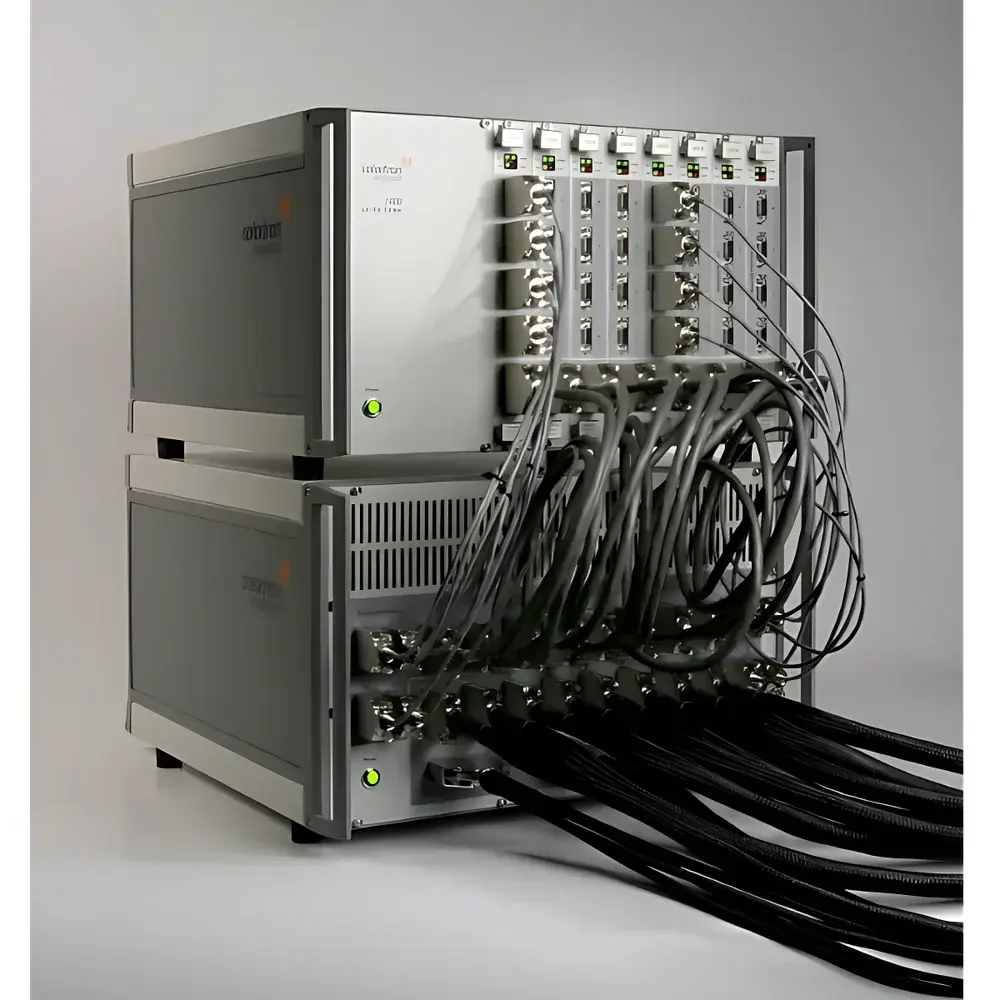
Solartron Analytical 1470E Multi-Channel Potentiostat/Galvanostat with Integrated FRA for Electrochemical Impedance Spectroscopy
| Brand | Solartron Analytical |
|---|---|
| Origin | United Kingdom |
| Model | 1470E Series |
| Channel Count | Up to 8 independent channels per unit |
| Current Range | ±4 A |
| Current Accuracy | ±0.2% of reading |
| Potential Accuracy | ±0.2% of reading |
| Potentiostatic Range | ±10 V |
| EIS Frequency Range | 10 µHz – 1 MHz |
| Control Interface | Ethernet |
| Compliance | ASTM G102, ISO 17475, IEC 62660-2, USP <1058>, FDA 21 CFR Part 11 (software audit trail enabled) |
| Safety | Per-channel hardware-based voltage/current limit enforcement, fast-acting termination logic (<100 µs response) |
Overview
The Solartron Analytical 1470E Multi-Channel Potentiostat/Galvanostat with Integrated Frequency Response Analysis (FRA) is a high-fidelity, modular electrochemical workstation engineered for rigorous DC and AC impedance characterization of energy storage and conversion systems. Based on Couette-type potentiostatic control architecture and dual-phase lock-in detection principles, the system delivers synchronized, time-aligned DC polarization and broadband electrochemical impedance spectroscopy (EIS) across up to eight fully isolated channels. Its design addresses the core metrological challenges in battery R&D—namely, channel crosstalk suppression, galvanic isolation under floating-ground conditions (e.g., pressurized autoclaves or fuel cell stacks), and precise superposition of small-signal AC perturbations onto large DC bias currents (up to ±4 A). The 1470E is not a general-purpose benchtop instrument; it is a laboratory-grade platform built for reproducible, standards-compliant testing in accordance with ASTM G102 (calculation of corrosion rates), ISO 17475 (electrochemical noise analysis), and IEC 62660-2 (secondary lithium-cell performance validation).
Key Features
- Eight electrically isolated, independently addressable potentiostat/galvanostat channels per 1470E unit—each capable of simultaneous DC and AC measurement without shared ground reference.
- Native Ethernet interface enabling deterministic latency-controlled command execution, remote lab management, and integration into centralized LIMS or MES environments.
- Hardware-enforced safety limits per channel: real-time monitoring of voltage, current, and dV/dt with sub-100 µs hardware-triggered shutdown—critical for abuse-condition testing of Li-ion cells or PEMFC stacks.
- Integrated auxiliary channel option (14702A) supporting separate anode/cathode EIS—enabling localized impedance mapping within asymmetric electrode configurations or multi-layer battery stacks.
- High-power DC capability via channel paralleling (up to 28 A aggregate) combined with dedicated low-noise EIS channel—ensuring optimal signal-to-noise ratio during AC measurement under load.
- Floating-ground architecture compliant with high-pressure electrochemical cells, molten salt systems, and solid oxide fuel cell (SOFC) test rigs operating up to 1000 °C (with optional temperature controller integration via RS-232/485).
- Sub-millisecond experimental step switching (≤0.1 ms) and 10 kS/s real-time data acquisition—essential for GSM pulse profiling, fast CV scans (>1 V/s), and transient overpotential capture.
Sample Compatibility & Compliance
The 1470E accommodates diverse electrochemical interfaces—from aqueous electrolyte three-electrode cells and solid-state Li-metal batteries to industrial-scale redox flow reactors and catalytic gas-diffusion electrodes. Its galvanically isolated analog front-end supports grounded, floating, and bipolar cell configurations. All firmware and PC-based control software comply with GLP/GMP requirements: full electronic audit trail (21 CFR Part 11), user role-based access control, immutable raw data logging (including metadata timestamps, calibration history, and hardware configuration fingerprints), and traceable calibration certificate generation. System validation documentation aligns with ISO/IEC 17025 for accredited testing laboratories and supports IQ/OQ/PQ protocols for pharmaceutical battery qualification (USP ).
Software & Data Management
CorrWare™ and SMaRT™ software suites provide unified control of DC techniques (CV, LSV, CP, CA, CC, OCV, pulse protocols) and EIS acquisition (single-sine correlation, multi-sine FFT, and hybrid mode). Raw data are stored in vendor-neutral HDF5 format with embedded SI-unit metadata and provenance tracking. Automated integration routines apply adaptive dwell time based on spectral noise floor estimation—extending integration at low-SNR frequencies while preserving speed at high-SNR bands. All EIS spectra include phase-compensated Kramers–Kronig validation flags and automatic outlier rejection using robust statistical thresholds (modified Thompson τ criterion). Export modules support direct import into MATLAB, Python (via PyMca or impedance.py), and commercial modeling platforms (e.g., COMSOL Multiphysics® with LiveLink™).
Applications
- Accelerated aging studies of Li-ion pouch cells under dynamic load profiles with concurrent EIS at defined SOC/SOH checkpoints.
- In-situ impedance tomography of PEMFC membrane-electrode assemblies (MEAs) under variable humidity and stoichiometry.
- Corrosion rate quantification of coated steel substrates in simulated marine environments (ASTM D1141 brine), including harmonic distortion analysis for pitting onset detection.
- Supercapacitor equivalent series resistance (ESR) and capacitance stability assessment over 100,000 charge/discharge cycles.
- Electrocatalyst screening for CO₂ reduction via high-throughput rotating disk electrode (RDE) arrays with synchronized EIS and voltammetric fingerprinting.
- Redox flow battery electrolyte degradation monitoring through time-resolved Nyquist plot evolution and distribution-of-relaxation-times (DRT) deconvolution.
FAQ
Can the 1470E perform true simultaneous EIS on all 8 channels?
Yes—when paired with the 1455FRA (10 mHz–1 MHz) or 1451FRA (10 mHz–100 kHz), each channel acquires time-synchronized impedance spectra using shared clock distribution and deterministic trigger routing.
Is hardware calibration traceable to NIST standards?
Yes—factory calibration certificates include uncertainty budgets referenced to NIST-traceable standards (Fluke 5720A multimeter, Keysight E4990A impedance analyzer), with annual recalibration intervals specified per ISO/IEC 17025.
How is DC bias rejection achieved during EIS measurements?
The 145x FRA employs active DC nulling circuitry with >120 dB common-mode rejection ratio (CMRR) and adaptive baseline correction—eliminating offset-induced harmonic distortion without external coupling capacitors.
Does the system support custom scripting for automated test sequences?
Yes—native Python API (via Solartron’s SDK) enables full programmatic control of experiment sequencing, parameter sweeps, conditional branching, and real-time feedback loops.
What is the minimum measurable impedance magnitude and maximum phase resolution?
The system achieves <1 mΩ impedance resolution at 1 kHz with ±0.1° phase accuracy across the full 10 µHz–1 MHz range, validated per IEC 60601-2-21 Annex BB.




