
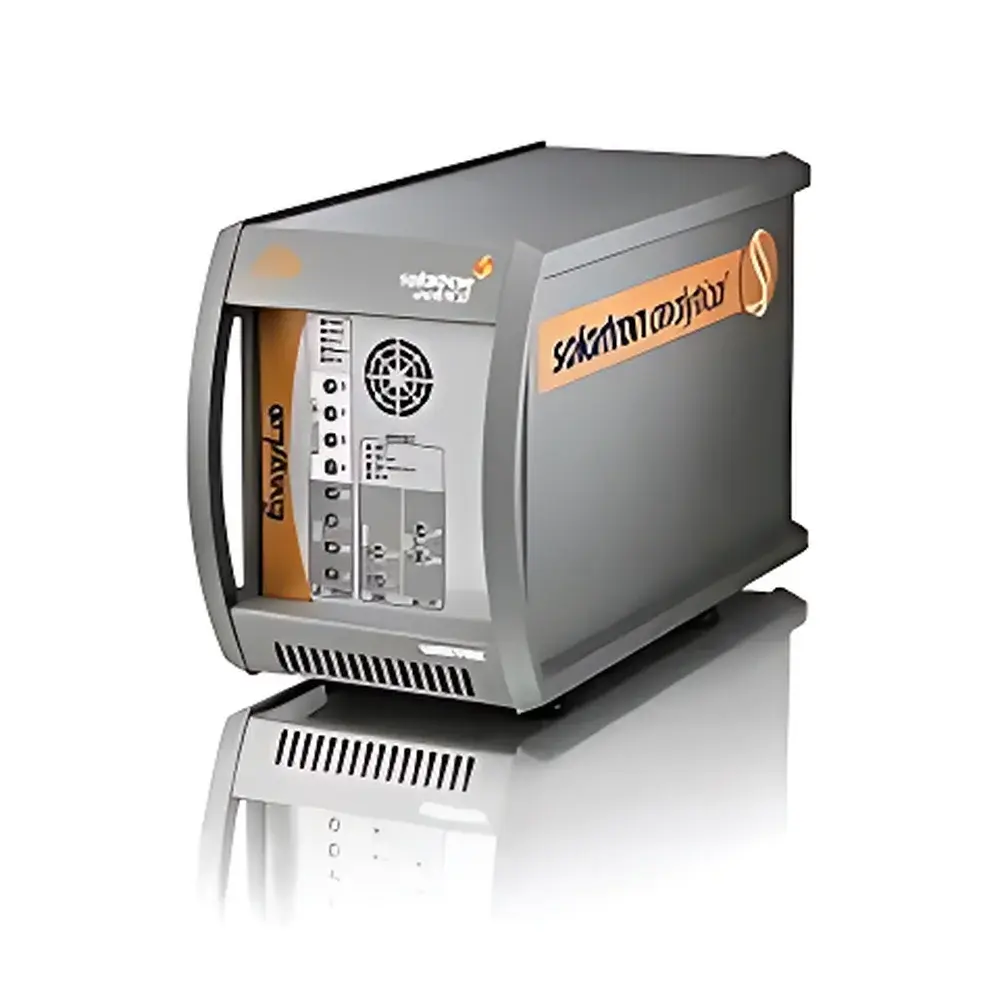
Solartron Analytical Energylab XM Electrochemical Workstation
| Brand | Solartron Analytical |
|---|---|
| Origin | United Kingdom |
| Model | Energylab XM |
| Channel Count | Single-Channel |
| Current Range | ±2 A |
| Current Accuracy | 0.1% + 0.05% + 30 fA |
| Potential Accuracy | 0.1% + 0.05% + 100 µV |
| Potentiostatic Range | ±8 V |
| EIS Frequency Range | 10 µHz – 1 MHz |
| Impedance Measurement Limit | <100 µΩ (with external amplifier support up to 100 A) |
| Sampling Rate | Up to 1 MS/s (DC), 40 MS/s (FRA) |
| Auxiliary Differential Inputs | 4-channel synchronized with RE |
Overview
The Solartron Analytical Energylab XM is a purpose-built, high-precision electrochemical workstation engineered for advanced characterization of next-generation energy storage and conversion devices. Designed as part of the Apps-XM modular platform, it integrates a reference-grade potentiostat/galvanostat, a high-resolution frequency response analyzer (FRA), and a 2 A current amplifier in a compact, benchtop form factor. Its core measurement architecture is based on dual-path analog signal conditioning, real-time digital synchronization, and multi-point factory calibration traceable to NPL (National Physical Laboratory) standards. The system supports both conventional and amplified operation modes—automatically switching between them to maintain optimal signal-to-noise ratio across wide dynamic ranges—from sub-picoampere currents in solid-electrolyte interphase (SEI) studies to kiloampere-equivalent transient responses in large-format battery cells. Unlike general-purpose workstations, the Energylab XM implements true four-terminal (Kelvin) impedance measurement with active guarding and differential reference electrode inputs, enabling micro-ohm-level accuracy (<10 µΩ demonstrated) even under high-current polarization conditions. This capability is essential for quantifying contact resistance, electrode kinetics, and degradation mechanisms in lithium-ion batteries, PEM fuel cells, and supercapacitors—particularly during in-situ/operando testing where thermal drift and parasitic impedance must be rigorously suppressed.
Key Features
- Modular, field-upgradable architecture supporting expansion to 100 A via externally controlled high-current amplifiers
- Simultaneous multi-electrode DC and AC impedance acquisition: full-cell, cathode, anode, or individual stack cells (up to 100 V total stack voltage)
- Ultra-low noise current measurement: 100 aA resolution, 100 TΩ) measurements
- High-fidelity waveform generation: 64 MS/s interpolated linear sweep, >25 kV/s scan rates with <1 µV RMS ripple, and 40× oversampling for EIS
- Dual-domain synchronization: all auxiliary channels (A/B/C/D) are hardware-timed and phase-locked to the reference electrode, enabling true differential voltage monitoring during pulsed or transient experiments
- Real-time experimental preview: software renders live waveform and connection diagrams prior to experiment execution, reducing setup errors and validation time
Sample Compatibility & Compliance
The Energylab XM is validated for use with standard three-electrode and four-electrode electrochemical cells, including Swagelok-type, coin-cell holders with spring-loaded contacts, and custom-designed flow cells for fuel cell membrane evaluation. It complies with ISO 17025 requirements for measurement uncertainty reporting and supports GLP/GMP audit trails through optional 21 CFR Part 11–compliant software modules. All calibration certificates include traceability to UKAS-accredited standards. For corrosion applications, the system meets ASTM G5, G59, and G102 guidelines for polarization resistance and EIS data acquisition. In battery testing, it aligns with IEC 62660-1 and USABC protocols for impedance spectroscopy at open-circuit and under load conditions. The floating ground design (±100 V isolation) and differential RE input ensure compatibility with grounded industrial battery management systems and multi-cell test benches without ground-loop interference.
Software & Data Management
The included ModuLab XM ECS software provides a unified interface for experiment design, real-time visualization, and post-processing. It supports over 80 predefined techniques—including hybrid methods such as galvanostatic intermittent titration (GITT), incremental capacity analysis (ICA), and multi-sine EIS—with full scripting capability via Python API. Raw data is stored in HDF5 format with embedded metadata (timestamp, instrument configuration, calibration ID, environmental logs). All measurements include automatic audit logging: user identity, parameter changes, hardware state transitions, and file export history. For regulatory environments, optional modules provide electronic signatures, role-based access control, and immutable data archiving compliant with FDA 21 CFR Part 11 Annex 11. Data reduction workflows integrate seamlessly with MATLAB, Python (SciPy, impedance.py), and commercial battery modeling tools (e.g., COMSOL Multiphysics®).
Applications
- Lithium-ion battery R&D: SEI growth kinetics, Li plating detection, cathode dissolution monitoring, and full-cell/anode/cathode decoupling via auxiliary channel synchronization
- Fuel cell membrane-electrode assembly (MEA) characterization: proton conductivity mapping, catalyst layer charge transfer resistance, and humidity-dependent EIS
- Supercapacitor aging studies: equivalent series resistance (ESR) evolution, pore accessibility loss, and frequency-dependent capacitance decay
- Corrosion science: localized pitting initiation tracking, coating defect quantification, and electrochemical noise analysis (ENA)
- Photoelectrochemical systems: transient photocurrent analysis under modulated illumination, Mott-Schottky profiling, and dielectric constant extraction
FAQ
Can the Energylab XM perform simultaneous multi-electrode impedance measurements?
Yes—it supports fully synchronized DC and AC impedance acquisition across up to four auxiliary differential inputs, enabling concurrent monitoring of full-cell voltage, cathode potential, anode potential, and reference electrode drift.
Is external amplifier integration automated?
Yes—the system detects connected Solartron high-current amplifiers (e.g., 100 A HCA) via digital handshake and auto-configures gain, bandwidth, and safety limits without manual recalibration.
What is the minimum measurable impedance with standard configuration?
With internal 2 A amplifier and optimized cabling, the system achieves reliable measurements down to 10 µΩ; sub-µΩ resolution is attainable using external current shunts and differential voltage sensing.
Does the software support custom sequence programming for battery cycling protocols?
Yes—ModuLab XM ECS includes a graphical sequence builder with conditional logic, loop structures, and real-time parameter feedback, enabling complex protocols such as variable-rate charge/discharge with embedded EIS pauses.
How is measurement traceability ensured across different labs?
All instruments ship with NPL-traceable calibration reports covering DC accuracy, AC phase linearity, timing jitter, and impedance magnitude/phase uncertainty across the full 10 µHz–1 MHz range.




