
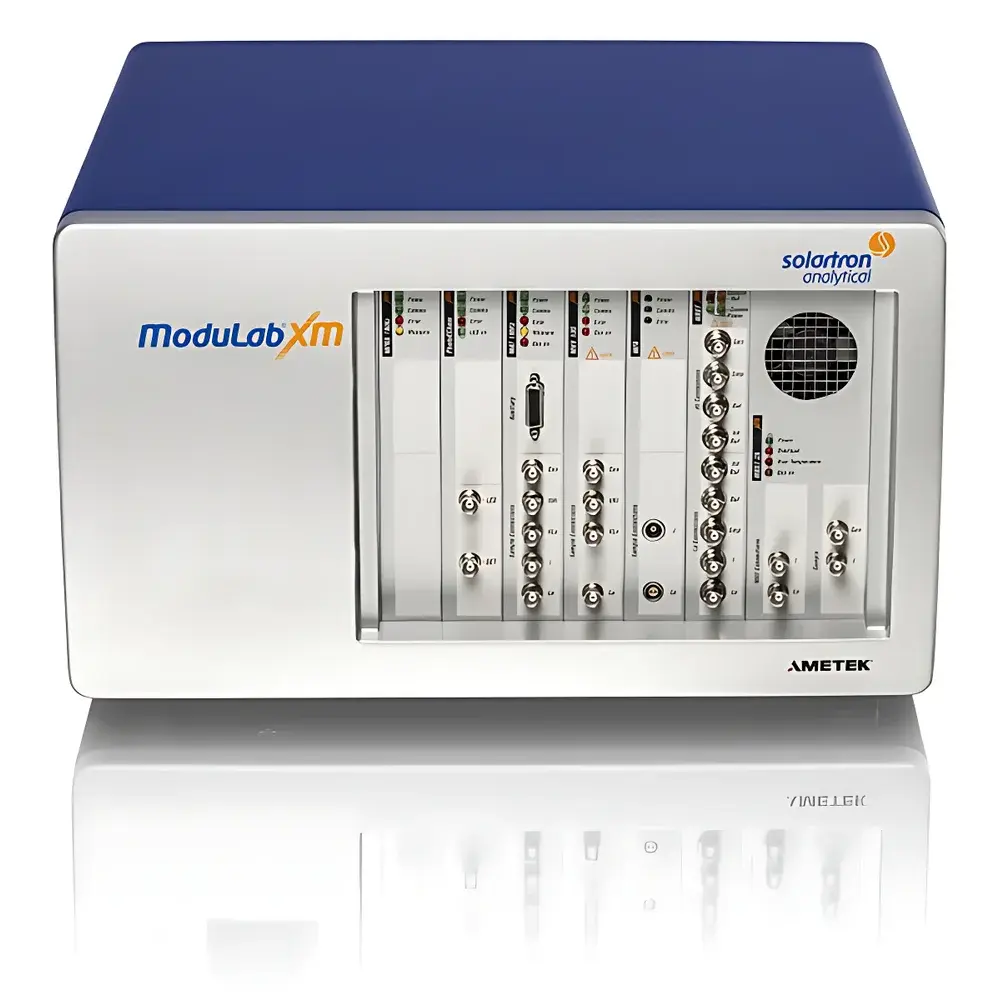
Solartron Analytical ModuLab XM MTS Electrochemical Workstation with 1296A Ultra-High-Impedance and 1294A Biomedical Interfaces
| Brand | Solartron Analytical |
|---|---|
| Origin | United Kingdom |
| Model | ModuLab XM MTS (1296A + 1294A) |
| Current Range | ±2 A |
| Current Accuracy | 0.1% reading + 0.05% range + 30 fA |
| Potential Accuracy | ±0.2% of setting |
| Potentiostatic Range | ±100 V |
| AC Impedance Frequency Range | 10 µHz – 1 MHz |
| Impedance Measurement Range | 100 Ω – 100 TΩ (12 decades) |
| Dielectric Loss Tangent Resolution | tan δ < 10⁻⁴ |
| Max DC Bias Voltage | 1000 V (with external high-voltage source or amplifier) |
| Compliance | IEC 601 for biomedical applications (1294A), ASTM D257, ISO 3001, IEEE Std 930 |
Overview
The Solartron Analytical ModuLab XM MTS Electrochemical Workstation is a fully integrated, modular research platform engineered for precision characterization of electrical transport properties across an exceptionally broad material spectrum—from insulators and dielectrics to semiconductors, conductive polymers, superconductors, and biological tissues. At its core, the system implements potentiostatic/galvanostatic control combined with frequency-domain electrochemical impedance spectroscopy (EIS), capacitance-voltage (C-V), Mott-Schottky analysis, and time-domain techniques including DC I-V sweeps, pulsed potential/current excitation, and stepped voltage protocols. Its architecture supports simultaneous multi-channel acquisition and synchronized stimulus-response measurement, enabling rigorous separation of bulk, interfacial, and electrode kinetic contributions in complex heterogeneous systems. Designed for fundamental materials science and applied R&D laboratories, the ModuLab XM MTS delivers traceable metrology-grade performance under controlled environmental conditions—critical for validating structure–property relationships in next-generation energy storage, corrosion science, biomaterials, and electronic packaging.
Key Features
- Modular hardware architecture with hot-swappable functional units—enabling seamless integration of the 1296A Ultra-High-Impedance Interface and 1294A Biomedical Interface without system recalibration.
- 1296A interface extends impedance measurement capability to 100 TΩ (10¹⁴ Ω) with <10⁻⁴ tan δ resolution, supporting low-conductivity polymer films, ceramic dielectrics, lubricating oils, and epoxy-based composites.
- 1294A interface meets IEC 601 safety and signal integrity requirements for in vitro and ex vivo biological tissue impedance, including cell monolayers, hydrogels, and implant-coating interfaces.
- True four-terminal (Kelvin) sensing with guarded inputs minimizes stray capacitance and leakage current errors—essential for sub-picoampere current measurements at ultra-low frequencies (down to 10 µHz).
- Programmable DC bias up to ±100 V (standard), extendable to ±1000 V via external high-voltage amplifiers—enabling polarization-dependent dielectric response mapping and breakdown threshold analysis.
- Real-time data streaming with timestamped metadata, full audit trail, and optional 21 CFR Part 11-compliant software modules for regulated environments.
Sample Compatibility & Compliance
The ModuLab XM MTS accommodates diverse sample geometries—including two- and three-electrode electrochemical cells, parallel-plate dielectric fixtures, interdigitated electrode arrays (IDEs), and custom biocompatible holders compatible with physiological saline and buffered media. The 1294A interface incorporates galvanic isolation and patient-isolated circuitry certified per IEC 601-1:2005+A1:2012, making it suitable for preclinical electrophysiological studies and regulatory submissions. For non-biomedical applications, the system adheres to ASTM D257 (resistivity of insulating materials), ISO 3001 (dielectric loss factor), and IEEE Std 930 (statistical analysis of reliability data). All impedance spectra are traceable to NIST-calibrated reference standards, and thermal drift compensation algorithms ensure stability across temperature-controlled stages (−180 °C to +600 °C, with optional cryostat/furnace integration).
Software & Data Management
Operation is managed through the ModuLab XM Control Suite—a Windows-based application built on a deterministic real-time kernel. It provides scriptable experiment sequencing (via Python API), automated parameter optimization (e.g., adaptive frequency stepping for EIS), and model-based fitting using equivalent circuit libraries compliant with IUPAC nomenclature. Raw data files (.mod) include embedded instrument configuration, calibration history, and environmental logs (temperature, humidity, ambient EMI). Export formats include ASCII, MATLAB (.mat), and HDF5 for interoperability with third-party analysis tools such as ZView®, EC-Lab®, and custom Python/Matlab pipelines. Audit trails record user actions, method changes, and data exports—fully configurable to meet GLP/GMP documentation requirements and FDA 21 CFR Part 11 electronic signature compliance.
Applications
- Dielectric relaxation spectroscopy of polymer electrolytes and solid-state battery separators.
- Corrosion mechanism analysis via low-frequency EIS on coated metals and passive films.
- Interface charge transfer kinetics in perovskite solar cells and organic photovoltaics.
- Hydration dynamics and ion transport in hydrogel-based biosensors and wound dressings.
- Quality control of high-k dielectric thin films in semiconductor fabrication.
- Electrochemical stability window determination for novel Li-ion and Na-ion electrolytes.
FAQ
What is the minimum measurable current with the 1296A interface?
The 1296A achieves sub-30 fA resolution in low-current mode (1 pA full scale), with noise floor <5 fA RMS over 10 s integration at 1 kHz.
Can the ModuLab XM MTS perform simultaneous EIS and C-V measurements?
Yes—dual-channel operation allows concurrent AC impedance acquisition and DC-biased capacitance profiling, enabling direct correlation of dielectric dispersion with carrier depletion profiles.
Is the system compatible with third-party temperature chambers?
Fully compatible via analog/digital I/O ports and RS-232/USB TTL interfaces; LabVIEW and Python drivers support closed-loop temperature synchronization.
Does the 1294A interface support real-time impedance monitoring during cell culture?
Yes—continuous 10-point EIS sweeps at 1 Hz update rate are supported, with automatic baseline correction for medium conductivity drift.
How is calibration traceability maintained across module swaps?
Each module contains embedded EEPROM-stored calibration coefficients verified against NIST-traceable standards; the control software auto-detects and applies corrections upon insertion.




