
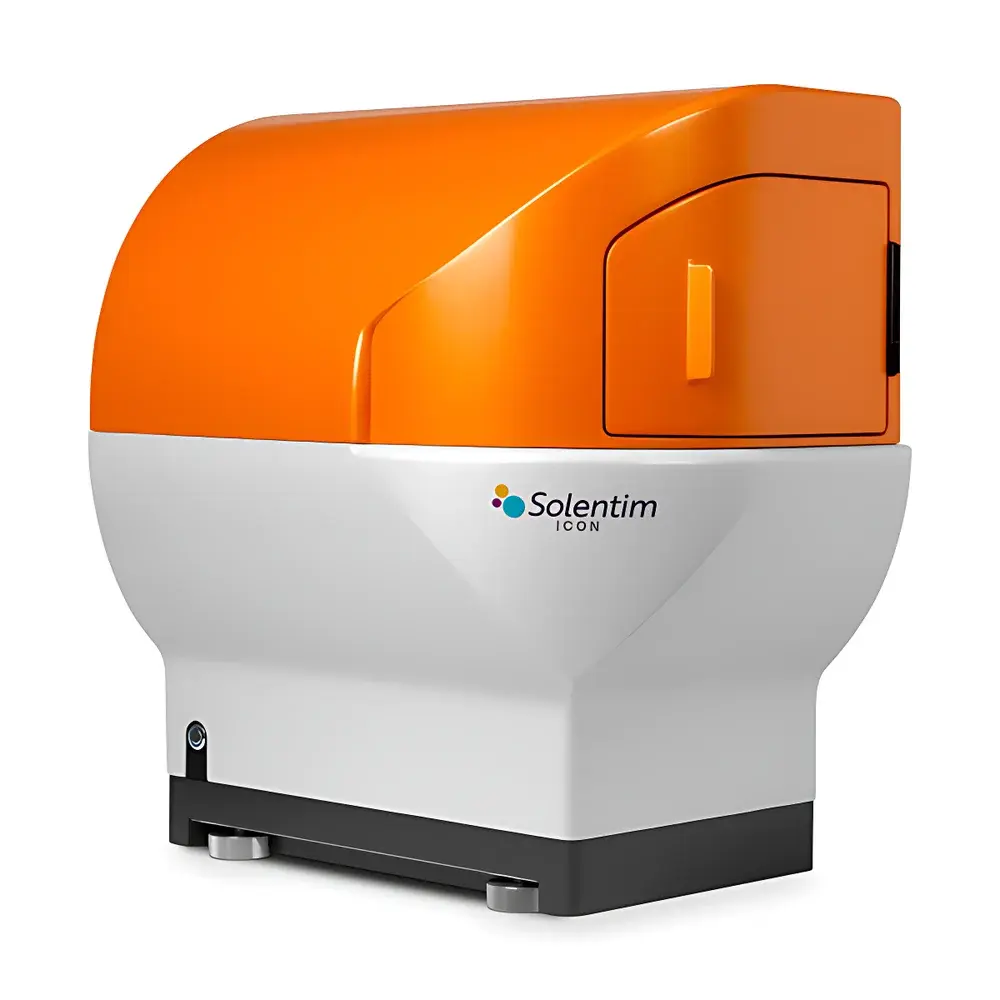
Solentim ICON™ Integrated Analyser for Human IgG Titer, Viable Cell Density (VCD), and Product Yield
| Brand | Solentim |
|---|---|
| Origin | United Kingdom |
| Manufacturer | Solentim Ltd. |
| Type | Integrated Bioprocess Analyser |
| Model | ICON |
| Software Platform | STUDIUS v4.x |
| Sample Throughput | Up to 96 samples per run |
| Minimum Sample Volume | 10 µL |
| Measurement Modes | IgG ELISA-based titer, automated brightfield/image-based cell counting (VCD), integrated yield calculation |
| Data Integration | Native support for Cell Metric® and VIPS™ clone imaging metadata |
| Compliance | Designed for GLP/GMP-aligned workflows |
Overview
The Solentim ICON™ Integrated Analyser is an engineered solution for bioprocess development laboratories seeking quantitative, multi-parameter characterization of mammalian cell culture processes—specifically human IgG-producing CHO or HEK cell lines. Unlike conventional standalone assays, the ICON employs a unified hardware platform combining three orthogonal analytical modalities: enzyme-linked immunosorbent assay (ELISA)-based quantification of secreted IgG titer, high-contrast brightfield image analysis for viable cell density (VCD) determination, and algorithmic yield calculation derived from titer and VCD time-series data. Its architecture eliminates inter-instrument variability and manual data reconciliation by performing all measurements on a single calibrated system using standardized reagent kits and traceable calibration standards. The analyser is purpose-built for early-stage process development, clone selection, and fed-batch optimization—enabling scientists to generate comparable, auditable datasets across microscale (e.g., Ambr® 15/250 systems), benchtop bioreactors, and static plate-based cultures.
Key Features
- Single-platform tri-modal analysis: Simultaneous IgG titer (ng/mL), viable cell density (cells/mL), and volumetric productivity (pg/cell/day) output per sample
- Micro-volume compatibility: Processes as little as 10 µL of clarified supernatant without dilution or pre-concentration
- Automated workflow integration: Direct import of clone-level confluency and morphology metrics from Solentim Cell Metric® and VIPS™ imaging platforms
- STUDIUS v4.x software suite: Embedded data normalization, batch comparison tools, and real-time trending with configurable pass/fail thresholds
- Robust liquid handling: Positive displacement pipetting with anti-droplet dispensing and tip-jet cleaning to prevent carryover between IgG and cell count modules
- GxP-ready infrastructure: Role-based user permissions, electronic signatures, full audit trail, and 21 CFR Part 11-compliant data archiving options
Sample Compatibility & Compliance
The ICON accepts samples directly from common bioprocessing formats—including 96-well plates, centrifuge tubes (1.5–15 mL), shake flasks, and miniature bioreactors (Ambr®, DASGIP, Sartorius Biostat®). It accommodates clarified harvests with turbidity up to 120 NTU and hemolysis indices ≤0.5 AU, validated per ISO 13485:2016 and aligned with ICH Q5A(R2) recommendations for host cell protein interference assessment. All IgG quantitation uses a calibrated, lot-controlled anti-human IgG Fc secondary detection system traceable to WHO International Standard NIBSC 14/282. Cell counting algorithms are trained on >50,000 manually verified images spanning low-confluence monoclonal colonies to high-density suspension cultures, achieving ≥98.2% concordance with manual hemocytometer counts (n=128, CV <4.7%). The system supports qualification documentation packages compliant with FDA Process Validation Guidance (2011) and EMA CHMP Guideline on Development of Biological Medicines (2023).
Software & Data Management
STUDIUS serves as the central analytical engine and data governance layer for the ICON. It enforces structured experimental metadata capture—including passage number, feed strategy, media lot, and environmental logging timestamps—and links raw absorbance (titer) and pixel-intensity (cell count) data to individual wells or vessels. Data export conforms to ASTM E2500-21 for instrument qualification records and supports CSV, PDF, and XML formats compatible with LIMS and MES integration. Version-controlled method templates ensure consistency across sites; change logs record every parameter modification with user ID and timestamp. Audit trails meet ALCOA+ principles (Attributable, Legible, Contemporaneous, Original, Accurate, Complete, Consistent, Enduring, Available) and are exportable for regulatory inspection.
Applications
- High-throughput clone ranking based on integrated titer × VCD × viability profiles over 14-day fed-batch timelines
- Media optimization studies comparing nutrient uptake kinetics against product accumulation rates
- Process characterization of scale-down models (e.g., Ambr® vs. 2-L bioreactor) using identical analytical endpoints
- Stability-indicating assays tracking IgG aggregation or fragmentation via correlation with declining VCD trends
- Regulatory submission support: Generating consistent, GMP-aligned datasets for IND/IMPD dossiers
- Technology transfer documentation: Pre-configured STUDIUS report templates aligned with ICH M4Q(R2) section requirements
FAQ
Does the ICON require external calibration with reference standards for each run?
No. The system performs daily self-calibration using onboard photometric and imaging references; primary calibration is performed during installation and annually during preventive maintenance.
Can STUDIUS integrate with third-party bioreactor control software such as BioCommand or WinControl?
Yes—via OPC UA and RESTful API interfaces, enabling bidirectional synchronization of setpoints, sensor readings, and analytical results.
Is the IgG assay specific to all human IgG subclasses (IgG1–IgG4)?
The assay detects total human IgG with cross-reactivity confirmed for IgG1, IgG2, and IgG4; IgG3 detection requires validation with customer-specific molecules due to hinge region variability.
How does the ICON handle samples containing high levels of BSA or other blocking proteins?
The ELISA wash protocol includes optimized stringency steps that reduce non-specific binding; recovery validation data for 0.1–10 mg/mL BSA-spiked samples show <8% signal suppression at typical assay concentrations.
What training and qualification support does Solentim provide?
Installation Qualification (IQ), Operational Qualification (OQ), and Performance Qualification (PQ) protocols are supplied; on-site operator training and STUDIUS administrator certification are available as optional services.
Related Products




