
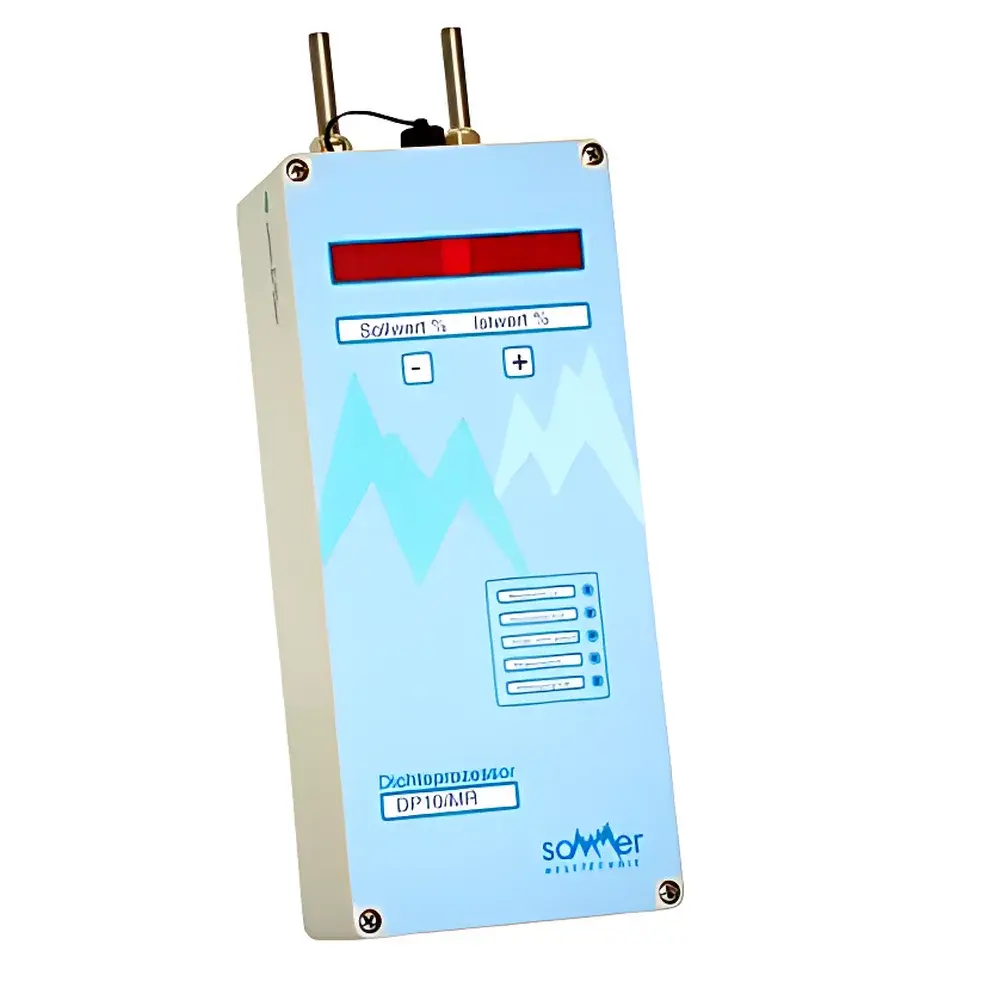
Sommer DP-10 Digital Oscillating U-Tube Density Meter
| Brand | Sommer |
|---|---|
| Origin | Austria |
| Model | DP-10 |
| Measurement Principle | Oscillating U-tube |
| Resolution | 0.001 g/cm³ |
| Measurands | NaCl, CaCl₂, MgCl₂ aqueous solution density & concentration |
| Analog Output | 0–10 V |
| Digital Interface | RS232 (9600 Bd, ASCII) |
| Power Supply | 20–30 VDC (80 mA) |
| Operating Temperature | −25 to +50 °C |
| Sample Temperature Range | −30 to +30 °C |
| Housing Dimensions | 150 × 340 × 100 mm (W × H × D) |
| Wetted Parts Material | Stainless Steel DIN 1.4439 |
| Process Connection | 10 mm tube |
| Weight | ~2 kg |
| Ingress Protection | IP65 |
Overview
The Sommer DP-10 Digital Oscillating U-Tube Density Meter is an industrial-grade inline density analyzer engineered for continuous, real-time monitoring of brine solutions used in winter road maintenance and de-icing operations. It operates on the well-established oscillating U-tube principle: a precisely machined U-shaped glass or metal tube—here constructed from corrosion-resistant stainless steel DIN 1.4439—is filled with sample fluid and electromagnetically excited to resonate at its natural frequency. Since the resonant frequency is inversely proportional to the square root of the sample’s density, high-precision measurement is achieved without moving parts or optical components. This principle delivers long-term stability, minimal drift, and high reproducibility—critical for closed-loop control of salt mixing stations where NaCl, CaCl₂, or MgCl₂ concentrations must be maintained within narrow operational tolerances (e.g., 20–30 wt% for optimized freezing-point depression). Unlike manual hydrometers or laboratory-based pycnometers, the DP-10 enables true process-integrated metrology—measuring density directly in a bypass line, eliminating sampling delays, operator variability, and contamination risk.
Key Features
- Real-time, continuous density measurement via oscillating U-tube technology with ±0.001 g/cm³ resolution
- Ruggedized stainless steel (DIN 1.4439) measurement cell rated for aggressive chloride-rich environments
- IP65-rated housing suitable for outdoor deployment in salt storage facilities, brine preparation plants, and roadside maintenance depots
- Compact form factor (150 × 340 × 100 mm) enabling installation in space-constrained bypass manifolds or skid-mounted mixing systems
- Two analog output options: standard 0–10 V signal for integration with PLCs or SCADA systems; optional internal LED display (DP-10/A) for local verification
- Integrated mixing controller variant (DP-10/MR) supports automated feedback control of water/salt dosing valves based on real-time density feedback
- Wide operating temperature range (−25 to +50 °C), with calibrated measurement capability down to −30 °C sample temperature—essential for cold-climate operation
Sample Compatibility & Compliance
The DP-10 is specifically validated for aqueous solutions of sodium chloride (NaCl), calcium chloride (CaCl₂), and magnesium chloride (MgCl₂)—the three most widely deployed liquid de-icers in municipal and highway winter maintenance. Its calibration is traceable to NIST-certified reference standards and supports user-defined concentration-density lookup tables aligned with ISO 27827 (Determination of density of aqueous salt solutions) and ASTM D1120 (Standard Test Method for Boiling Point of Engine Coolants). While not intended for highly viscous or particulate-laden media, the instrument complies with EN 61326-1 for electromagnetic compatibility in industrial environments and meets CE marking requirements for machinery safety (2006/42/EC). Its design facilitates routine validation per GLP-aligned procedures, including daily zero-point checks using air and reference water measurements.
Software & Data Management
The DP-10 communicates via RS232 serial interface (9600 Bd, ASCII protocol), enabling direct connection to data loggers, HMIs, or custom supervisory software. ASCII-formatted output includes timestamped density (g/cm³), calculated concentration (% w/w), temperature (°C), and diagnostic status flags. No proprietary software is required; raw data streams are compatible with common industrial platforms such as Ignition SCADA, Siemens Desigo, or LabVIEW-based QA dashboards. For auditability, users may configure external logging to record all density readings at configurable intervals (e.g., every 5 seconds), supporting compliance with internal quality protocols and facilitating retrospective analysis of mixing consistency across seasonal campaigns. While the base model lacks built-in data storage, the DP-10/MR variant includes non-volatile memory for up to 30 days of 1-minute interval logs.
Applications
- Automated brine production: Real-time density feedback for closed-loop control of NaCl/CaCl₂ dissolution tanks and metering pumps
- Mobile de-icer applicators: Onboard density verification prior to road spraying to ensure regulatory-compliant application rates
- Quality assurance in salt storage facilities: Continuous monitoring of stored brine inventory density to detect dilution or crystallization events
- Research and development of novel de-icing formulations: High-resolution density profiling during formulation optimization and thermal stability testing
- Environmental compliance reporting: Correlating measured density with chloride ion load for discharge permitting under EU Water Framework Directive reporting frameworks
FAQ
What concentration ranges can the DP-10 accurately measure for NaCl solutions?
The instrument is calibrated for 0–30 wt% NaCl, with optimal accuracy (±0.1% relative) between 15–25 wt%. Calibration curves for CaCl₂ and MgCl₂ are user-loadable and cover typical field ranges of 0–40 wt% and 0–35 wt%, respectively.
Can the DP-10 be installed directly in the main flow line?
No—it requires a dedicated bypass line with laminar, bubble-free flow and stable temperature. Minimum recommended flow rate is 0.5 L/min; upstream filtration (≤50 µm) is advised to prevent sensor fouling.
Is the DP-10 compliant with FDA 21 CFR Part 11 for electronic records?
The base DP-10 does not include audit trail, electronic signature, or user access control features required by Part 11. However, when integrated into a validated SCADA system with appropriate validation documentation, it may support Part 11–compliant workflows.
How often does the sensor require recalibration?
Under stable operating conditions, annual calibration against certified reference fluids is recommended. Daily air/water zero-span verification is sufficient for routine operational confidence.
Does the DP-10 support Modbus RTU or Ethernet/IP protocols?
No—the native interface is RS232 only. Protocol conversion to Modbus RTU or Ethernet/IP requires an external industrial protocol gateway configured for ASCII-to-Modbus mapping.







