
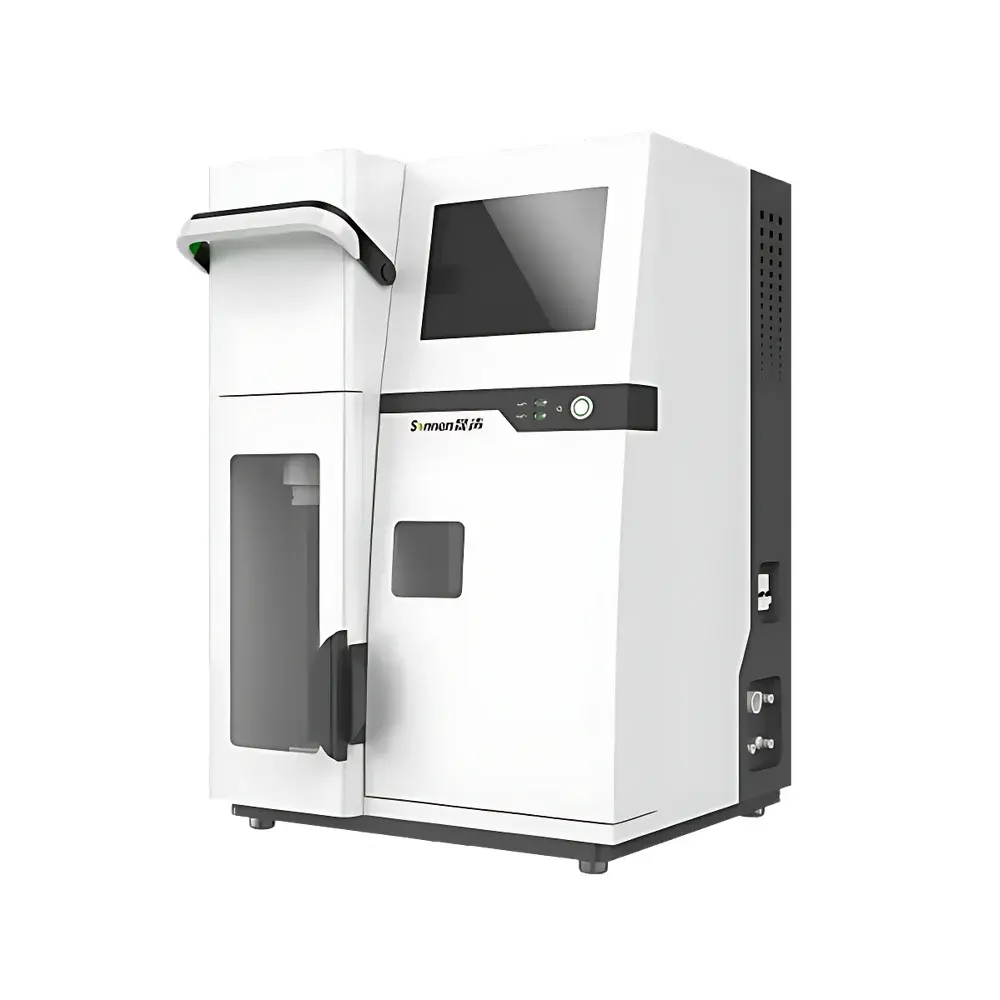
Sonnen K12 Fully Automated Kjeldahl Nitrogen Determinator
| Brand | Sonnen |
|---|---|
| Origin | Shanghai, China |
| Model | K12 |
| Instrument Type | Kjeldahl Nitrogen Determinator |
| Automation Level | Fully Automated |
| Nitrogen Determination Range | 0.1–240 mg N per sample |
| Distillation Time (Ammonium Nitrogen) | 3–7 min/sample |
| Repeatability | ≤0.5% RSD |
| Sample Weight Capacity | ≤6 g (solid), ≤25 mL (liquid) |
| Recovery Rate | ≥99.5% |
| Linearity | RSD ≤1% over 1–3× nitrogen concentration range in digestion tube |
| Power Consumption | 1800 W |
| Dimensions (L×W×H) | 460 × 450 × 720 mm |
| Titration Resolution | 0.1 µL/step |
| Internal Data Storage | 1,000,000 test records |
| User-Defined Methods | 500 |
| Cooling Water Flow | 0.5 L/min (at 15 °C), 1.5 L/min (at 25 °C) |
| Compliance | ISO 9001 certified, CE marked |
Overview
The Sonnen K12 Fully Automated Kjeldahl Nitrogen Determinator is an integrated, regulatory-compliant solution for quantitative nitrogen analysis based on the classical Kjeldahl method—comprising acid digestion, alkaline steam distillation, boric acid absorption, and potentiometric or colorimetric endpoint titration. Engineered for precision and reproducibility in high-throughput laboratory environments, the K12 implements standardized wet chemistry principles aligned with ISO 8968, AOAC 984.13, ASTM D1142, and GB/T 22923–2008. Its core architecture supports both routine protein quantification (via nitrogen-to-protein conversion factors) and specialized applications including cation exchange capacity (CEC) determination in soils and ammonium-nitrogen speciation in environmental matrices. The system operates under full GLP/GMP-aligned workflow control, with hardware-level safeguards and software audit trails ensuring data integrity across all analytical phases.
Key Features
- Fully automated reagent dosing, steam distillation, back-titration, digestion tube waste ejection, titration vessel cleaning, calibration, liquid level monitoring, calculation, and report generation—eliminating manual intervention from digestion to final reporting.
- Multi-layer safety architecture: motorized safety door with position verification; pressure and temperature sensors in the steam generator; dual water-level detection (float + electrode); real-time monitoring of distillate temperature and volume; continuous cooling water flow rate sensing with low-flow alarm and automatic shutdown; condensate outlet temperature control to ensure complete ammonia condensation.
- Optional 35-position robotic autosampler enables unattended operation for extended batch processing, reducing labor dependency and improving inter-day consistency.
- Industrial-grade ARM-based embedded OS with dual-language (English/Chinese) 10-inch HD capacitive touchscreen interface for real-time process visualization and parameter adjustment.
- Four-tier user permission system (Program Administrator → Chief Administrator → Assistant Administrator → Operator) with time-locked data access and electronic signature support—fully compliant with FDA 21 CFR Part 11 and EU Annex 11 requirements.
- Dynamic titration algorithm enabling adaptive delivery speed: rapid approach near endpoint followed by ultra-fine 0.1 µL/step micro-dosing, synchronizing titration completion with distillation output and reducing total cycle time by up to 40%.
- High-stability peristaltic and diaphragm reagent pumps resistant to strong acids (e.g., concentrated H₂SO₄) and alkalis (e.g., 40% NaOH), featuring anti-clogging geometry and vacuum-assisted aspiration for hazard-free liquid handling.
- Corrosion-resistant 304 stainless steel distillation chamber and PTFE-coated safety viewing window; high-molecular-weight splash guard optimized for ammonia retention and recovery fidelity.
Sample Compatibility & Compliance
The K12 accommodates diverse sample types—including solid foods (≤6 g), liquid beverages (≤25 mL), feedstuffs, soil extracts, wastewater, pharmaceutical excipients, and biological tissues—without modification to core methodology. It meets critical regulatory benchmarks: ISO 9001 quality management certification, CE marking per Directive 2014/30/EU (EMC) and 2014/35/EU (LVD), and conformance to JJF 109–2012 “Calibration Specification for Kjeldahl Nitrogen Determinators.” Method validation data demonstrate ≥99.5% nitrogen recovery across matrix types, with repeatability ≤0.5% RSD at mid-range concentrations (10–100 mg N) and linearity maintained (RSD ≤1%) over a 1:3 nitrogen concentration span within the digestion tube—validating robustness per ICH Q2(R2) guidelines.
Software & Data Management
The K12 runs on a Windows-based desktop application supporting method creation, result review, statistical evaluation (recovery %, RSD, confidence intervals), and automated report generation in 12 export formats—including editable Word (.docx) and Excel (.xlsx) files. All instrument-generated data—including raw titration curves, distillate temperature logs, reagent consumption timestamps, and operator IDs—are stored locally (1 million records) with optional cloud or network server backup. USB 2.0 port enables secure offline data transfer; built-in Wi-Fi module supports TLS-encrypted wireless synchronization with lab information management systems (LIMS). Audit trail functionality records every user action with timestamp, IP address (if networked), and change justification—enabling full traceability during GLP audits or regulatory inspections.
Applications
The K12 delivers validated nitrogen quantification across regulated and research-driven sectors: protein content in dairy, cereals, meat, and plant-based alternatives (AOAC 981.10); crude protein estimation in animal feed and fertilizer formulations; ammonium-N in wastewater and leachates per EPA Method 350.1; total Kjeldahl nitrogen (TKN) in soil and sediment per ISO 11261; CEC assessment in agronomic studies; and nitrogen impurity profiling in active pharmaceutical ingredients (APIs) under ICH Q5C. Its sub-10 ppm detection capability extends utility to ultra-trace nitrogen screening in high-purity chemicals and semiconductor-grade reagents.
FAQ
Does the K12 comply with FDA 21 CFR Part 11 requirements for electronic records and signatures?
Yes—the four-tier user authentication, time-locked data encryption, immutable audit trail, and electronic signature capture fully satisfy Part 11 technical and procedural controls.
Can the system analyze nitrate-nitrogen or high-nitrogen samples without hardware modification?
Standard configuration supports ammonium-N only; optional modules for nitrate reduction (e.g., Devarda’s alloy) and high-nitrogen digestion (up to 240 mg N) are available as factory-installed upgrades.
What maintenance protocols are recommended for long-term operational stability?
Daily: rinse reagent lines and titration cell; weekly: inspect steam trap and condenser tubing; quarterly: calibrate temperature/pressure sensors and verify titration syringe accuracy using certified standard solutions.
Is remote diagnostics supported?
Yes—via encrypted Wi-Fi or Ethernet, authorized service engineers can perform firmware updates, sensor diagnostics, and calibration verification while preserving data sovereignty.
How is method validation documented for regulatory submissions?
The software exports IQ/OQ/PQ-ready validation packages including system suitability tests, recovery studies, intermediate precision assessments, and linearity reports—all traceable to NIST-traceable reference materials.
Related Products






