
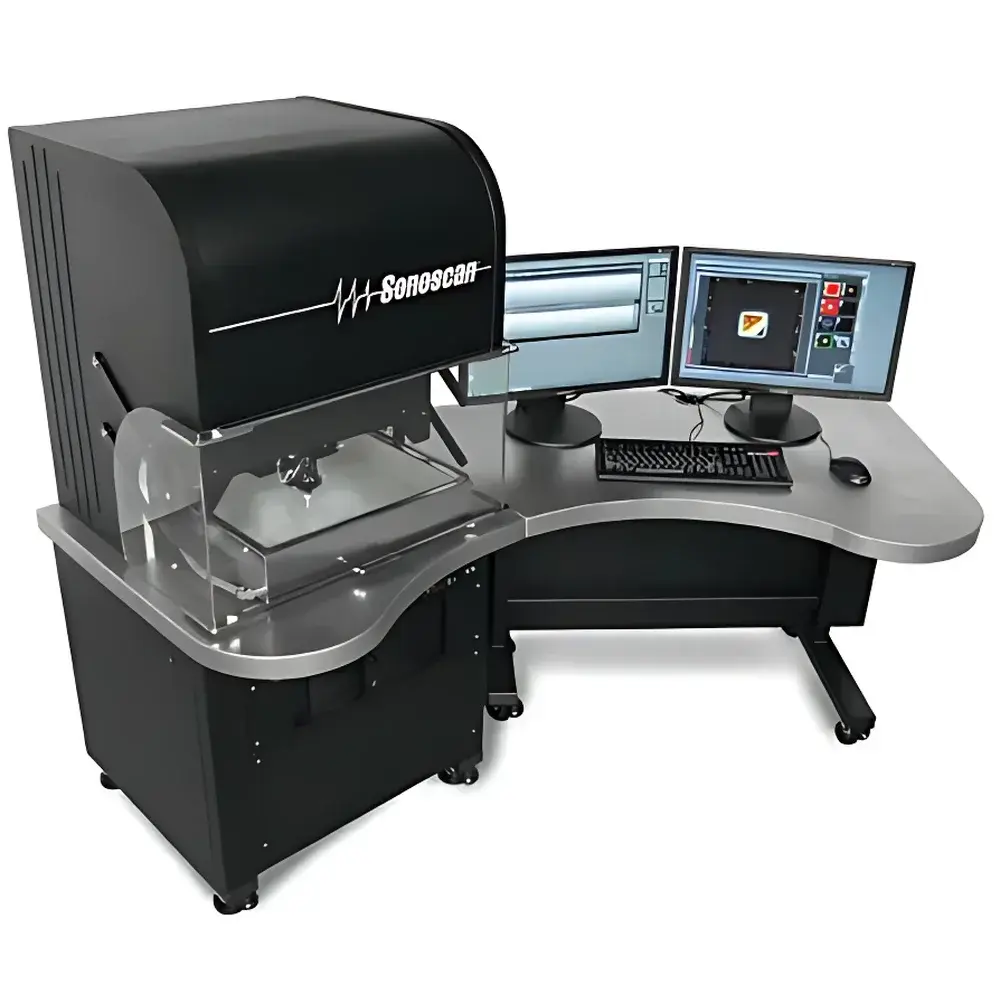
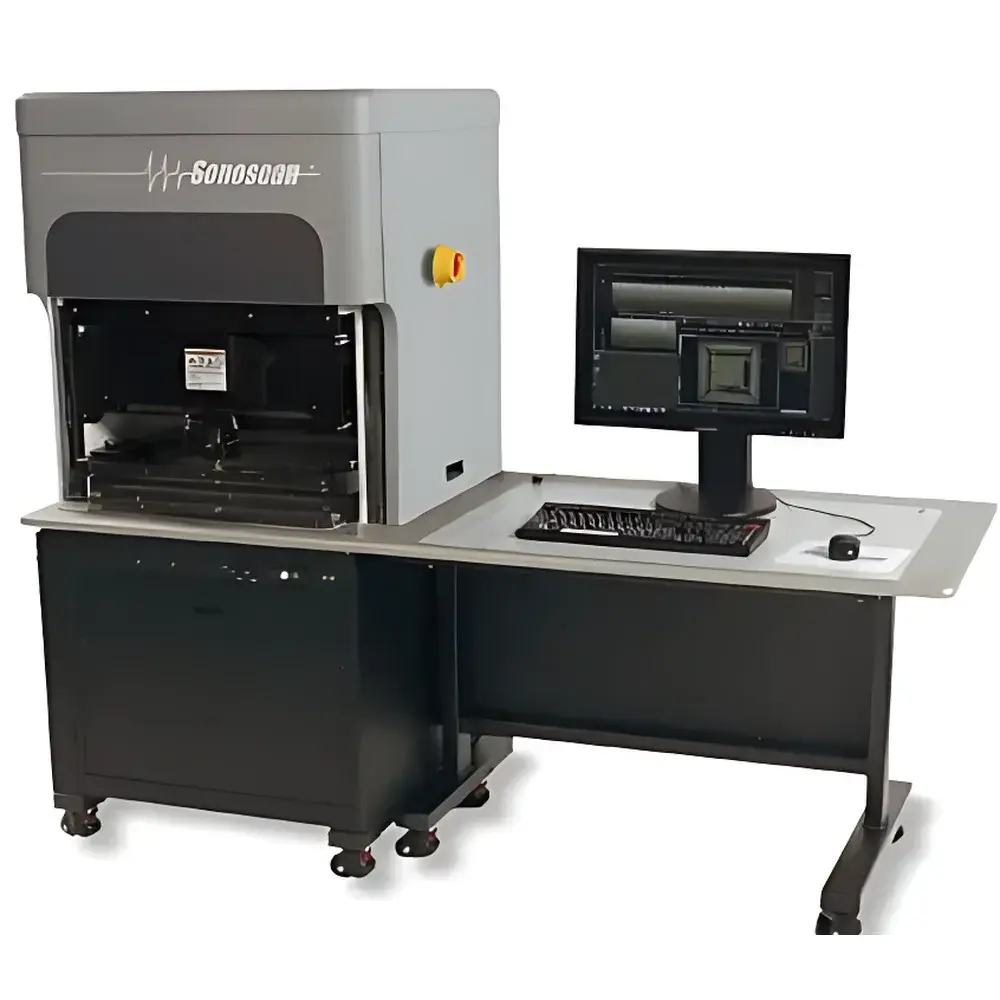
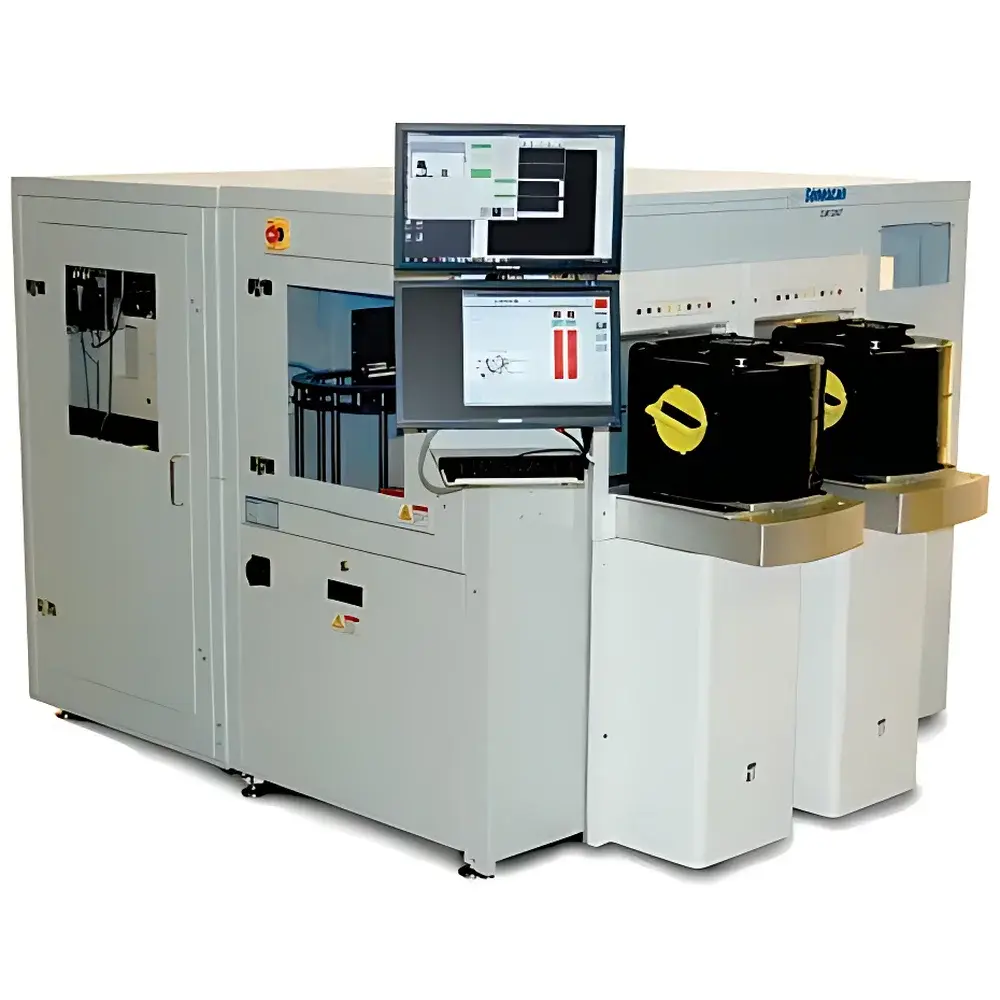
Sonoscan D9650 C-SAM Ultrasonic Scanning Acoustic Microscope
| Origin | USA |
|---|---|
| Manufacturer Type | Authorized Distributor |
| Origin Category | Imported |
| Model | Sonoscan D9650 C-SAM |
| Instrument Type | Digital |
| Compliance | ASTM E1783, ISO/IEC 17025-compatible workflow support, GLP/GMP-ready audit trail (via Sonolytics software) |
Overview
The Sonoscan D9650 C-SAM is a high-precision, digitally controlled scanning acoustic microscope engineered for non-destructive internal inspection of microelectronic packages, advanced packaging substrates, power modules, MEMS devices, and composite materials. Operating on the fundamental principle of acoustic impedance mismatch detection, the system transmits high-frequency ultrasound (typically 10–200 MHz) through a water-coupled immersion medium into the sample; variations in acoustic reflection amplitude and time-of-flight at material interfaces—such as delaminations, voids, cracks, solder joint discontinuities, or resin-rich/resin-poor zones—are captured and reconstructed into quantitative C-mode (planar), B-mode (cross-sectional), and Q-BAM (quantitative B-scan analysis mode) images. Unlike optical or X-ray methods, C-SAM provides direct sensitivity to interfacial integrity without ionizing radiation or vacuum requirements, making it indispensable for failure analysis labs, process qualification, reliability testing, and incoming quality control in semiconductor, automotive electronics, and aerospace supply chains.
Key Features
- PolyGate™ and Multi-Gate architecture enabling simultaneous acquisition and independent gating of up to 100 time windows per channel—critical for isolating subsurface features at varying depths with high signal-to-noise ratio
- Probing-Gate functionality supporting dynamic depth-resolved interrogation of layered structures, including stacked die, TSVs, and embedded passives
- Linear rod motor-driven scanner with sub-micron positional repeatability (< ±0.5 µm), optimized for JEDEC-standard trays (up to two full trays scanned without repositioning)
- Ergonomically designed open-access scanning tower with integrated LED illumination, low-profile sample stage, and tool-free mounting fixtures—reducing operator fatigue and improving throughput in high-mix lab environments
- Quantitative B-Scan Analysis Mode (Q-BAM) delivering calibrated depth, polarity, and amplitude data for virtual cross-sections—traceable to NIST-traceable calibration standards
- 64-bit Windows® OS platform (Windows 10 Pro, not Windows 7 Ultimate—hardware and security compliance updated per current IEC 62304 and FDA guidance)
- Optional integrated water temperature control (±0.1 °C stability), Waterfall™ transducer array for multi-angle interrogation, and closed-loop recirculating deionized water system meeting SEMI F57 purity specifications
Sample Compatibility & Compliance
The D9650 accommodates samples ranging from bare dies (≥0.2 mm × 0.2 mm) to full 300-mm wafers (with optional wafer-handling module), PCB assemblies (up to 457 mm × 457 mm), and molded packages (QFN, BGA, LGA, SiP, fan-out WLP). All scanning modes comply with industry-recognized test methodologies including ASTM E1783 (Standard Guide for Acoustic Microscopy of Electronic Components), IPC-J-STD-033 (Moisture Sensitivity Level evaluation), and JEDEC JESD22-A110 (Mechanical Shock) correlation protocols. Data acquisition and reporting workflows support 21 CFR Part 11-compliant electronic signatures and audit trails when configured with Sonolytics Enterprise Edition—validated for use in ISO 9001, IATF 16949, and AS9100-certified facilities.
Software & Data Management
Sonolytics v5.x is the native application suite, offering intuitive ribbon-based navigation, scriptable batch processing, and vendor-neutral data export (TIFF, PNG, CSV, HDF5). Advanced Digital Image Analysis (DIA) modules provide automated defect classification using morphology-based thresholds, grayscale histogram segmentation, and user-defined acceptance/rejection rules—fully traceable and version-controlled. Raw RF data is preserved alongside processed images, enabling retrospective re-gating and spectral analysis. Integration with LIMS and MES platforms is supported via OPC UA and RESTful API endpoints. All software updates undergo functional safety assessment per IEC 62304 Class B requirements.
Applications
- Failure analysis of thermal interface delamination in power modules and EV inverters
- Qualification of underfill and mold compound adhesion in flip-chip and 2.5D/3D IC packages
- Detection of voids and porosity in laser-welded battery tabs and copper-aluminum joints
- Verification of bond line integrity in ceramic-metal brazed assemblies for aerospace hydraulics
- Process window development for plasma-enhanced ALD and electroplating steps in advanced packaging lines
- Reliability screening per AEC-Q200 stress tests (temperature cycling, HAST, uHAST) with pre-/post-test acoustic baseline comparison
FAQ
What is the minimum detectable defect size at 100 MHz?
Detection limit depends on material velocity and gate width; typical resolution is ≤15 µm lateral and ≤5 µm axial in epoxy-molded packages.
Does the system support both pulse-echo and through-transmission modes?
Yes—dual transducer configuration enables full reflection (C-scan), transmission (through-scan), and hybrid B-scan acquisition without hardware reconfiguration.
Is sonogram data compatible with third-party image analysis tools?
All exported images include embedded metadata (transducer frequency, gate settings, water path length, sample thickness); TIFF and HDF5 formats are natively readable in MATLAB, Python (scikit-image, h5py), and ImageJ/Fiji.
Can the D9650 be integrated into an automated test cell?
Yes—RS-232, Ethernet/IP, and digital I/O ports support PLC synchronization, robotic arm handshaking, and trigger-based scan initiation per factory automation standards.
What calibration standards are supplied with the instrument?
NIST-traceable aluminum step wedge (0.1–2.0 mm depth steps), fused silica reference block, and polyethylene timing standard—all documented per ISO/IEC 17025 calibration certificates.



