
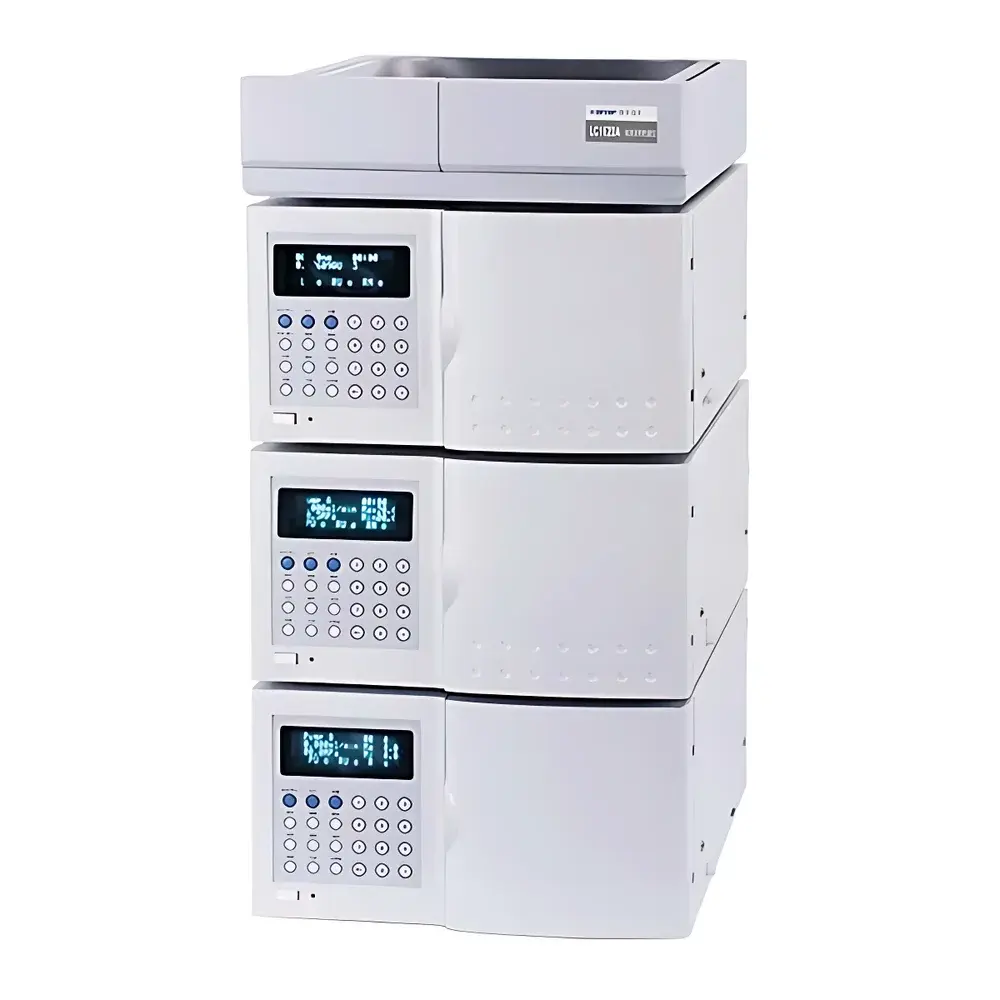
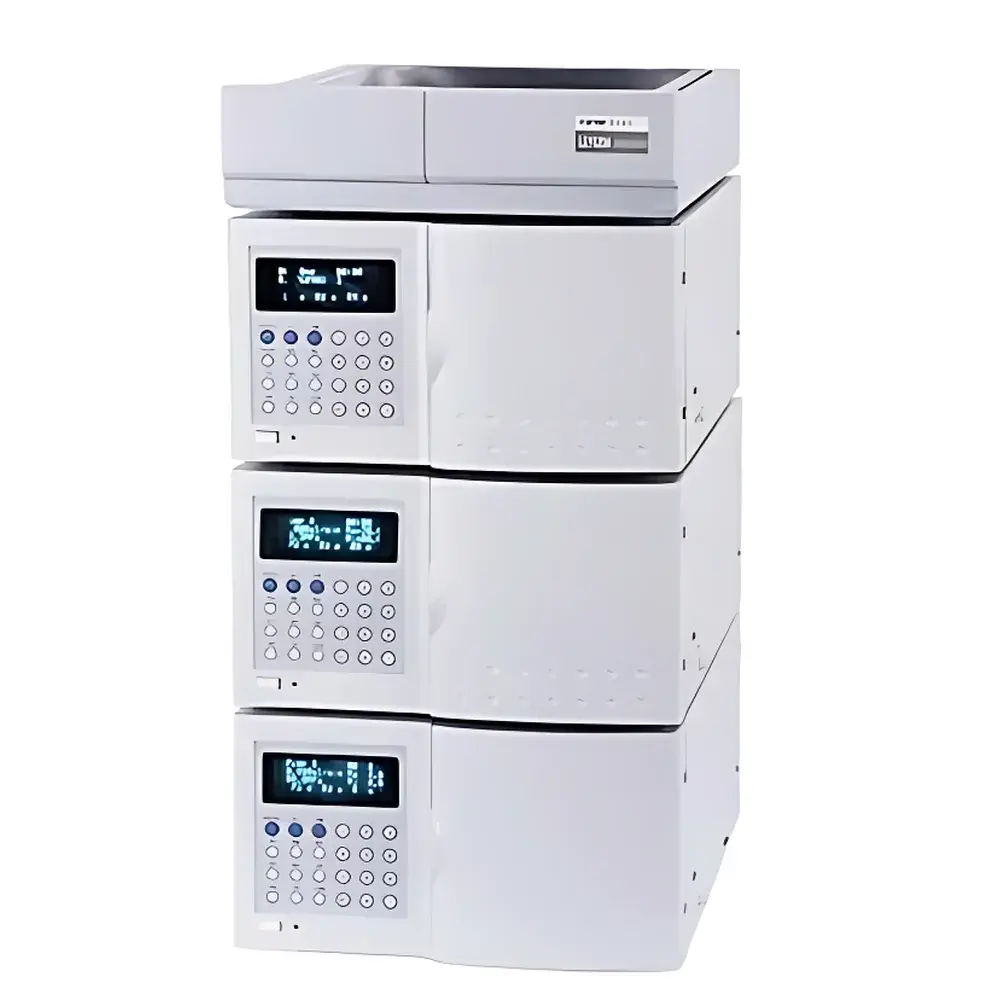
SOPOTOP LC1620A High-Performance Liquid Chromatograph
| Brand | SOPOTOP |
|---|---|
| Origin | Shanghai, China |
| Model | LC1620A |
| Instrument Type | Conventional High-Performance Liquid Chromatograph (HPLC) |
| Flow Rate Range | 0.001–9.999 mL/min |
| Maximum Operating Pressure | 45 MPa |
| Autosampler Capacity | Up to 120 positions |
| Injection Volume Range | 0.1–120 μL |
| Column Oven Temperature Range | Ambient +5°C to 100°C |
| UV Detector Wavelength Range | 190–700 nm |
| Data Acquisition Frequency | 1 Hz |
| Flow Accuracy | ≤±0.5% (at 1 mL/min, water) |
| Flow Precision (RSD) | ≤0.08% (at 1 mL/min, water) |
| UV Wavelength Accuracy | ±1 nm |
| UV Wavelength Repeatability | 0.1 nm |
| Baseline Noise | ≤±0.8×10⁻⁵ AU |
| Baseline Drift | ≤1×10⁻⁴ AU/h |
| LOD (UV) | 0.4×10⁻⁸ g/mL (naphthalene in methanol) |
| Linear Dynamic Range (UV) | ≥10⁴ |
| RI Detector Refractive Index Range | 1.00–1.75 |
| ELSD Evaporator Temp Range | Ambient to 130°C |
| ELSD Detection Limit | <1 ng (glucose, direct injection) |
| Autosampler Precision (RSD) | <0.5% |
| Carryover | <0.01% |
Overview
The SOPOTOP LC1620A is a modular, high-reliability high-performance liquid chromatograph engineered for routine and method-development applications in regulated and non-regulated laboratory environments. It operates on the principle of reversed-phase, normal-phase, ion-exchange, or size-exclusion chromatography—separating analytes based on differential partitioning between a mobile phase (liquid solvent gradient or isocratic) and a stationary phase (packed column). The system integrates a high-precision quaternary pump, a variable-wavelength UV-Vis detector, a thermostatically controlled column compartment, and a low-carryover autosampler—all synchronized via a dedicated HPLC control workstation compliant with GLP/GMP data integrity expectations. Designed for robust daily operation in pharmaceutical QC, food safety testing, environmental monitoring, and academic research labs, the LC1620A delivers reproducible retention times, quantitative accuracy, and long-term system stability under sustained 45 MPa pressure conditions.
Key Features
- High-accuracy dual-cam piston pump with patented end-face cam profile—minimizes mechanical hysteresis and assembly-induced flow deviation; achieves ≤±0.5% flow accuracy and RSD ≤0.08% at 1 mL/min (water).
- UV-Vis detector with real-time wavelength calibration, wavelength scanning, and time-programmable spectral acquisition; 190–700 nm range with ±1 nm wavelength accuracy and 0.1 nm repeatability.
- Column oven with precise PID-controlled heating (ambient +5°C to 100°C, ±0.5°C uniformity), supporting method transfer and temperature-sensitive separations.
- Autosampler with 120-position capacity, 0.1 μL minimum injection volume, <0.01% carryover (full-loop/partial-loop modes), and <100 ms valve actuation time.
- Integrated flow monitoring and dual-level pressure alarm system—triggers audible alert or automatic pump shutdown upon threshold breach to protect columns and seals.
- Online plunger seal wash function using dual-seal architecture—effectively removes buffer salt crystallization, extending pump lifetime and reducing maintenance frequency.
Sample Compatibility & Compliance
The LC1620A accommodates a broad spectrum of sample matrices—including aqueous extracts, organic solvent solutions, biological fluids (after protein precipitation), and purified small-molecule standards—across pharmaceutical, agrochemical, environmental, and food testing workflows. Its hardware architecture supports ASTM D7097 (hydrocarbon analysis), USP (chromatography system suitability), ISO 17025-compliant instrument qualification protocols, and FDA 21 CFR Part 11-ready software configurations when deployed with audit-trail-enabled firmware and user-access controls. Detectors meet ICH Q2(R2) linearity and sensitivity requirements for assay validation: UV LOD of 0.4×10⁻⁸ g/mL (naphthalene), linear dynamic range ≥10⁴; ELSD detection limit <1 ng (glucose); RI detector offers 2.5 nRIU noise floor and 600 μRIU linear span.
Software & Data Management
The SOPOTOP Chromatography Workstation provides full bidirectional instrument control, method building, sequence definition, real-time chromatogram visualization, peak integration (tangent skim, valley-to-valley, exponential baseline correction), and report generation (PDF/CSV/XLS export). It supports electronic signatures, user role-based permissions (admin/operator/auditor), and complete audit trail logging per FDA 21 CFR Part 11 Annex 11 guidelines. Raw data files are stored in vendor-neutral .cdf format (compatible with OpenLab CDS, Chromeleon, and AIA-standard readers). System suitability tests—including theoretical plate count, tailing factor, resolution, and %RSD of retention time and peak area across replicate injections—are automated and embedded within sequence templates.
Applications
- Pharmaceutical QC: Assay of active pharmaceutical ingredients (APIs), related substances, and residual solvents per ICH Q3C/Q5C guidelines.
- Food & Beverage: Quantification of preservatives (sorbic acid, benzoic acid), sweeteners (aspartame, sucralose), mycotoxins (aflatoxin B1), and pesticide residues (organophosphates, carbamates).
- Environmental Analysis: Detection of PAHs, PCBs, phenolic compounds, and endocrine disruptors (e.g., bisphenol A) in water, soil, and sediment extracts.
- Academic Research: Method development for natural product isolation, polymer molecular weight distribution (SEC-GPC), and chiral separation using polysaccharide-based columns.
- Chemical Manufacturing: Batch release testing of monomers, catalysts, and reaction intermediates under cGMP-aligned documentation practices.
FAQ
Is the LC1620A compatible with third-party CDS platforms such as Thermo Fisher Chromeleon or Agilent OpenLab?
Yes—the system communicates via standard RS-232, USB, and Ethernet interfaces and supports AIA/ANDI-compliant data exchange. Vendor-provided SDKs enable custom integration with enterprise LIMS and CDS environments.
What regulatory documentation is supplied with the instrument?
Each unit ships with Factory Acceptance Test (FAT) report, IQ/OQ protocol templates, Certificate of Conformance, and electronic copies of operation manuals, maintenance logs, and spare parts lists.
Can the UV detector be used for multi-wavelength quantitative analysis?
Yes—the detector supports up to four simultaneous wavelength channels, enabling ratiometric quantitation, peak purity assessment, and spectral library matching without hardware modification.
Does the system support gradient delay volume compensation?
Yes—gradient dwell volume can be measured and compensated programmatically within the workstation, ensuring reproducible gradient elution profiles across different column dimensions and flow rates.
What is the recommended preventive maintenance schedule?
Pump seal replacement every 6–12 months (depending on buffer usage), UV lamp replacement every 2,000 hours, and annual performance verification per USP criteria including system precision, linearity, and detector response time calibration.





